

Understanding Adult ARFID Symptoms: More Than Just Being Picky
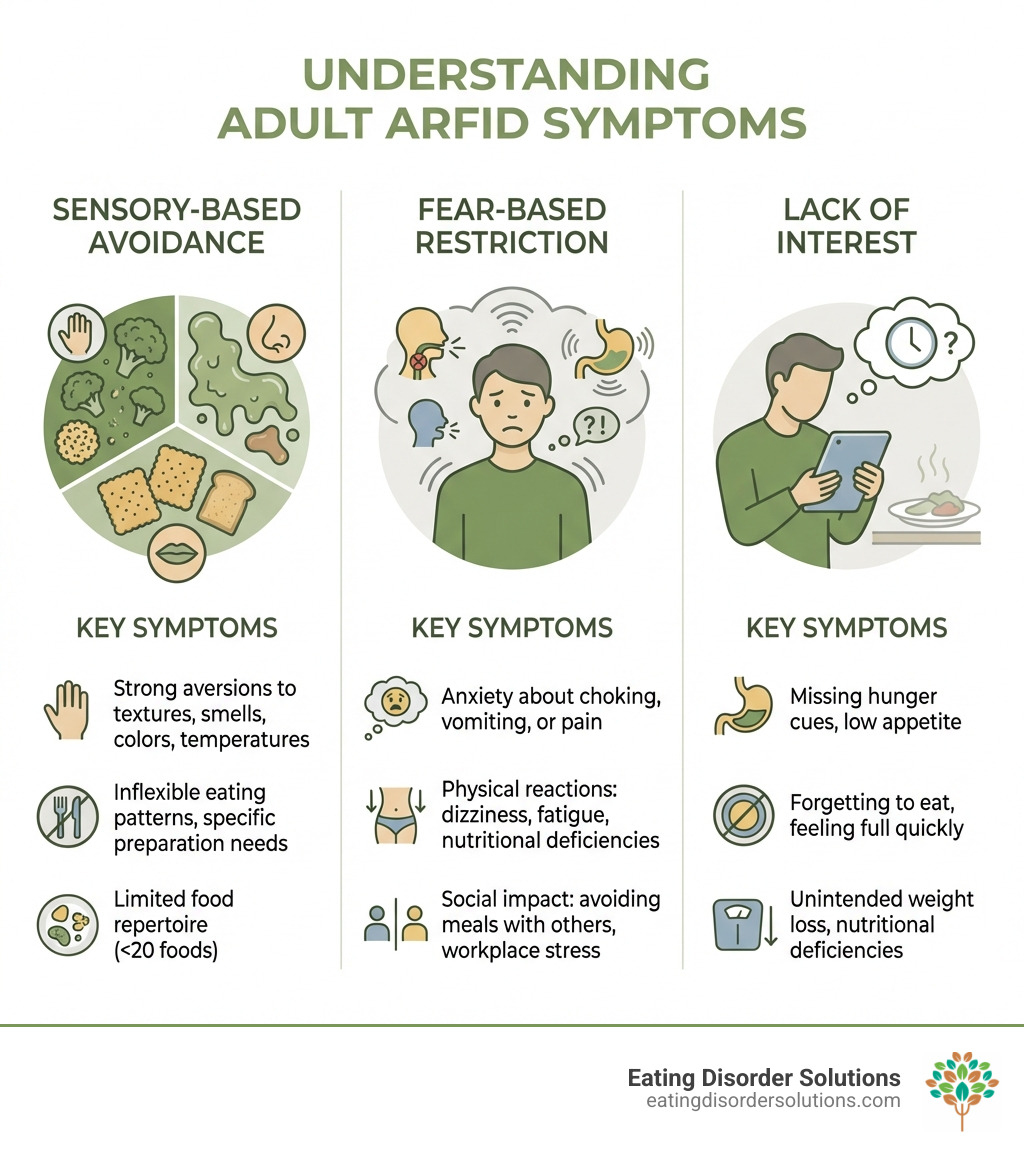
Adult ARFID symptoms include persistent avoidance of foods due to sensory sensitivities (texture, smell, appearance), fear of aversive consequences (choking, vomiting, nausea), or lack of interest in eating altogether. Unlike typical picky eating, ARFID leads to significant nutritional deficiencies, weight loss, social withdrawal, and interference with daily life—without any concern about body image or weight gain.
Key symptoms to watch for:
- Inflexible eating patterns – refusing to try new foods, requiring specific preparation methods
- Sensory-based avoidance – strong aversions to certain textures, colors, smells, or temperatures
- Fear-driven restriction – anxiety about choking, vomiting, or gastrointestinal pain
- Limited food repertoire – eating fewer than 20 different foods regularly
- Physical consequences – unintended weight loss, fatigue, dizziness, nutritional deficiencies
- Social impact – avoiding meals with others, declining invitations, workplace stress
- Forgetting to eat – missing hunger cues, low appetite, feeling full quickly
For many adults, these patterns have persisted since childhood. Others develop ARFID after a traumatic food-related experience—a choking incident, severe food poisoning, or ongoing gastrointestinal problems. Research shows that among adults seeking evaluation for GI symptoms, about 24% show ARFID symptoms, with 92.8% reporting fear of gastrointestinal distress as their primary motivation for food avoidance.
What sets ARFID apart from simple picky eating is the severity and impact. While a picky eater might dislike broccoli, someone with ARFID may avoid entire food groups, rely on nutritional supplements to survive, or experience genuine panic at the thought of trying something new.
“Adults with ARFID often describe their eating patterns as ‘picky’ or ‘childish,'” explains one eating disorder specialist. “But that language hides the real issue—a nervous system stuck in a loop of avoidance and fear.”
If you’ve been told you’re “just being difficult” about food, or you’ve wondered whether your eating restrictions go beyond normal preferences, you’re not alone. ARFID is a recognized eating disorder that affects up to 15% of the general population. It was officially added to the DSM-5 in 2013, and awareness has grown dramatically—searches for ARFID information increased by 400% since 2022.
Understanding your symptoms is the first step toward getting proper support. You deserve care that addresses the root causes of your food avoidance, not judgment about being “too picky.”
What is Avoidant Restrictive Food Intake Disorder (ARFID)?
Avoidant Restrictive Food Intake Disorder, or ARFID, is a relatively new term in mental health, but the experiences it describes are very real and often lifelong. It was officially recognized in the DSM-5 in 2013%20(1).), the manual used by clinicians to diagnose mental health conditions. Before this, many adults with these symptoms were simply labeled as “selective eaters” or “extremely picky,” which often minimized the clinical severity of their struggle.
At its core, ARFID involves a significant disturbance in feeding or eating that results in a failure to meet appropriate nutritional or energy needs. This isn’t about dieting or trying to look a certain way. Instead, it’s a functional block between the person and the food they need to survive. When we look at the signs and symptoms of an eating disorder, ARFID stands out because the avoidance is driven by the characteristics of the food itself or the physiological consequences of eating it, rather than a desire to lose weight.
How ARFID differs from anorexia nervosa
The most critical distinction between ARFID and anorexia nervosa is the motivation behind the food restriction. In anorexia, the restriction is driven by a distorted body image, an intense fear of gaining weight, or a preoccupation with body shape and size. Individuals with ARFID do not typically have these concerns.
Instead, the restriction in ARFID is based on sensory issues, a lack of interest in food, or a fear of “aversive consequences” like choking. This distinction from traditional eating psychopathology is vital for treatment. If a clinician treats an adult with ARFID using standard anorexia protocols that focus on body image, they may miss the mark entirely. In ARFID, the “fear” isn’t about the scale; it’s about the texture of a tomato or the possibility of vomiting after a meal.
The three types of adult arfid symptoms
While every individual’s experience is unique, adult arfid symptoms generally fall into three primary presentations:
- Sensory Avoidance: This is often what people think of as “extreme picky eating.” The individual is hyper-sensitive to the smell, texture, color, or temperature of food. For example, “mushy” foods might trigger a gag reflex, or the smell of certain meats might feel unbearable.
- Fear of Aversive Consequences: This type is often triggered by a traumatic event. The person restricts their intake because they are terrified of choking, vomiting, or experiencing allergic reactions. This can lead to “food neophobia,” an intense fear of trying anything new or unfamiliar.
- Lack of Interest: Some adults simply don’t feel hunger cues the way others do. They may find eating to be a “chore,” forget to eat when busy, or feel full after only a few bites.
Identifying Common Adult ARFID Symptoms
Recognizing adult arfid symptoms can be difficult because many adults have spent years “masking” their behaviors or finding ways to avoid social eating situations. Unlike children, whose parents might notice a limited diet at the dinner table, adults have more autonomy, which can lead to a delay in seeking help.

Physical and behavioral adult arfid symptoms
The behavioral side of ARFID often involves a very narrow “safe food” list—frequently fewer than 20 items. These foods are often highly processed or “predictable” in texture, such as crackers, bread, or specific brands of fast food. Behavioral signs include:
- Careful, slow chewing or “pocketing” food.
- Dressing in layers to hide weight loss or to stay warm due to poor circulation.
- Intense anxiety when a safe food brand changes its recipe or packaging.
Physically, the physical health consequences of ARFID can be severe. Because the body isn’t getting a balanced range of vitamins and minerals, an adult might experience:
- Significant, unintended weight loss (though ARFID can occur at any weight).
- Menstrual irregularities or the complete loss of a period.
- Dizziness, fainting, and muscle weakness.
- Impaired immune function and slow wound healing.
For many eating disorders in adults, these physical markers are a cry for help from a body that is running on empty.
The link between GI distress and adult arfid symptoms
One of the most complex areas of adult arfid symptoms is the relationship with the gut. Many adults with ARFID report chronic gastrointestinal issues like nausea, bloating, or abdominal pain. This creates a “chicken or the egg” scenario: does the GI pain cause the food avoidance, or does the restricted diet cause the GI issues?
Research on ARFID in neurogastroenterology found that 92.8% of adults with ARFID symptoms reported a fear of GI distress as their primary reason for restriction. Conditions like Irritable Bowel Syndrome (IBS) or GERD can exacerbate ARFID, as the individual begins to associate almost all food with physical pain. This leads to a cycle of avoidance that further weakens the digestive system, making it even harder to reintroduce variety.
Picky Eating vs. ARFID: Knowing the Difference
We often hear the question: “Can picky eating be an eating disorder?” The answer lies in the degree of impairment. A picky eater might be annoying to cook for, but an adult with ARFID is often suffering from malnutrition or significant psychosocial impairment.
| Feature | Picky Eating | ARFID |
|---|---|---|
| Variety | Limited, but usually meets basic needs. | Often fewer than 20 safe foods; avoids entire groups. |
| Physical Health | Generally stable weight and energy. | Weight loss, deficiencies, or reliance on supplements. |
| Social Life | Might complain, but can usually find something to eat. | Avoids social events, dates, or work lunches entirely. |
| Progression | Often outgrown or stays stable. | Tends to worsen or become more rigid over time. |
| Emotional Response | Dislike or mild annoyance. | Intense anxiety, panic, or gagging/vomiting. |
Adults with ARFID often have a high “supplement reliance,” meaning they depend on meal replacement shakes or multivitamins to function. While these can be helpful tools, they don’t address the underlying disorder.
Diagnostic challenges in adults
Getting a diagnosis as an adult is notoriously difficult. Many primary care doctors aren’t familiar with the DSM-5 diagnostic criteria for ARFID and may dismiss the patient as “difficult” or “anxious.” Furthermore, because parents aren’t there to report symptoms (as they are with children), the burden of proof falls on the adult, who may feel deep shame about their eating habits.
Causes and Risk Factors for Adult Food Aversion
Why do some people develop ARFID while others can eat anything? The answer is a mix of biology, environment, and psychology.
Inherited factors and neurobiology
Genetics play a massive role. A major Swedish twin study found that inherited factors in ARFID account for about 79% of the risk. This means that for many, the “wiring” for sensory sensitivity or a low appetite is present from birth. Neurobiologically, researchers have looked at brain reward systems, suggesting that people with ARFID may not get the same “dopamine hit” from food that others do, or their “threat center” (the amygdala) may overreact to new tastes and textures.
Comorbidities and neurodevelopmental links
There is a very strong anxiety and ARFID correlation. Additionally, ARFID frequently co-occurs with neurodevelopmental conditions:
- Autism Spectrum Disorder (ASD): Sensory processing differences are a core part of autism, making the textures and smells of food overwhelming.
- ADHD: Executive function issues can lead to “forgetting to eat,” while sensory seeking or avoidance can limit food choices.
- OCD: About one-third of adults with ARFID also show moderate to severe OCD symptoms, often involving rituals around food safety or cleanliness.
The role of trauma and environment
For some, ARFID is a response to a “traumatic food-related event.” This could be a terrifying choking incident, a severe bout of food poisoning, or even witnessing someone else have a medical emergency while eating. Adverse childhood experiences (ACEs) and even history of food insecurity can also shape how a person views the “safety” of their meals. Being pressured or shamed into eating “just one bite” as a child can also backfire, creating a deep-seated aversion that lasts into adulthood.
Treatment Options and the Path to Recovery
Recovery from ARFID is not about “just trying harder” to eat. It requires a specialized, avoidant restrictive food intake disorder treatment plan led by a multidisciplinary team. At Eating Disorder Solutions, we believe in a holistic, trauma-informed approach that respects the individual’s sensory needs while working toward nutritional stability.
Cognitive Behavioral Therapy (CBT-AR)
The “gold standard” for adult ARFID is CBT-AR (Cognitive Behavioral Therapy for ARFID). This isn’t standard talk therapy; it’s a structured approach that focuses on:
- Thought Reframing: Challenging the belief that a new food is “dangerous” or will cause vomiting.
- Food Chaining: Gradually moving from a safe food to a similar but slightly different food (e.g., moving from one brand of cracker to another, then to a slightly different texture).
- Desensitization: Reducing the “disgust” response through repeated, low-pressure exposure.
- Habit Acquisition: Building a routine that ensures the body gets regular fuel, even when hunger cues are missing.
The feasibility of CBT for ARFID has been well-documented, showing that adults can and do expand their diets when given the right tools.
Nutritional support and medication
A Registered Dietitian is a vital part of the team, helping to bridge nutritional gaps without overwhelming the patient. In our residential eating disorder treatment program, we provide a warm, home-like setting in Dallas and Weatherford, TX, where patients can work on these goals at their own pace.
While there are no FDA-approved medications specifically for ARFID, some are used off-label to help:
- Mirtazapine or Cyproheptadine: To help stimulate appetite and reduce nausea.
- Olanzapine: To help with the “cognitive rigidity” and intense anxiety surrounding mealtime.
- SSRIs: To treat co-occurring anxiety or depression that may be fueling the avoidance.
Frequently Asked Questions about Adult ARFID
Can an adult suddenly develop ARFID?
Yes. While many adults have had symptoms since childhood, “late-onset” ARFID is often triggered by a traumatic event. A choking incident in your 30s or a severe GI illness can cause the brain to suddenly categorize most foods as “unsafe,” leading to rapid restriction.
Is ARFID the same as being a “super-taster”?
Not exactly, but they are related. “Super-tasters” have more taste buds and may find bitter flavors or certain textures more intense. However, being a super-taster is a biological trait, whereas ARFID is a clinical disorder that involves significant distress and health consequences.
How does ARFID impact professional life?
It can be incredibly stressful. Business lunches, networking events, and holiday parties often revolve around food. Adults with ARFID may decline promotions that involve travel, avoid “team-building” dinners, or feel immense shame when they have to explain their “limited” plate to colleagues.
Conclusion
Living with adult arfid symptoms can feel incredibly isolating, especially in a culture that revolves around “foodie” experiences. But you aren’t just a “picky eater”—you are someone navigating a complex neurobiological and psychological condition.
Recovery is possible, and it doesn’t mean you have to love every food on the planet. It means building a relationship with food that is based on safety, nutrition, and freedom from fear. At Eating Disorder Solutions, we provide individualized, compassionate care in a setting that emphasizes human connection. We stand by our 75-day treatment guarantee because we believe in the power of specialized, trauma-informed care.
If you’re ready to expand your world and your plate, we are here to help. Start your journey with avoidant restrictive food intake disorder treatment today and rediscover what it feels like to be in control of your health.


