
Levels of Care
Why “treatment” isn’t one setting
Eating disorder treatment isn’t a single program — it’s a ladder of care intensity, and where someone starts (and how they move through it) depends on medical stability, the severity and type of the eating disorder, and how much support is realistic day to day.
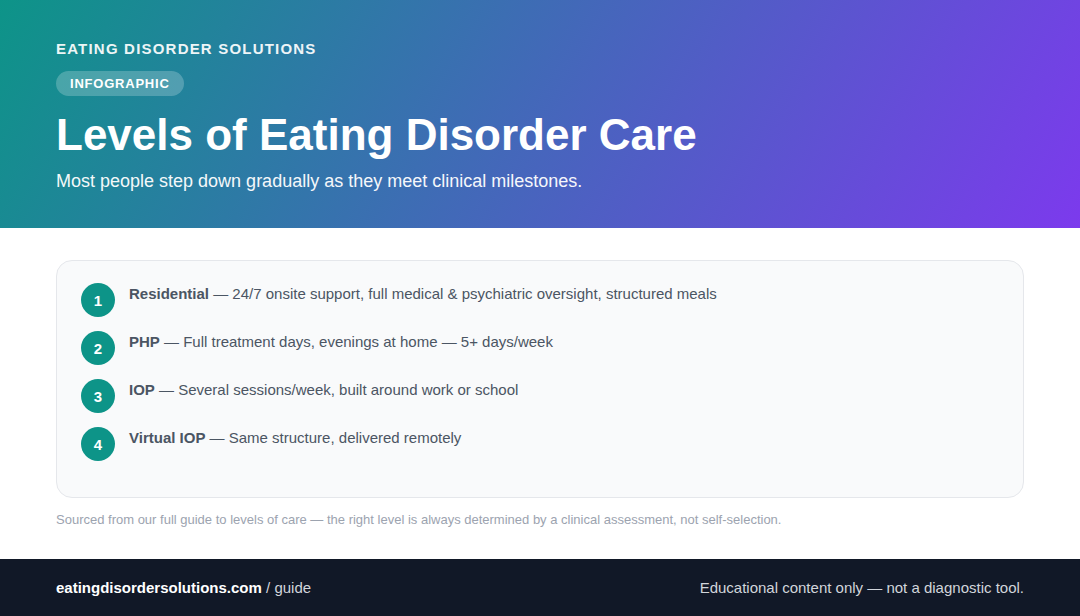
Residential
The highest level of structured care, involving 24-hour supervision in a live-in setting. Typically appropriate when someone needs medical stabilization, is not yet safe to manage meals and behaviors independently, or hasn’t responded to less intensive levels of care.
Partial Hospitalization Program (PHP)
A step down in intensity from residential, PHP typically involves treatment most days of the week for several hours a day, while the person returns home in the evenings and overnight. Often appropriate for someone who’s medically stable enough not to need 24-hour supervision, but who still needs significant structure and support, including supervised meals.
Intensive Outpatient Program (IOP)
A further step down, IOP typically involves a few hours of treatment several days a week, allowing for more day-to-day independence — often returning to work, school, or regular routines around the treatment schedule.
Virtual Intensive Outpatient (Virtual IOP)
The same general structure as in-person IOP, delivered remotely — particularly valuable for people balancing treatment with work, school, or family responsibilities, or for people without easy access to specialized care nearby.
Outpatient
The least intensive level, typically involving regular but less frequent sessions with a therapist, dietitian, or physician. Often the right fit for someone who’s stable day to day but benefits from ongoing support, or as a long-term maintenance step.
How the right level gets decided
The right starting point depends on medical stability, the severity and frequency of eating disorder behaviors, whether there’s a safe and supportive home environment, and how the person has responded to treatment before, if applicable. This isn’t a decision to make alone — a professional assessment is what actually determines level of care, though our Treatment Readiness / Level of Care Navigator can help organize your thinking beforehand.
What a typical transition between levels looks like
Movement between levels of care is usually planned rather than abrupt. A treatment team typically evaluates a set of factors before recommending a step down — medical stability (vital signs, weight trajectory, lab values), how consistently someone can manage meals and coping strategies with less structure, and how much support is available outside of treatment hours, whether that’s family, a partner, or an existing outpatient provider ready to continue care. A step down from residential to PHP, for example, generally happens once someone no longer needs 24-hour medical monitoring but still benefits from a full-day structured program; a step down from PHP to IOP generally happens once someone can safely manage evenings, work, or school without daily full-day support.
It’s also normal, and not a sign that treatment has failed, for someone to step back up a level if they hit a harder stretch. Eating disorder recovery is rarely a straight line, and treatment teams generally build in the expectation that intensity may need to flex in either direction as someone’s needs change over time.
What insurance and logistics usually look like at each level
Coverage and pre-authorization requirements vary significantly by insurance plan and by level of care, and residential treatment in particular often involves a more involved authorization process than outpatient levels. Rather than general guidance here, our Insurance Navigator tool walks through what to ask an insurance provider and lists the specific carriers we work with directly. Logistically, residential and PHP typically involve the most schedule disruption (residential requires living on-site; PHP is usually a full day, most days of the week), while IOP, virtual IOP, and outpatient are built to fit around work, school, or family responsibilities to varying degrees — which is often a real factor in which level makes sense alongside the clinical recommendation, not instead of it.
Family involvement across levels
How much a family or support system is directly involved tends to shift by level of care. Residential and PHP programs commonly build in structured family sessions, since a higher level of care often coincides with a period where the person needs more external support and their household needs guidance on how to help rather than accidentally reinforce old patterns once someone returns home. At IOP, virtual IOP, and outpatient levels, family involvement is often less structured into the program itself but can still be built in through periodic family sessions, especially for younger patients or when family dynamics are a significant factor in the eating disorder. None of this is a requirement — treatment plans vary by program and by what’s clinically appropriate for the individual — but it’s a reasonable thing to ask about directly when comparing programs or levels.
Frequently asked questions
Do you have to start at residential and work down?
No. Level of care is based on individual assessment, not a fixed starting point. Some people start at outpatient or IOP and never need a higher level; others start at residential due to medical needs.
How long does someone typically stay at each level?
This varies significantly by individual, condition, and response to treatment — there’s no standard timeline.
Is virtual IOP as effective as in-person?
Virtual IOP follows the same structured approach as in-person IOP and has become a well-established option, though the right fit depends on individual circumstances.
Who decides which level of care is right?
A qualified clinical assessment — not a self-assessment — determines level of care. Our navigator tool is for organizing your own thinking beforehand, not a substitute for that professional evaluation.
Can someone go straight to outpatient without a higher level of care first?
Yes, when clinical evaluation supports it. Level of care is based on current medical and psychological needs, not a mandatory sequence everyone has to pass through — some people are appropriately stable enough to begin at outpatient, while others need to start at a higher level first.
What happens if a level of care isn’t working?
A treatment team will typically reassess and adjust — that could mean stepping up to a more intensive level, changing the specific treatment approach within the current level, or addressing a co-occurring issue (like an untreated mental health condition) that’s interfering with progress. Treatment plans are meant to be responsive, not fixed once decided.
What this covers
- Residential: 24/7 structured care for the highest level of medical or psychiatric need.
- PHP (Partial Hospitalization): full-day structured treatment, returning home or to housing in the evening.
- IOP (Intensive Outpatient): several structured sessions per week, alongside daily life.
- Virtual IOP: the same intensive outpatient structure, delivered remotely.
- Sourced from our live levels-of-care page to stay consistent with what’s already published.