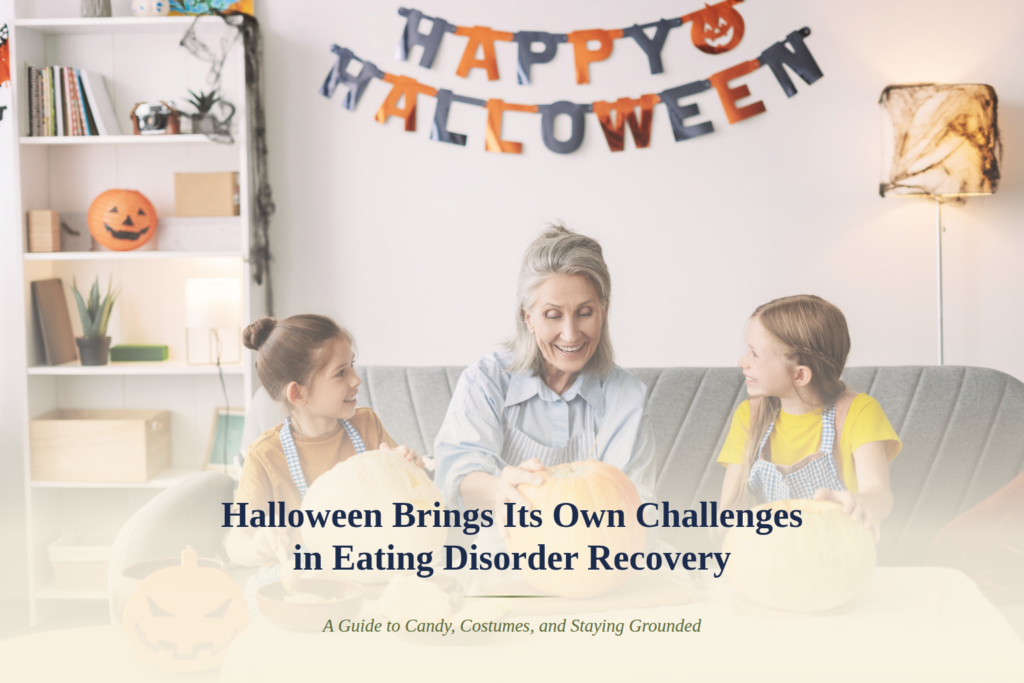
Halloween Brings Its Own Challenges in Eating Disorder Recovery
Halloween doesn’t get talked about as a hard holiday the way Thanksgiving or Christmas does, but for someone in eating disorder recovery, it can bring up a lot. Candy shows up everywhere for weeks, not just on the day itself: school parties, office candy bowls, trick-or-treat bags, leftover bags on the counter. Costumes add another layer, since costume shopping and Halloween’s appearance-focused costume marketing can stir up body image concerns even for people who feel steady most of the year. None of that means Halloween has to be dreaded. It means it’s worth a little more thought than “just get through it.”
Candy, Fear Foods, and All-or-Nothing Thinking
For some people in recovery, Halloween candy may be associated with anxiety, avoidance, or rigid eating-disorder rules. These foods are sometimes described as “fear foods,” although the reasons behind that vary from person to person and may involve concerns about weight or control, past experiences, sensory sensitivity, or fear of an unpleasant consequence. Having more candy around than usual, in less structured settings, can be harder to navigate for some people, whether that shows up as increased restriction and avoidance or as a binge-restrict pattern. Neither reaction means someone is doing recovery wrong.
Planned exposure to avoided foods may be used as part of eating disorder treatment, typically in a structured, gradual way that’s individualized to a person’s specific symptoms and treatment goals. It is not automatically helpful simply because candy happens to be present during a holiday, and it isn’t the right approach for every diagnosis or every person. For some people, a Halloween candy activity might fit an exposure goal they’re already working on with their treatment team; for others, Halloween may not be the right setting for that work at all. Our own guide on facing fear foods in eating disorder recovery goes into that process in more depth and is worth reading before the holiday, especially if you’re working with a dietitian or treatment team on food exposure goals already. Any exposure goals should be based on your current treatment plan, not on pressure to participate in a holiday activity.
A Simple Plan Before Trick-or-Treat Night
Planning ahead may reduce some of the pressure of making decisions in the moment, the same way it can for any food-centered holiday. Before the day arrives, it can help to talk with your dietitian or treatment team about how you want to approach Halloween candy specifically, rather than deciding on the spot. Decide in advance who you can text or call if things get hard, whether that’s a friend, a family member, or your treatment team.
If costume shopping or costume parties feel like they might bring up body comparison, consider what level of participation best supports your current recovery plan. That might mean choosing clothing based on comfort, shopping with a supportive person, limiting time spent browsing appearance-focused marketing, choosing a non-body-focused activity instead, or deciding not to attend. There isn’t one right answer here, and what helps depends on where you are in recovery and what you’re working on with your treatment team.
If kids are part of your Halloween, trick-or-treating is naturally structured around walking, talking, and being outdoors with others, which for some people may feel like an easier context to be around candy than an unstructured bowl on the counter. That said, it also comes with its own pressures, like family scrutiny, less privacy, or kids sorting and trading candy, so it isn’t automatically lower-pressure for everyone. What works best depends on your own situation and treatment goals.
When to Reach Out for Help
If you notice old thoughts or behaviors getting louder as Halloween approaches, that’s a sign to reach out, not a sign you’ve done something wrong. Friends and family can provide valuable emotional support, while a therapist, dietitian, physician, or treatment program can provide clinical guidance and care. Reaching out sooner may make it easier to discuss what you’re experiencing and identify appropriate support. If you or someone you love is experiencing worsening eating-disorder symptoms, contact a qualified treatment provider. If there is immediate danger, possible medical instability, or a life-threatening emergency, call 911 or go to the nearest emergency department. For suicidal thoughts or an emotional crisis, call or text 988.
Supporting Someone You Love Through Halloween
Halloween puts pressure on the people around someone in recovery too. Parents, partners, roommates, and friends often want to help but aren’t sure what actually helps versus what accidentally makes the night harder. A few concrete things make a real difference.
Comments about candy, portions, or “being good” tonight land differently than they’re intended, even when they come from a caring place. NEDA’s guidance for loved ones is consistent on this point: comments about someone else’s food choices, body, or willpower are rarely helpful, even when framed as encouragement, because they reinforce the idea that food and body size are something to be monitored and judged. A safer default is to talk about the parts of Halloween that have nothing to do with food: costumes, decorations, plans with friends, the movie someone wants to watch.
Costumes carry their own risk. Store racks skew toward tight, revealing, or size-specific options, and mirrors, photos, and offhand comments about how a costume fits can turn a fun night into a body-image gauntlet. If a costume-shopping trip feels heavy, it’s reasonable to suggest options that don’t require trying things on in a store, order a few sizes to try at home, or lean toward costumes built around props and makeup rather than fitted clothing.
Trick-or-treating and parties put candy in a shared, visible space in a way that’s different from an ordinary week. ANAD’s holiday guidance for supporters recommends normalizing that all foods, including holiday candy, fit within a flexible eating pattern, and cautions against language that separates food into “good” and “bad” categories, since that framing tends to increase anxiety and secrecy around eating rather than reduce it. If a person in recovery brings up a food fear on their own, the most useful response is usually curiosity and support, not solutions offered on the spot, unless they specifically ask for help problem-solving.
It also helps to have a plan for early exits. Parties, haunted houses, and neighborhood trick-or-treating can all run longer or feel more overwhelming than expected. Agreeing ahead of time on a signal or a simple excuse to leave takes the pressure off the person in recovery to explain themselves in the moment, and lets a support person step in without making a scene.
A Few Phrases That Tend to Help, and a Few That Tend to Land Wrong
“What would make tonight easier for you?” and “I’m glad you’re here” tend to land well because they put the person in recovery in control of the conversation instead of putting them on the spot. Comments like “you’ve barely had any candy, good for you” or “are you sure you want another piece?” tend to land badly even when meant kindly, because they turn a shared moment into a public accounting of what someone ate. The same is true of body-focused costume compliments (“you look so skinny in that”) — even positive comments about weight or shape reinforce that a person’s body is something others are evaluating, which research on family support consistently identifies as a stressor rather than a help in recovery.
None of this requires a background in eating disorder treatment. ANAD’s guide for talking with a loved one about an eating disorder emphasizes that support doesn’t mean having the right words for every moment. It means staying present, listening without trying to fix things immediately, and following the person’s lead on how much they want to talk about it. Asking “What would be helpful tonight?” a day or two before Halloween is often more useful than guessing in the moment.
Supporting someone through a food-centered holiday can also be draining for the support person, and that’s worth acknowledging rather than pushing aside. NEDA’s resources for loved ones note that caregivers and family members benefit from their own support, whether that’s a therapist, a support group for families, or simply another person in the household to split the emotional labor of the evening with. A support person who is running on empty has less capacity to stay calm and steady when something unexpected comes up, so taking care of that side of the equation isn’t optional, it’s part of what makes the support sustainable.
Related Reading
- Eating disorder treatment at Eating Disorder Solutions
- Making It Through the Holidays: Christmas, more on getting through a challenging, food-centered season
- Getting Through Thanksgiving in Eating Disorder Recovery, another look at a food-focused holiday
References
National Alliance for Eating Disorders. Types of Psychotherapy for Eating Disorders (Exposure and Response Prevention).
Butler, R. M., & Heimberg, R. G. (2020). Exposure therapy for eating disorders: A systematic review. Clinical Psychology Review, 78, 101851.
Centre for Clinical Interventions. Tackling Avoided Foods.
National Eating Disorders Association. “How to Help a Loved One with an Eating Disorder.” nationaleatingdisorders.org.
National Eating Disorders Association. “Resources for Loved Ones of People with Eating Disorders.” nationaleatingdisorders.org.
ANAD. “Not Sure How to Talk With a Loved One About Eating Disorders? Read This.” anad.org.
ANAD. “Holiday Eating Disorder Resources.” anad.org.
Resources
National Alliance for Eating Disorders Helpline: 1-866-662-1235, Monday-Friday, 9 a.m.-7 p.m. Eastern. The helpline provides eating-disorder support and treatment referrals and is not a 24/7 crisis service.
988 Suicide & Crisis Lifeline: Call or text 988. Available 24/7 for suicidal crisis or emotional distress.