Quick Summary: Updated clinical outcomes data from Eating Disorder Solutions’ Weatherford program shows measurable progress for clients treated between March and September 2026. The clearest gains were in interpersonal connection and trust, often among the hardest areas to rebuild in eating disorder recovery, alongside continued use of the program’s residential-to-outpatient continuum of care.
Key Takeaways
- Interpersonal functioning showed the strongest improvement of any area measured, with a real reduction in feelings of isolation and difficulty trusting others.
- Of Weatherford residential episodes that closed in this reporting window, 57% transitioned into EDS’s outpatient or Tele-IOP programs to continue care.
- Emotional symptom relief was gradual and steady, consistent with what’s clinically expected for eating disorder recovery.
Why We Track Outcomes
Eating disorder recovery is a long process, and it doesn’t look the same for every client. At Eating Disorder Solutions, we track progress using a structured clinical outcomes assessment, administered at intervals throughout each client’s time in treatment and tailored to their level of care. That gives our clinical team an ongoing, data-driven picture of what’s changing over the course of treatment.
This update covers 90 clients across our Weatherford residential program, outpatient program, and Tele-IOP, with 57 clients providing before-and-after survey data between March and September 2026. Findings were reviewed by Dr. Jerry Vaccaro, M.D., and Lauren Reisman, LMSW, and verified by Discovery MSO, LLC.
What the Data Shows
Interpersonal Connection: Our Clearest Area of Progress
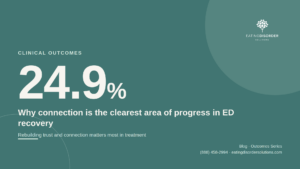
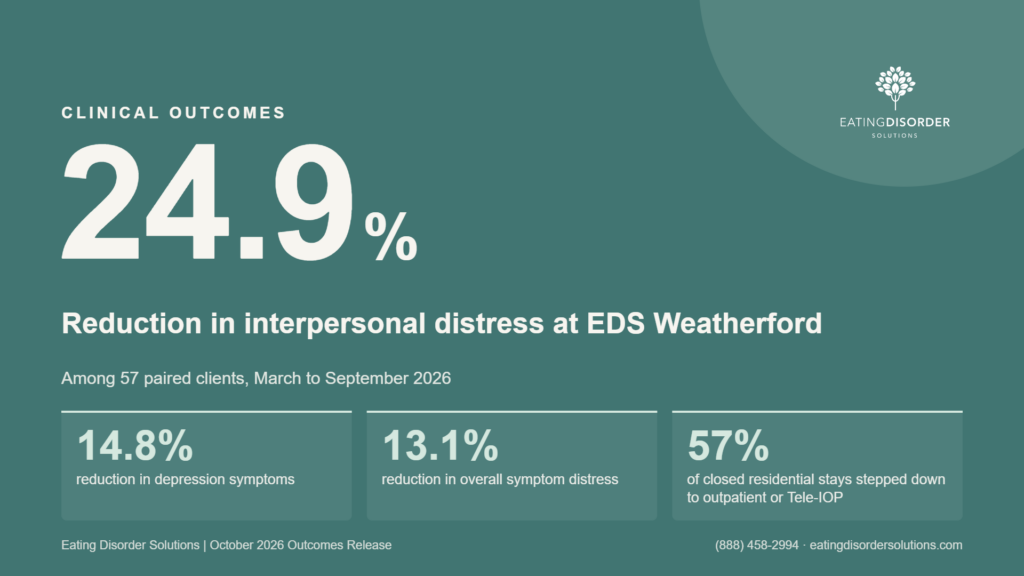
Eating disorders often isolate people from the relationships that matter most: family, friends, and their own sense of trust in others. In this reporting period, clients with paired survey data showed a 24.9% reduction in interpersonal distress, driven by gains in trust and a measurable drop in feelings of loneliness. This was the strongest result of any domain measured in this refresh, and it reflects the relational core of our treatment model.
Emotional Symptom Relief
Clients also showed improvement in mood-related and anxiety-related distress over the course of treatment. Because eating disorders are chronic, complex conditions, progress on these measures tends to be gradual rather than dramatic, which is the pattern we saw, consistent with what’s clinically expected for this population.
Continuity of Care
Of Weatherford residential episodes that closed during this reporting window, 57% transitioned into EDS’s outpatient or Tele-IOP programs to continue treatment, one indicator that clients are actively using the step-down pathway between our residential and outpatient levels of care.
Full Results at Weatherford
These figures cover Weatherford residential, outpatient and Tele-IOP clients from March 2 to September 24, 2026. 90 clients and 366 surveys are included, and 57 clients have paired before-and-after surveys. This is a small group, and some measures use a subset of the survey questions, so treat the figures as a snapshot. Lower scores are better.

| Measure | First to last survey | Reduction | Clients improved | Clients worsened |
|---|---|---|---|---|
| Interpersonal connection | 3.3 to 2.5 of 12 | 24.9% | 35.1% | 19.3% |
| Depression symptoms | 10.1 to 8.6 of 20 | 14.8% | 57.9% | 35.1% |
| Overall symptom distress | 23.6 to 20.5 of 44 | 13.1% | 57.9% | 35.1% |
| Anxiety | 9.1 to 8.0 of 16 | 12.5% | 56.1% | 33.3% |
| Trauma symptoms | 4.4 to 4.0 of 8 | 10.3% | 49.1% | 29.8% |
| Social role | 5.9 to 5.4 of 12 | 8.3% | 49.1% | 33.3% |
Interpersonal scores start low, so 46% of clients were unchanged on that measure.
When to Reach Out for Help
Eating disorders can be difficult to recognize, both in ourselves and in people we love. Changes in eating patterns, increased focus on weight or body image, withdrawal from friends and family, or mood changes around meals are all worth paying attention to. You don’t need to wait until things feel like a crisis to reach out.
Talking With a Professional
Every client at Eating Disorder Solutions begins with a confidential clinical assessment to understand their history and determine the right level of care to start at. You don’t need to have all the answers before you call. Our team can walk you through what treatment could look like, insurance questions, and next steps for you or someone you love.
Related Reading
- Eating Disorder Treatment Programs
- Weatherford Residential Program
- Weatherford Outpatient Program
- Virtual Intensive Outpatient (Tele-IOP) Program
References
- National Alliance for Eating Disorders. “Help & Support.” Accessed October 2026. https://www.allianceforeatingdisorders.com
- National Institute of Mental Health (NIMH). “Eating Disorders.” Accessed October 2026. https://www.nimh.nih.gov/health/topics/eating-disorders
Source for the outcomes data: Eating Disorder Solutions client survey data, March to September 2026, reviewed by Dr. Jerry Vaccaro, M.D., and Lauren Reisman, LMSW.
FAQ
What assessment does EDS use to track outcomes? EDS uses a structured clinical outcomes assessment administered at intervals throughout treatment to track changes in emotional symptoms, interpersonal functioning, and engagement with care over time.
Does residential treatment automatically lead to outpatient step-down care? Step-down planning is individualized to each client and coordinated by our clinical team based on readiness and clinical need, not automatic, but our program is built to support that transition when appropriate.
Is client information kept confidential? Yes. All outcomes reporting is conducted in aggregate under HIPAA-compliant clinical protocols. No individual client information is shared publicly.
Is EDS’s outcomes data independently reviewed? Yes. Findings are reviewed by EDS’s clinical leadership, including a licensed physician and licensed clinical social worker, and verified by Discovery MSO, LLC.
Resources
- National Alliance for Eating Disorders Helpline
- In an emergency, call 911
This article is general education and is not medical advice.
If you or someone you love may be struggling, Eating Disorder Solutions’ team is available for a confidential conversation about treatment options. Call (888) 458-2994 to speak with someone today.