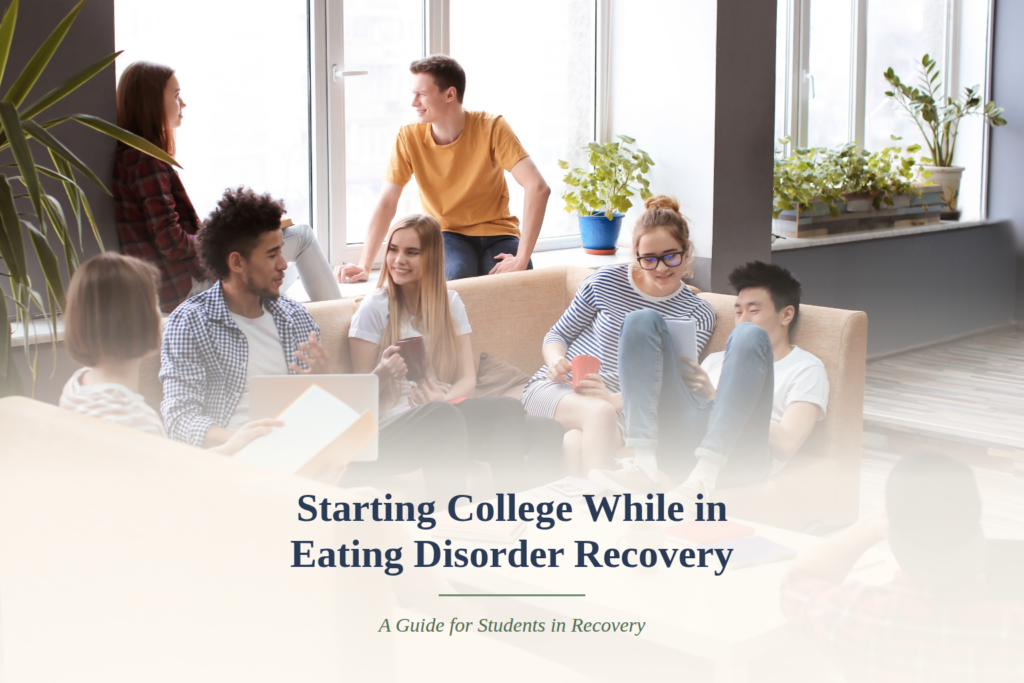
Starting College While in Eating Disorder Recovery
The weeks around move-in day get talked about like a fresh start, and for a lot of students that’s exactly what they are. But if you have a history with an eating disorder, whether you’re actively in treatment, several years into recovery, or somewhere in between, the transition also brings real changes: a new routine, a new environment, less oversight, and a lot of unfamiliar social pressure, on top of being farther from the people who used to notice if something was off. Eating disorders often begin during adolescence or early adulthood (Hudson et al., 2007), so college-age students are already in a life stage where symptoms can be more present, separate from anything about the move itself.
One study that followed women through the transition from high school into college found that dieting behavior and disordered-eating patterns were largely established before college and didn’t significantly worsen during the first year, even though many participants felt heavier or more self-conscious about their bodies (Vohs, Heatherton, & Herrin, 2001). That’s not a guarantee, and it doesn’t mean college can’t bring up hard moments. It does mean a rough week doesn’t have to mean the semester is doomed, and it’s worth walking in with a plan instead of hoping the structure that worked at home just carries over on its own.
Why the Transition Itself Can Be Hard, Not Just the Food
It’s easy to assume dining halls are the whole problem, but for some students the bigger adjustment is the transition itself. You’re managing a new schedule, new relationships, less privacy, and often a lot more unstructured time, all while the people who used to notice if something was off, parents, a coach, a longtime friend, aren’t around anymore. Being farther from familiar support can make that adjustment feel harder for some students, separate from anything about food.
Dining Halls Don’t Have to Be a Minefield
Dining halls can feel overwhelming: open serving lines, unfamiliar portions, no one plating your food for you, and often an audience. That’s a real adjustment, not a personal failing if it feels hard at first. If you have a meal plan from a treatment team, this is the time to lean on it, and to loop your campus health center or a local provider in early rather than waiting to see how the semester goes. If you don’t have a plan yet, it’s worth discussing dining hall meals and campus routines with an eating-disorder-specialized dietitian or another member of your treatment team before you’re standing in the dining hall figuring it out in real time.
It also helps to scope out your options ahead of move-in, most schools publish dining hall menus and hours online, so the first week doesn’t have to be the first time you’re seeing what’s available.
Talking to a Roommate (or Not)
You don’t owe your roommate your full history on day one, or ever, if you don’t want to share it. But if you’re comfortable giving them even a little context, like asking them not to comment on what you eat or how your body looks, that can take pressure off both of you. If you’d rather not disclose anything, that’s a valid choice too. Either way, it’s worth deciding in advance what you’re comfortable sharing rather than figuring it out in the moment.
Staying Connected to Your Treatment Team From Campus
If you’re working with a therapist, dietitian, or treatment program back home, ask before you leave whether they can continue seeing you by telehealth, or get a referral to someone near campus. An interruption in care can make it harder to maintain continuity, so it’s worth sorting this out before you move rather than after. Telehealth rules vary by state, so ask your provider whether they can legally continue seeing you while you’re physically located in the state where your school is, and whether your insurance will cover those visits. Campus counseling centers can also be a starting point, though wait times vary a lot by school, so it’s worth reaching out early rather than waiting for a crisis to make the call.
Building a Support Plan Before Move-In Day
Planning before the semester starts can help you know where to turn if concerns come up. Identify one or two people on campus, a friend, an RA, a roommate, who could be part of your personal support network if things get hard. Know how to contact your treatment team from a distance. And if certain campus environments, like communal bathrooms, gyms, or dining halls at peak hours, feel like they’ll be harder than others, it’s worth talking through individualized strategies with your treatment team rather than figuring it out alone.
Warning Signs to Watch For After the Semester Starts
It’s normal for routines to shift in the first few weeks of school. What’s worth paying attention to is a pattern: skipping meals to study or sleep, avoiding the dining hall altogether, a return to rules or rituals around food that you thought you’d moved past, or withdrawing from friends. None of those things mean you’ve failed, and none of them on their own are a diagnosis. A recurring pattern is a reason to check in with your treatment team or another qualified professional.
When and How to Reach Out
If you notice old thoughts or behaviors getting louder once the semester is underway, that’s a sign to ask for help, not a sign something is wrong with you for struggling. Professional support can come from an eating-disorder-specialized provider, your existing treatment team, a local treatment program, or campus health and counseling services. A trusted friend, roommate, or RA can offer real support and help you connect with care, but they aren’t a substitute for clinical treatment or emergency services. Reaching out earlier can help you identify your needs and explore appropriate support before concerns become more severe. If you or someone you know is in crisis, please don’t wait to reach out.
Related Reading
- Eating disorder treatment at Eating Disorder Solutions
- Eating disorder counseling and resources for Texas colleges
References
Vohs, K. D., Heatherton, T. F., & Herrin, M. (2001). Disordered eating and the transition to college: A prospective study. International Journal of Eating Disorders, 29(3), 280-288.
Hudson, J. I., Hiripi, E., Pope, H. G., Jr., & Kessler, R. C. (2007). The prevalence and correlates of eating disorders in the National Comorbidity Survey Replication. Biological Psychiatry, 61(3), 348-358.
Resources
National Alliance for Eating Disorders Helpline: 1-866-662-1235
988 Suicide & Crisis Lifeline: Call or text 988