Key Takeaways
Social comparison, measuring ourselves against others, can play a powerful role in eating disorders. Comparing our bodies, eating, or appearance to other people, especially on social media, can fuel body dissatisfaction and disordered eating. Recognizing and addressing these patterns is an important part of treatment and recovery.
- Social comparison means evaluating yourself against others, which can intensify body dissatisfaction.
- Upward comparisons, to people seen as “better,” are especially linked to disordered eating.
- Social media increases exposure to idealized images and appearance-based comparison.
- Therapy can help people notice comparison habits and build a steadier sense of self-worth.
- Reducing harmful comparison supports recovery alongside medical and nutritional care.
Introduction
Eating disorders affect millions of adults across the United States and worldwide. While biological and psychological factors contribute to their development, the role of social comparison is increasingly recognized as a critical influence on disordered eating behaviors and body dissatisfaction. Social comparison, the process of evaluating oneself relative to others, is a natural human tendency but can become harmful in the context of eating disorders.
This article delves into the mechanisms of social comparison and how it impacts body image and eating behaviors in adults struggling with eating disorders. By understanding these processes, individuals and healthcare providers can better identify risk factors and effective treatment strategies.
Understanding Social Comparison Theory
Social comparison theory, first introduced by psychologist Leon Festinger in 1954, explains that individuals determine their own social and personal worth based on how they stack up against others. This evaluation often influences self-esteem and body satisfaction, both pivotal factors in eating behaviors.
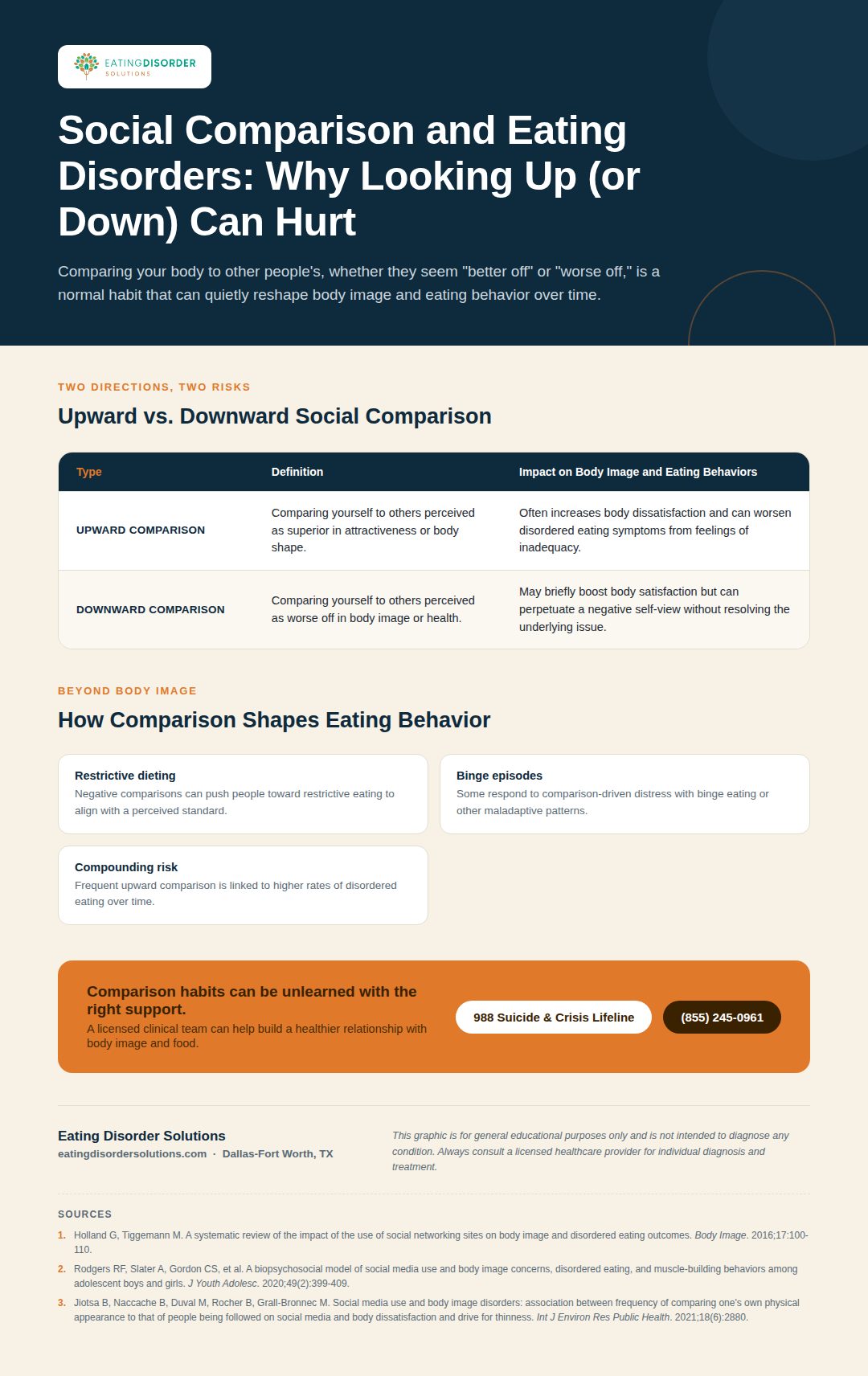
Two primary types of social comparisons exist: upward comparisons, where individuals compare themselves to others perceived as better or more desirable, and downward comparisons, involving comparisons to others considered worse off. Both forms can impact eating disorder symptoms in complex ways.
Upward vs. Downward Social Comparison in Eating Disorders
| Type of Comparison | Definition | Impact on Body Image and Eating Behaviors |
| Upward Comparison | Comparing oneself to others perceived as superior in attractiveness or body shape. | Often increases body dissatisfaction and can worsen disordered eating symptoms due to feelings of inadequacy. |
| Downward Comparison | Comparing oneself to others perceived as worse off in terms of body image or health. | May temporarily increase body satisfaction but can perpetuate negative self-view and does not resolve eating disorder issues. |
When adults engage in upward social comparisons, especially regarding body image, it often leads to increased body dissatisfaction. For example, comparing oneself to thin or fit individuals, particularly via media images, may exacerbate feelings of inadequacy, triggering unhealthy eating behaviors or intensifying disordered eating patterns.
Conversely, downward comparisons may provide temporary relief by boosting body satisfaction when comparing to those perceived as less attractive or less healthy. However, this can reinforce a negative self-schema and does not address underlying body image issues.
Media Images and Social Comparison
Research connects social media use with body image concerns and disordered eating, with appearance-based comparison acting as a key link. A systematic review by Holland and Tiggemann (2016) found that comparing appearance on social networking sites helps explain the relationship between social media use and eating concerns.
Media images play a significant role in shaping social comparison processes, especially for adults vulnerable to eating disorders. The high prevalence of idealized and often unattainable body types portrayed in advertisements, television, and social media fuels upward comparisons, increasing body dissatisfaction.
Research documented in the Journal of Eating Disorders and multiple meta-analytic reviews reveal that exposure to such media images correlates strongly with disordered eating and negative body image outcomes. This highlights the importance of media literacy and strategies to reduce the impact of harmful comparisons.
Effects of Social Comparison on Eating Behaviors
Comparing oneself to others influences not only body image but also eating behaviors. Negative social comparisons can lead to restrictive dieting, binge eating, or other maladaptive eating patterns as individuals attempt to align with perceived societal standards.
Studies emphasize that adults with a tendency towards frequent upward comparisons often experience higher rates of disordered eating, reinforcing the cyclical nature of social comparison and eating disorder symptomatology.
Addressing Social Comparison in Eating Disorder Treatment
Therapeutic approaches focused on reducing harmful social comparison can significantly improve treatment outcomes for adults with eating disorders. Cognitive-behavioral therapy (CBT) and other evidence-based interventions often incorporate techniques to challenge and reframe negative comparisons and promote body acceptance.
Mindfulness and media literacy training are also effective strategies to help individuals recognize triggers related to social comparison and develop healthier self-perceptions.
Frequently Asked Questions
1. How does social comparison lead to eating disorders?
Social comparison, especially upward comparison, can cause individuals to feel inadequate about their bodies, leading to body dissatisfaction and disordered eating behaviors as they strive to meet unrealistic standards.
2. What is the difference between upward and downward social comparison?
Upward comparison involves comparing oneself to someone perceived as better in a certain aspect, often leading to dissatisfaction, while downward comparison is comparing oneself to someone perceived as worse off, which might provide temporary relief but can still harm self-esteem.
3. Can media images worsen eating disorder symptoms?
Yes, idealized media images commonly promote upward comparisons, increasing body dissatisfaction and potentially triggering or worsening disordered eating patterns in vulnerable adults.
4. Are social comparison tendencies changeable?
Yes, through therapy and mindfulness practices, individuals can learn to reduce harmful social comparisons and develop more positive body image and eating behaviors.
5. Does social comparison only affect adolescents?
No, social comparison impacts adults as well and is an important factor considered in adult eating disorder treatments.
6. How can I stop comparing myself to others?
Techniques include practicing self-compassion, limiting exposure to triggering media, cognitive restructuring in therapy, and focusing on personal values and achievements unrelated to appearance.
7. Is social comparison assessed during eating disorder treatment?
Yes, many treatment programs evaluate social comparison behaviors as they are closely linked to body dissatisfaction and disordered eating, helping to tailor individualized interventions.
Contact Eating Disorder Solutions (EDS) for Support
If you or a loved one is struggling with an eating disorder influenced by social comparison and body dissatisfaction, professional help is available. Eating Disorder Solutions (EDS) provides compassionate, evidence-based treatment tailored for adults seeking recovery.
Call EDS today at Eating Disorder Solutions to learn more about our programs and begin your journey toward healing.
References
- Holland G, Tiggemann M. A systematic review of the impact of the use of social networking sites on body image and disordered eating outcomes. Body Image. 2016;17:100-110. https://doi.org/10.1016/j.bodyim.2016.02.008
- Rodgers RF, Slater A, Gordon CS, McLean SA, Jarman HK, Paxton SJ. A Biopsychosocial Model of Social Media Use and Body Image Concerns, Disordered Eating, and Muscle-Building Behaviors among Adolescent Girls and Boys. J Youth Adolesc. 2020;49(2):399-409. https://doi.org/10.1007/s10964-019-01190-0
- Jiotsa B, Naccache B, Duval M, et al. Social media use and body image disorders: association between frequency of comparing one’s own physical appearance to that of people being followed on social media and body dissatisfaction and drive for thinness. Int J Environ Res Public Health. 2021;18(6):2880. https://doi.org/10.3390/ijerph18062880
Support and Crisis Resources
If you or someone you care about is struggling with an eating disorder, support is available:
If you or someone you love is struggling, support is available. The National Institute of Mental Health offers free, research-based information about eating disorders at nimh.nih.gov. If you are in crisis or need immediate help, call or text 988 to reach the 988 Suicide and Crisis Lifeline, a free, confidential service available 24/7.