
Physical Warning Signs
Why physical signs need their own page
The general Warning Signs page covers physical signs alongside behavioral, emotional, and social ones. This page goes deeper into just the physical category, because physical signs carry a specific kind of urgency — they’re evidence of what’s actually happening in the body, and some of them cross the line into needing medical attention, not just a supportive conversation.
Weight changes
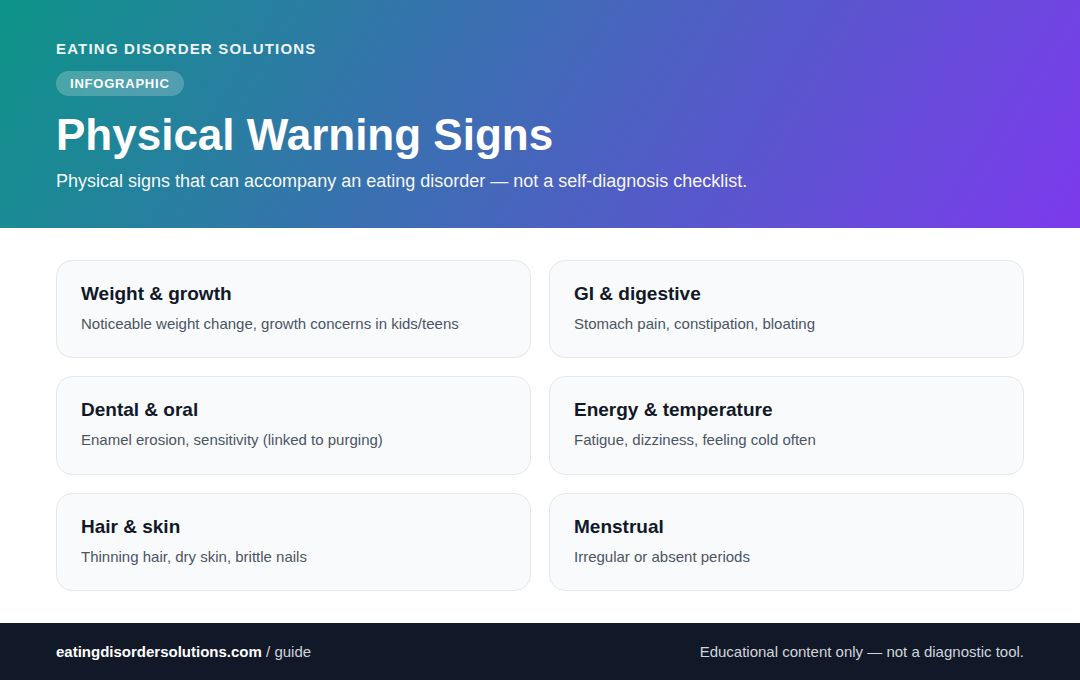
Noticeable weight loss or gain, especially if rapid, is one of the more visible physical signs — but it’s worth repeating that plenty of eating disorders occur without dramatic weight change, so its absence doesn’t rule anything out.
Gastrointestinal symptoms
Digestive complaints — bloating, constipation, stomach pain, acid reflux — show up frequently across multiple eating disorders, whether from restriction slowing digestion, from binge episodes, or from purging behaviors that directly affect the GI tract.
Cardiovascular and metabolic signs
Dizziness, fainting, a slow or irregular heartbeat, cold intolerance, and low blood pressure can all result from the metabolic and electrolyte effects of restriction, bingeing, or purging. Some of these — particularly fainting and irregular heartbeat — cross into emergency territory; see our Safety Red Flags page for exactly where that line is.
Appearance-related signs
Hair thinning or loss, brittle nails, dry skin, and in some cases the development of fine body hair (lanugo) as the body tries to conserve heat, are common signs of sustained undernutrition. Dental erosion and calluses on the knuckles (from repeated self-induced vomiting) are specific, recognizable signs associated with purging behaviors.
Energy and sleep
Persistent fatigue that doesn’t track with activity level or sleep, along with disrupted sleep patterns, is common across restrictive and binge-purge presentations alike.
When physical signs mean it’s urgent
Most physical signs on this page are reasons to schedule a medical evaluation, not reasons to panic. A smaller subset — fainting, chest pain, a very slow or irregular heartbeat, or inability to keep any food or water down — are different: those warrant emergency care, not a routine appointment.
Lab and vital sign changes a doctor might check
Because this page focuses on what’s visible or noticeable without medical equipment, it’s worth naming — in general terms — what a doctor typically screens for once physical warning signs prompt a visit. Vital signs commonly checked include heart rate and rhythm (restrictive eating and purging behaviors can both slow or destabilize heart rate), blood pressure, including a check for a significant drop when standing up, and body temperature, since the body conserves energy by lowering core temperature when consistently under-fed. Bloodwork commonly looks at electrolyte levels — particularly potassium, sodium, and magnesium — since these can shift significantly with restriction, vomiting, or laxative use and directly affect heart function. A doctor may also check kidney function, blood sugar, and in some cases bone density, since prolonged malnutrition affects bone health even in younger patients.
None of this is a substitute for an actual medical evaluation, and this page isn’t the place to interpret specific lab values. The point of naming these checks is so a visit to a doctor doesn’t feel like a mystery — knowing broadly what’s being screened for can make it easier to have that conversation, whether it’s for yourself or someone you’re bringing in for care.
Why physical signs often lag behind behavioral ones
The body is remarkably good at compensating for a while before physical signs become obvious externally — this is part of why physical signs are frequently the last category to show up, even when behavioral and emotional changes have been present for months. Metabolic and hormonal systems adjust to reduced intake in ways that can temporarily mask more serious underlying strain, and someone can appear physically unremarkable on the outside while significant internal changes are already underway. This lag is one of the more important reasons not to wait for visible physical signs before taking behavioral or emotional signs seriously — by the time physical signs are obvious, the body has often already been under strain for a considerable period.
Signs specific to purging behaviors
Some physical signs on this page are more closely tied to purging behaviors — self-induced vomiting, laxative or diuretic misuse, or excessive exercise used to compensate for eating — than to restriction alone, and are worth naming separately since they can appear even when weight looks entirely unremarkable. Recurrent vomiting can cause swelling around the jaw and cheeks from irritated salivary glands, calluses or scarring on the back of the knuckles from repeated contact with teeth, and enamel erosion that a dentist often notices before anyone else does. Laxative misuse can cause chronic GI discomfort, dependency where the digestive system stops functioning normally without them, and, like vomiting, significant electrolyte disruption. Because these signs are specific to the compensatory behavior rather than to being under-fed generally, they can be the first or only physical clue in a presentation where weight isn’t providing any signal at all.
Frequently asked questions
Do physical signs always mean someone has an eating disorder?
No. Many of these signs overlap with other medical conditions. Physical signs are a reason to see a doctor for an evaluation, not a basis for self-diagnosis.
Can physical signs be present without any noticeable weight change?
Yes. Digestive symptoms, fatigue, dental erosion from purging, and cardiovascular signs can all occur at a stable or even increasing body weight.
Which physical signs need emergency care rather than a routine doctor visit?
Fainting or feeling faint, chest pain, a very slow or irregular heartbeat, and inability to keep any food or water down are emergency-level signs.
Are dental problems really connected to eating disorders?
Yes — repeated self-induced vomiting exposes teeth to stomach acid, which can cause noticeable enamel erosion over time.
Can bloodwork come back completely normal even when an eating disorder is medically serious?
Yes, and this is a genuinely important point. The body prioritizes maintaining certain lab values, like electrolyte levels, for as long as possible, sometimes right up until a sudden and dangerous shift. Normal labs do not rule out a serious eating disorder — they should be interpreted alongside behavioral and physical history, not treated as a stand-alone clearance.
Do physical signs resolve quickly once treatment starts?
Some physical signs, like low energy or GI discomfort, can begin improving within days to weeks of nutritional stabilization. Others, particularly bone density loss and certain cardiac changes from prolonged restriction, can take much longer to recover or may not fully reverse.
What this covers
- Weight changes (in either direction), GI complaints, dental erosion (associated with purging).
- Hair thinning, cold intolerance, dizziness or fainting, irregular menstruation.
- These signs could indicate a problem — this is not a checklist to self-diagnose from.
- If you notice several of these together, it’s worth a conversation with a provider.