
Warning Signs
Why these signs are worth knowing
Eating disorders rarely announce themselves. They tend to build gradually, hidden inside habits that can look, at first, like discipline, pickiness, or a rough patch — skipping a meal here, an offhand comment about weight there. Family members and friends are often the first to notice something’s off, usually before the person experiencing it is ready or able to name it themselves. That’s exactly why a quick-reference list like this one matters: it gives you a way to recognize a pattern early, when there’s more room to act, rather than waiting for a crisis to make it obvious.
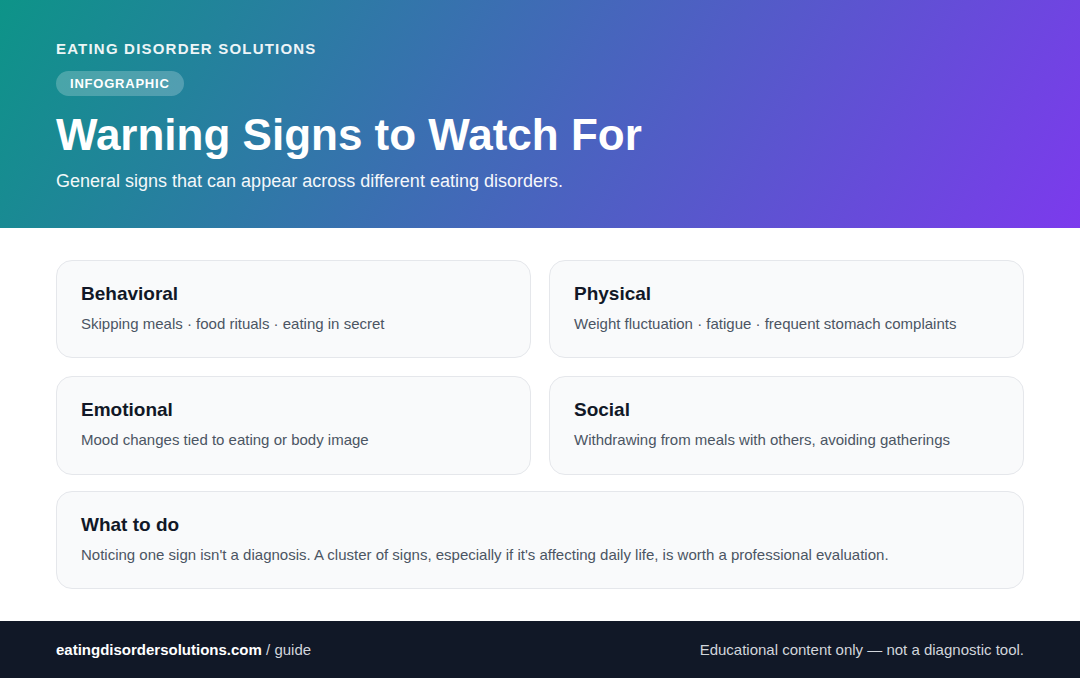
This page is built to be scanned in under a minute — the infographic above covers the essentials. What follows goes a level deeper into each category, because “what to look for” and “what it actually looks like day to day” aren’t always the same thing.
How to use this page
Think of this as a starting point, not a checklist to score. A single sign, on its own, usually isn’t meaningful — everyone skips a meal occasionally or has an off day with body image. What matters more is pattern and persistence: several signs showing up together, sticking around for weeks rather than days, or getting more pronounced over time.
If you want a more structured way to think through what you’re noticing, our Warning Signs Tool walks through the same categories in a short, private checklist format. For a closer look at a specific condition rather than general cross-disorder signs, the full guide to eating disorder types breaks down anorexia, bulimia, binge eating disorder, ARFID, and related conditions individually — each with its own more specific warning-sign profile.
A closer look at each category
Behavioral signs are often the easiest for people close to the situation to notice first, because they show up in routine — mealtimes, grocery shopping, social plans. Skipping meals or claiming to have “already eaten,” developing rigid rules around specific foods or food groups, eating in secret or disappearing to the bathroom right after meals, and a sudden new intensity around exercise (exercising through injury or illness, distress when a workout is missed) all fall into this bucket. Individually, any one of these could be unrelated. Together, and repeated, they’re worth paying attention to.
Physical signs are frequently the last to become visible, since the body can compensate for a while before changes are obvious externally. Noticeable weight change in either direction, fatigue that doesn’t track with sleep or activity level, dizziness or lightheadedness, digestive complaints that don’t have another clear cause, and changes in skin, hair, or nails are common. Because these overlap with a wide range of other medical conditions, physical signs alone aren’t diagnostic of an eating disorder — they’re a reason to loop in a doctor, not a reason to assume the worst.
Emotional signs tend to cluster around food, body image, and control. This can look like anxiety or distress that spikes specifically around eating or before meals, mood swings that seem tied to what was or wasn’t eaten, a preoccupation with weight or body shape that crowds out other thoughts, or perfectionism and a need for control that extends beyond food into other areas of life. These signs are often the most invisible from the outside, since a person can carry a lot of internal distress while presenting as fine.
Social signs show up as withdrawal — skipping meals with family or friends, avoiding restaurants or gatherings built around food, pulling back from activities that used to matter, or a general drop in socializing that coincides with the other changes above. Isolation both hides the other signs and tends to make things harder, which is part of why it’s worth noticing on its own.
What a cluster of signs might mean — and what it doesn’t
Seeing two or three of these signs together, especially if they’re new or getting more pronounced, is a reasonable signal to take seriously — not a diagnosis, and not proof that treatment is automatically warranted. Eating disorders exist on a spectrum, and plenty of people show some of these patterns without meeting clinical criteria for a specific disorder. At the same time, waiting for certainty before checking in with someone can mean waiting through months of a worsening pattern.
The most useful next step is usually a conversation — with the person you’re concerned about, or with a professional if it’s about yourself — rather than trying to self-diagnose from a list. If what you’re noticing includes anything on our Safety Red Flags page — fainting, chest pain, an irregular heartbeat, inability to keep food or water down, or thoughts of self-harm — that’s not a “watch and wait” situation. That calls for emergency care.
Frequently asked questions
How many warning signs need to be present before it’s a concern?
There’s no fixed number. What matters more than a count is whether signs are clustering together, persisting over weeks rather than days, and getting more pronounced rather than resolving on their own. A single sign in isolation is common and often unrelated to disordered eating; several signs together, especially across different categories, are more worth a closer look.
Can someone have an eating disorder without being visibly underweight?
Yes. Weight is one possible physical sign, not a requirement. Binge eating disorder, bulimia, ARFID, and other conditions can occur at any body weight, and outward appearance is often one of the least reliable indicators.
What should I do if I notice these signs in someone else?
Start with a private, low-pressure conversation rather than a confrontation — focus on what you’ve noticed and that you care, rather than diagnosing them. If you’re not sure how to start that conversation, our Guide for Friends and Loved Ones walks through it in more detail.
Are these signs the same for every eating disorder?
No — this page covers general, cross-disorder signs. Each condition also has signs more specific to it. See the Physical Warning Signs page for a more clinical physical-only list, or the full guide for condition-specific breakdowns.
What this covers
- Behavioral: skipping meals, rigid food rituals.
- Physical: weight fluctuation, fatigue.
- Emotional: mood changes tied to eating.
- Social: withdrawing from meals with others.
- These are general, cross-disorder signs — see the Physical Warning Signs page for a more clinical, physical-only list.