Key Takeaways
Eating disorders and obsessive-compulsive disorder (OCD) frequently co-occur and share overlapping features such as rigidity, intrusive thoughts, and repetitive behaviors. When both are present, integrated treatment that addresses each condition together tends to be important for recovery.
- OCD and eating disorders share overlapping traits including perfectionism, anxiety, and ritualized behaviors.
- Research suggests OCD is a common co-occurring condition among people with eating disorders, particularly anorexia nervosa.
- Evidence-based approaches such as exposure and response prevention (ERP) and cognitive behavioral therapy (CBT) are used for both conditions.
- Treating only one condition while leaving the other unaddressed can make recovery harder.
- Care should be individualized, weight-inclusive, and delivered by clinicians experienced in co-occurring disorders.
The relationship between eating disorders and OCD (Obsessive-Compulsive Disorder) is one of the most common and complex intersections in mental health. For many people with eating disorders, their struggles with food and body image are deeply intertwined with obsessive thoughts and compulsive behaviors. Understanding the connection between OCD and eating disorders is crucial for effective eating disorder treatment and long-term recovery.
Research indicates a high rate of comorbidity between these conditions. Individuals with an eating disorder are significantly more likely to have an anxiety disorder, particularly co-occurring OCD, compared to the general population. This dual diagnosis situation requires a specialized approach that addresses both the disordered eating behaviors and the underlying obsessive-compulsive disorder.
The Overlap Between Eating Disorders and OCD
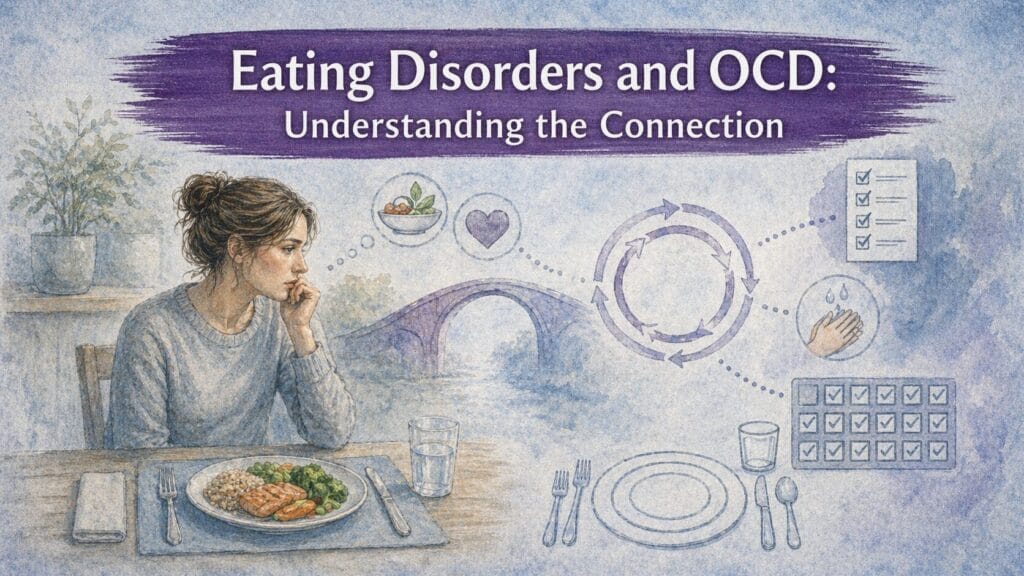
At their core, both eating disorders and OCD involve intrusive thoughts (obsessions) that cause severe anxiety, followed by repetitive behaviors (compulsions) performed to alleviate that anxiety. The connection between OCD and eating disorders often lies in the focus of these thoughts and behaviors, which often overlap in meaningful ways.
In OCD, obsessions can revolve around contamination, symmetry, harm, or a need for perfection, sometimes described as a “just right” feeling. Compulsions might include excessive checking, counting, or ritualistic behaviors. In an eating disorder, the obsessions are typically focused on food, calories, weight, body shape, or “clean” eating. The compulsions are the disordered eating behaviors themselves: restricting food intake, binge eating, purging, or excessive exercise. OCD symptoms and eating disorder symptoms often overlap, making accurate diagnoses essential.
Shared Neural Pathways and Genetics
The high comorbidity between eating disorders and OCD is not coincidental. Scientific research suggests that these related disorders share common neural pathways and genetic vulnerabilities. Both disorders involve dysfunction in the brain’s serotonin and dopamine systems, which regulate mood, anxiety, and impulse control. Some neuroimaging research has found altered activity in brain regions responsible for habit formation, reward processing, and cognitive flexibility in both people with eating disorders and people with OCD.
How OCD Manifests in Specific Eating Disorders
The intersection of eating disorders and OCD can look different depending on the specific diagnosis. Understanding what’s the connection in each case helps clinicians tailor treatment options appropriately.
Anorexia Nervosa and OCD
The connection between anorexia nervosa and obsessive-compulsive disorder is particularly strong. OCD and anorexia nervosa often co-occur, with people with anorexia exhibiting intense perfectionism, rigidity, and a need for control, traits commonly seen in obsessive-compulsive disorder. The obsession with weight loss and the compulsion to restrict food or exercise excessively can mirror the cycle of OCD. Some researchers even conceptualize anorexia nervosa and OCD as part of the same obsessive-compulsive spectrum. Obsessive-compulsive disorder is a common co-occurring condition among people with anorexia nervosa. A meta-analysis of comorbidity rates reported a lifetime OCD comorbidity of roughly 18% across eating disorders and about 19% in anorexia nervosa, with prospective follow-up studies finding substantially higher rates (Mandelli et al., 2020).
Bulimia Nervosa, Binge Eating Disorder, and OCD
While anorexia is most closely linked to the restrictive and perfectionistic aspects of OCD, bulimia and binge eating disorder also share features with OCD. The intrusive urge to binge eat can function as an obsession, and the act of bingeing (and subsequent purging in bulimia) can act as a compulsion to temporarily relieve distress. An eating disorder may develop or worsen when OCD symptoms go untreated.
Orthorexia and OCD
Orthorexia, an obsession with “healthy” or “clean” eating, bears a striking resemblance to OCD. The intense fear of consuming “impure” foods and the ritualistic rules surrounding diet are highly characteristic of obsessive-compulsive behavior. Disordered eating in this form is often misidentified as simply “healthy living” rather than a clinical condition.
| Eating Disorder | OCD-Like Obsessions | OCD-Like Compulsions |
| Anorexia Nervosa | Fear of weight gain, need for “just right” restriction | Calorie counting, ritualistic meal preparation, excessive exercise |
| Bulimia Nervosa | Intrusive urges to binge, guilt about eating | Bingeing and purging cycles, ritualistic food behaviors |
| Binge Eating Disorder | Obsessive thoughts about food, loss of control | Compulsive binge eating episodes to relieve distress |
| Orthorexia | Fear of “impure” or unhealthy foods | Ritualistic food checking, avoidance of non-approved foods |
Effective Treatment Options for Co-Occurring Eating Disorders and OCD
Treating a dual diagnosis of an eating disorder and OCD requires a comprehensive, integrated approach. Treating one condition while ignoring the other often leads to relapse. Effective eating disorder treatment must target both the disordered eating behaviors and the OCD symptoms simultaneously.
Exposure and Response Prevention (ERP)
Exposure and Response Prevention (ERP) is a well-established, evidence-based psychological treatment for OCD and is also used in eating disorder care. In ERP, patients are gradually exposed to their feared stimuli (e.g., “fear foods,” feeling full) and are guided to resist engaging in their typical compulsions. Over time, this helps the brain learn that the feared outcome will not happen and that the anxiety will subside on its own. ERP is a cornerstone of treatment options for co-occurring OCD and eating disorders.
Cognitive Behavioral Therapy (CBT)
CBT is widely used to treat both eating disorders and OCD. It helps patients identify and challenge the distorted thoughts and beliefs that drive their obsessions and compulsions. By restructuring these thought patterns, individuals can develop healthier coping mechanisms and reduce disordered eating behaviors.
Medication Management
Psychiatric medication, particularly Selective Serotonin Reuptake Inhibitors (SSRIs), can be beneficial in treating both OCD and the anxiety and depressive symptoms often associated with eating disorders. Medication can help reduce the intensity of OCD symptoms, making it easier for patients to engage in ERP and CBT. An eating disorder may also respond to medication when combined with therapy.
Seeking Specialized Care
If you or a loved one is struggling with an eating disorder and OCD, seeking specialized, integrated care is vital. At Eating Disorder Solutions, we understand the complex interplay between these related disorders. Our multidisciplinary team of therapists, dietitians, and psychiatric providers collaborates to create individualized treatment plans that address the whole person.
We utilize evidence-based treatment options, including ERP and CBT, to help clients break free from the cycle of obsessions and compulsions, heal their relationship with food, and achieve lasting recovery. Call us today at to learn more about our comprehensive programs.
Frequently Asked Questions
Are eating disorders associated with OCD?
Yes. Eating disorders and OCD are commonly associated. Research has found that co-occurring OCD is found in a significant percentage of people with eating disorders, particularly anorexia nervosa. Both conditions share neural pathways, genetic vulnerabilities, and symptom patterns involving obsessions and compulsions.
Is anorexia a form of OCD?
Anorexia nervosa is a distinct diagnosis, but it shares many clinical features with OCD. OCD and anorexia nervosa often co-occur, and some experts consider anorexia to be part of the obsessive-compulsive spectrum due to the significant overlap in obsessive thoughts and ritualistic behaviors.
How do you treat someone with both OCD and an eating disorder?
Integrated eating disorder treatment that addresses both conditions at the same time is generally recommended. This typically involves Exposure and Response Prevention (ERP), Cognitive Behavioral Therapy (CBT), nutritional counseling, and, in some cases, psychiatric medication. Understanding the connection between OCD and eating disorders is essential for building an effective treatment plan.
Is recovery possible when an eating disorder and OCD co-occur?
Yes, recovery is possible. While OCD is often a chronic condition that requires ongoing management, evidence-based treatment options can significantly reduce OCD symptoms and improve quality of life. Similarly, with comprehensive eating disorder treatment, individuals can achieve full and lasting recovery from disordered eating.
References
- Mandelli L, Draghetti S, Albert U, De Ronchi D, Atti AR. Rates of comorbid obsessive-compulsive disorder in eating disorders: A meta-analysis of the literature. J Affect Disord. 2020;277:927-939. https://doi.org/10.1016/j.jad.2020.09.003
- Cederlöf M, Thornton LM, Baker J, et al. Etiological overlap between obsessive-compulsive disorder and anorexia nervosa: a longitudinal cohort, multigenerational family and twin study. World Psychiatry. 2015;14(3):333-338. https://doi.org/10.1002/wps.20251
- Mahjani B, Bey K, Boberg J, Burton C. Genetics of obsessive-compulsive disorder. Psychol Med. 2021;51(13):2247-2259. https://doi.org/10.1017/S0033291721001744
Support and Crisis Resources
If you or someone you care about is struggling with an eating disorder, support is available:
If you or someone you love is struggling, support is available. The National Institute of Mental Health offers free, research-based information about eating disorders at nimh.nih.gov. If you are in crisis or need immediate help, call or text 988 to reach the 988 Suicide and Crisis Lifeline, a free, confidential service available 24/7.
Related Reading
- Grief and Eating Disorders: Understanding the Connection
- Eating Disorders and Sleep Disorders: The Bidirectional Relationship
- Hair Loss and Eating Disorders: The Connection Explained
- Emotional Eating vs. Binge Eating Disorder: Understanding the Difference