Eating disorders do not affect every community equally. Research consistently finds that LGBTQ+ people, across sexual orientation and gender identity, face a meaningfully higher risk of developing an eating disorder than their heterosexual, cisgender peers (Harriger, 2020). That gap is not about identity causing disordered eating. It is about what LGBTQ+ people are often exposed to because of that identity.
This page pulls together what the research actually shows about LGBTQ+ eating disorder risk, and links out to more specific guides on terminology, transgender-specific experiences, and why this connection still does not get talked about enough.
Key Takeaways
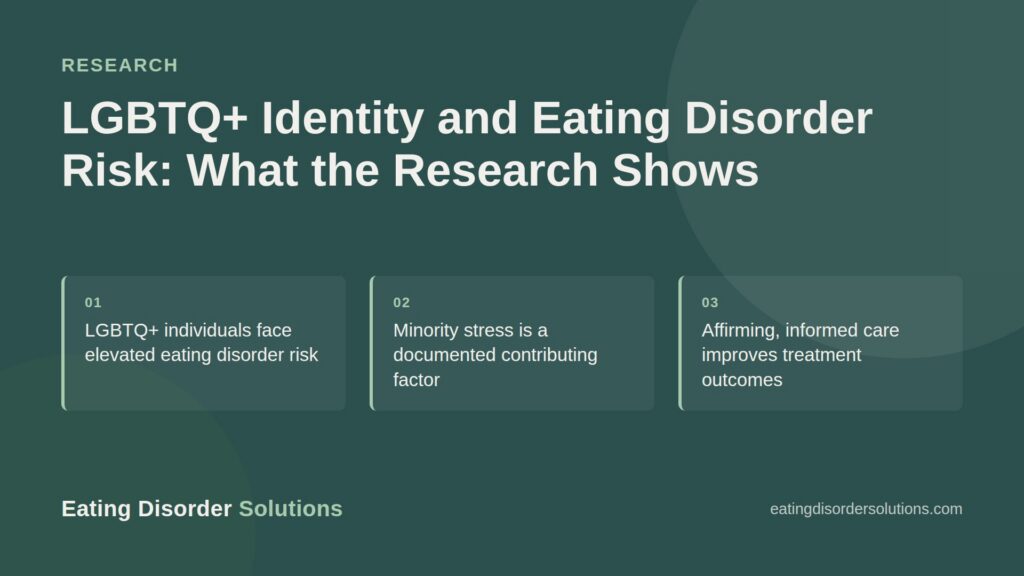
- LGBTQ+ people face a significantly higher risk of eating disorders than heterosexual, cisgender people (Harriger, 2020).
- Minority stress, not identity itself, is the driver: chronic exposure to stigma, discrimination, and the need to conceal or defend one’s identity is what elevates risk (Rollè et al., 2024).
- Risk varies a lot within the community. Transgender and gender-diverse college students are diagnosed with an eating disorder at more than four times the rate of their cisgender peers (Simone et al., 2022).
- Fear of discrimination in treatment settings is a real barrier to care, which is why affirming, identity-informed treatment matters clinically, not just ethically.
Why LGBTQ+ People Face Higher Eating Disorder Risk
The leading explanation is the minority stress model. It holds that health disparities in LGBTQ+ populations come from chronic exposure to a hostile or unwelcoming environment, things like harassment, discrimination, rejection, and the ongoing work of concealing or defending one’s identity, not from anything inherent to being LGBTQ+ (Rollè et al., 2024).
A 2024 systematic review found that minority stress reliably predicts disordered eating across sexual and gender minority groups, and that the relationship is often carried through shame, body shame, or general negative affect. In plain terms: the stress of navigating stigma builds up, and for some people it comes out as disordered eating (Rollè et al., 2024).
Risk Looks Different Across the LGBTQ+ Community
LGBTQ+ is not one experience, and eating disorder risk does not land the same way for everyone under that umbrella. Understanding the specific terms and identities involved matters here. For a plain-language breakdown of what each letter means, see our guide to understanding the LGBTQ+ acronym.
Gay and Bisexual Men
Gay and bisexual men report body dissatisfaction and disordered eating at higher rates than heterosexual men, often tied to muscularity-focused ideals within some gay social and dating spaces. This can show up as restrictive eating, compulsive exercise, or steroid or supplement misuse aimed at achieving a specific body type.
Lesbian and Bisexual Women
Findings here are more mixed. Some research suggests lesbian women report somewhat lower rates of body dissatisfaction than heterosexual women, while bisexual women in several studies show elevated risk, potentially linked to navigating stigma from both straight and gay communities. Bisexual identity specifically has been flagged as a higher-risk group in more recent reviews (Rollè et al., 2024).
Transgender and Gender-Diverse People
This is where the numbers are the starkest. A national study of transgender and gender-diverse college students found they were diagnosed with an eating disorder at more than four times the rate of cisgender students, with genderqueer and gender-nonconforming students showing the highest rates of elevated eating disorder risk of any subgroup studied (Simone et al., 2022). For transgender individuals specifically, disordered eating is sometimes used, consciously or not, as a way to change the body’s shape in the absence of or alongside gender-affirming care. We go deeper on this in T Is for Transgender.
Barriers That Keep LGBTQ+ People From Getting Help
Elevated risk does not automatically mean people get treatment. Fear of discrimination or having to explain or justify one’s identity to a provider is a documented reason LGBTQ+ people delay or avoid eating disorder treatment altogether. Combine that with an eating disorder research and treatment field historically built around a white, thin, cisgender ideal, and a lot of LGBTQ+ people simply do not see themselves reflected in standard care. We have written more about why this connection still does not get the awareness it needs in Why Eating Disorders in the LGBTQ Community Need Awareness.
What LGBTQ+-Affirming Eating Disorder Treatment Looks Like
Affirming care starts with not having to explain or defend your identity before you can talk about the eating disorder itself. At Eating Disorder Solutions, that means clinicians who use correct names and pronouns as a baseline, treatment planning that does not assume a cisgender or heterosexual default, and a team that understands minority stress as a clinical factor, not a footnote. Identity-affirming care is not a separate track from evidence-based treatment. For LGBTQ+ clients, it is part of what makes evidence-based treatment actually work.
References
- Harriger, J. A. (2020). Eating disorders and disordered eating behaviors in the LGBT population: a review of the literature. Journal of Eating Disorders, 8, 51. https://doi.org/10.1186/s40337-020-00327-y
- Simone, M., Askew, A., Lust, K., Eisenberg, M. E., & Pisetsky, E. M. (2022). Variability in eating disorder risk and diagnosis in transgender and gender diverse college students. Annals of Epidemiology. PMID: 35472489
- Rollè, L., Santoniccolo, F., et al. (2024). The role of minority stress in disordered eating: a systematic review of the literature. Eating and Weight Disorders, 29, 41. https://doi.org/10.1007/s40519-024-01671-7
Resources
- National Eating Disorders Association (NEDA)
- 988 Suicide & Crisis Lifeline: call or text 988
Related Reading
- How to Use FMLA for Eating Disorder Treatment at Eating Disorder Solutions (EDS)
- Eating Disorders and Dissociation: What the Research Shows
- Emotional Eating vs. Binge Eating Disorder: Understanding the Difference
- Can Picky Eating Be an Eating Disorder?