
Binge Eating Disorder
The most common, least talked-about eating disorder
Binge eating disorder (BED) is the most commonly diagnosed eating disorder in the U.S. — more common than anorexia and bulimia combined — and it’s also one of the most under-recognized, both by the people experiencing it and by the people around them. Part of that gap is stigma: bingeing gets dismissed as a willpower issue or ordinary overeating, rather than understood as a diagnosable condition with real psychological and physical drivers.
What separates BED from “overeating”
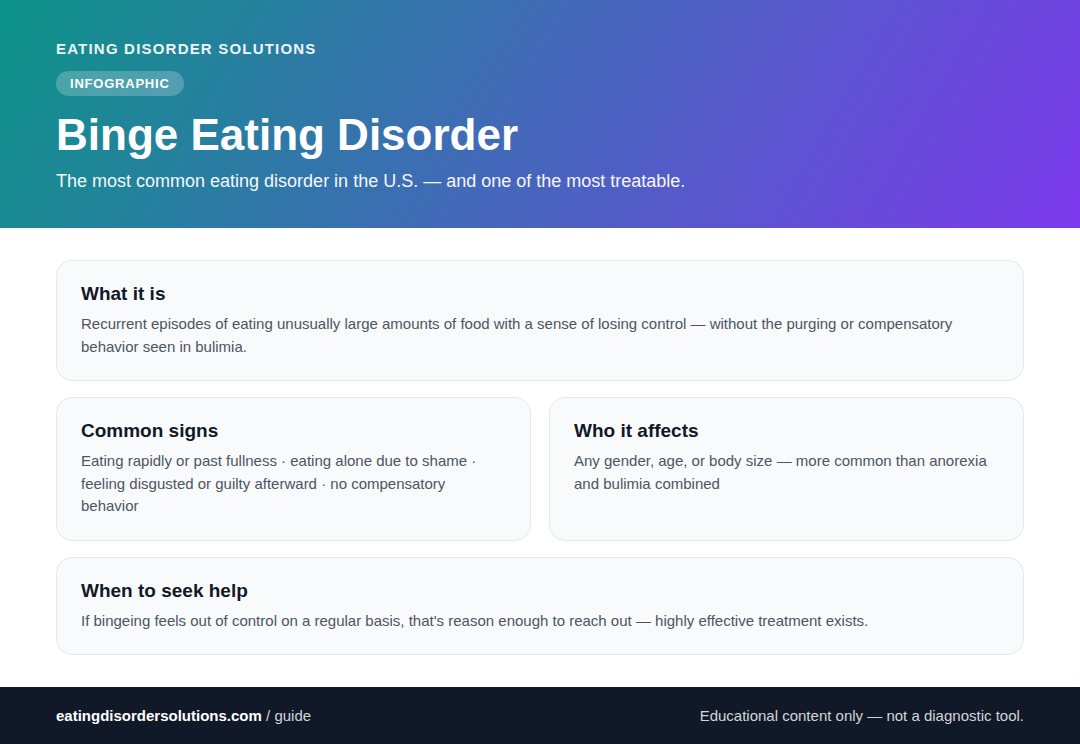
The defining feature of BED is recurring episodes of eating a large amount of food in a discrete period, accompanied by a felt sense of loss of control — not simply eating more than planned at a holiday meal. Episodes are typically followed by intense distress, shame, or guilt, and happen without the regular compensatory behaviors seen in bulimia. Frequency and the emotional weight of the episodes are what distinguish a clinical pattern from an occasional overeating episode everyone has now and then.
Who it affects
BED occurs across genders, ages, and body sizes, and unlike the common assumption, it’s not exclusive to people who are clinically overweight — plenty of people with BED are at an average body weight. It often develops alongside anxiety, depression, or a history of dieting and food restriction, and episodes are frequently triggered by emotional states — stress, boredom, sadness — rather than physical hunger.
Warning signs beyond the binge episode itself
Eating unusually large amounts of food quickly, eating past the point of physical fullness, eating alone specifically out of embarrassment about quantity, and a pattern of strict dieting between episodes are all common. Emotionally, look for shame or self-criticism tied to eating, and a cycle where restriction makes a future binge episode more likely — a pattern that can feel self-reinforcing without support.
When to seek help
If binge episodes are happening regularly — clinically, once a week for three months is a common reference point, though you don’t need to hit a specific threshold before it’s worth addressing — or if they’re causing significant distress, it’s reasonable to talk to a professional. BED is treatable, commonly through therapy approaches like CBT, and sometimes medication, without requiring restrictive dieting as a “fix,” which often makes the cycle worse rather than better.
Common triggers and the restrict-binge cycle
Binge episodes rarely happen at random. For a lot of people with BED, episodes cluster around a specific set of triggers: emotional states like stress, boredom, loneliness, or sadness; restrictive dieting that leaves the body physically under-fed; and specific times of day, often evening, when willpower and structure both tend to be lowest. Understanding what precedes an episode is often more clinically useful than focusing on the episode itself, because it points toward what treatment actually needs to address.
One of the more counterintuitive patterns clinicians see is that dieting can directly fuel binge eating rather than prevent it. Restricting food intake — skipping meals, cutting calories aggressively, declaring entire food groups off-limits — creates both physiological hunger and a psychological sense of deprivation. Both increase the likelihood of a binge episode, which is often followed by guilt, which frequently leads to more restriction, which resets the cycle. This is sometimes called the restrict-binge cycle, and it’s a major reason why “just try a diet” is not effective advice for someone showing signs of BED — it tends to make the underlying pattern worse, not better.
Myths that keep people from seeking help
Myth: “Binge eating disorder is just poor discipline around food.” Fact: BED is a recognized psychiatric diagnosis in the DSM-5, with underlying patterns involving emotional regulation, brain reward pathways, and often a history of restrictive dieting — not a simple lack of self-control.
Myth: “You can tell who has BED by looking at them.” Fact: BED occurs across the full range of body sizes. Assuming it only affects people in larger bodies means it gets missed in people who don’t fit that assumption.
Myth: “If someone doesn’t binge every day, it’s not serious enough to need help.” Fact: diagnostic criteria for BED specify at least one binge episode per week over three months as a threshold for consideration, not a daily occurrence — and even below that threshold, a recurring pattern is worth addressing before it escalates.
Recovery and relapse patterns
Recovery from BED is rarely a single milestone — it’s more commonly described as a reduction in binge frequency over time, alongside a shift in the emotional relationship to food, rather than an abrupt stop. Many people in recovery report occasional lapses, particularly during high-stress periods, and treatment approaches that build in a plan for handling a lapse without it spiraling into shame and a full return to the old cycle tend to produce more durable results than approaches that treat any lapse as a failure. This is one reason ongoing outpatient support after the initial, more intensive phase of treatment is often recommended even once binge frequency has dropped significantly — consolidating new patterns takes time, and the underlying triggers (stress, emotional regulation, body image) don’t disappear the moment behavior improves.
Frequently asked questions
Is binge eating disorder the same as being overweight?
No. BED is defined by the pattern of episodes and the loss-of-control experience, not by body weight. People with BED exist across the full range of body sizes, and treatment doesn’t center on weight loss.
How is BED different from bulimia?
Both involve binge episodes, but bulimia includes regular compensatory behavior afterward — purging, excessive exercise, fasting — while BED does not.
Can dieting make binge eating worse?
Often, yes. Restriction is a common trigger for the next episode, creating a cycle. Effective treatment usually focuses on breaking that cycle rather than adding more restriction.
What does treatment for BED usually involve?
Most commonly, structured therapy (CBT is well-supported for BED specifically), sometimes alongside medication. Our Binge Eating Assessment is a starting point.
Is binge eating disorder linked to any specific mental health conditions?
BED frequently co-occurs with depression, anxiety disorders, and, for some, symptoms similar to substance use patterns around food. It’s not caused by these conditions, but treatment that addresses only the eating behavior without considering what else is going on tends to be less effective.
Can someone have BED without ever binging in front of anyone else?
Yes, and this is typical rather than unusual. Secrecy and eating alone are common features of binge episodes, which is part of why BED can go unnoticed by family and friends for a long time even when it’s significantly affecting someone’s life.
What this covers
- Recurrent episodes of eating unusually large amounts of food with a sense of losing control.
- No regular compensatory behaviors (like purging) — that’s the key difference from bulimia.
- It’s the most common eating disorder in the U.S., across all ages, genders, and body sizes.
- Warning signs include eating rapidly, eating alone out of embarrassment, and feeling shame or distress after eating.