
Key Takeaways
When body dysmorphia is severe or co-occurs with an eating disorder, a structured live-in program can provide closer support — here is what residential treatment for body dysmorphia involves.
Constant mirror-checking and comparison are hallmarks of BDD, and the habit often intensifies online, as we cover in our guide to body checking on social media.
Body dysmorphic disorder (BDD) is a mental health condition in which a person becomes intensely preoccupied with perceived flaws in their appearance that others often cannot see. It can cause significant distress and time-consuming behaviors such as mirror checking, and it frequently overlaps with eating disorders. BDD is treatable, and most people improve with evidence-based care such as cognitive behavioral therapy and, when appropriate, medication.
- BDD involves distressing, time-consuming preoccupation with perceived appearance flaws that are minor or not visible to others.
- It occurs across all genders and is more common than many people realize.
- BDD and eating disorders frequently co-occur and share features such as body checking and distorted body image.
- Common signs include mirror checking or avoidance, reassurance seeking, and camouflaging perceived flaws.
- Cognitive behavioral therapy is the most established treatment, and medication can help in many cases.
Understanding BDD: A Critical Mental Health Condition
What is BDD? BDD stands for Body Dysmorphic Disorder, a serious psychological condition where you become fixated on perceived flaws in your appearance that are often minor or invisible to others. This guide focuses on body dysmorphic disorder, its symptoms, treatment options, and its strong overlap with eating disorders.Quick Facts About Body Dysmorphic Disorder
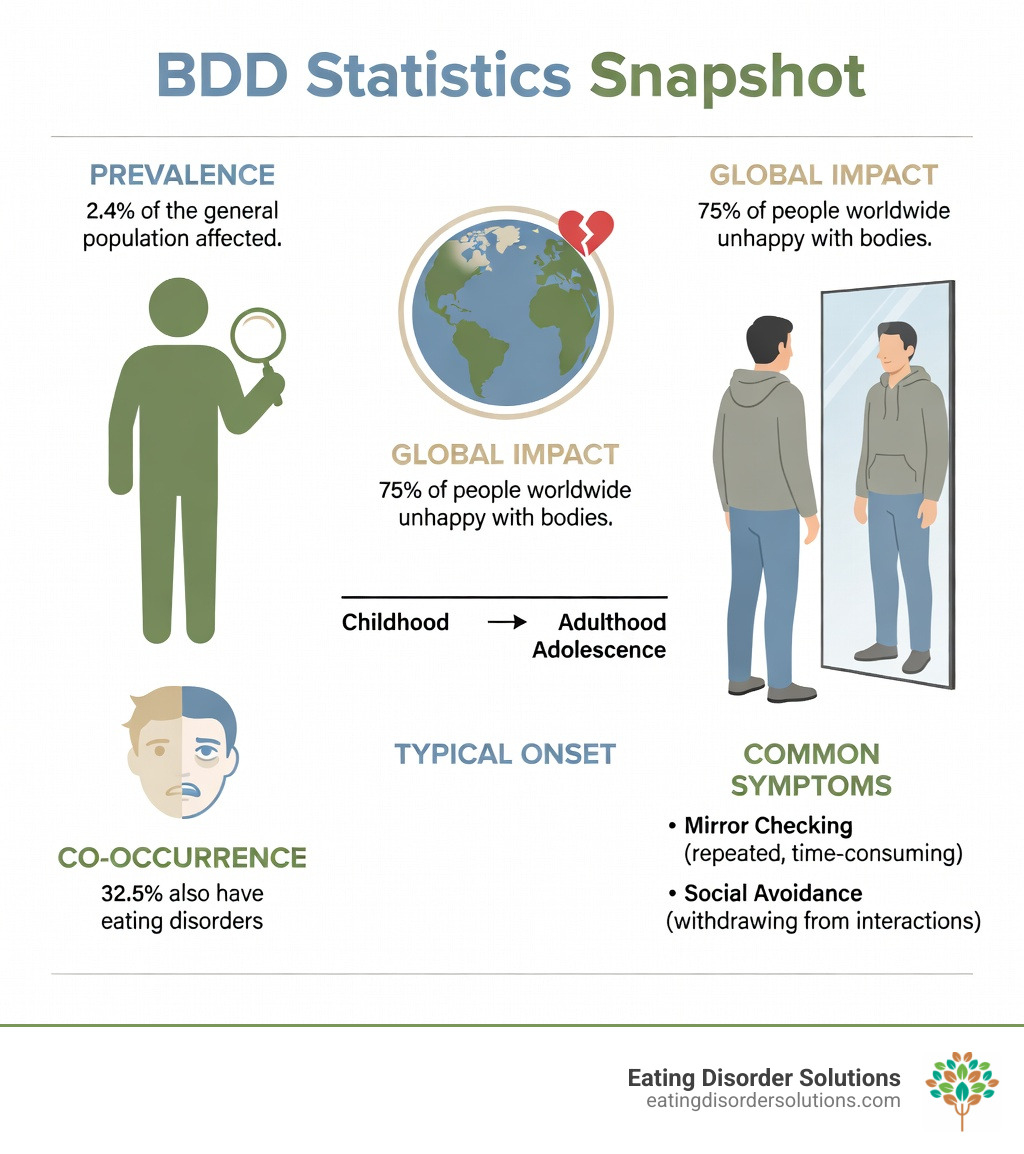
Definition: A mental health condition characterized by obsessive preoccupation with perceived physical defects Who it affects:- About 1 in every 100 people
- Usually begins in adolescence or teenage years
- Affects men and women equally
- Constant mirror checking or avoidance
- Excessive grooming or skin picking
- Hiding perceived flaws with clothing or makeup
- Seeking repeated cosmetic procedures
- Social isolation and avoidance
- Feelings of anxiety, depression, or suicidal thoughts
What is Body Dysmorphic Disorder?
BDD refers to Body Dysmorphic Disorder, a psychiatric diagnosis listed in the DSM-5-TR under “Obsessive-Compulsive and Related Disorders.” BDD describes a distressing preoccupation with imagined or slight defects in physical appearance, defects that other people typically do not notice or consider minor. For people living with BDD, the preoccupation is not vanity and it is not a passing insecurity. It is a perceptual disorder that can consume hours of the day and significantly interfere with relationships, work, and daily functioning. This guide focuses on what Body Dysmorphic Disorder looks like, how it overlaps with eating disorders, and how it is treated.Body Dysmorphic Disorder: Symptoms, Causes, and Risks
Body Dysmorphic Disorder is more common than many realize. Statistics suggest that about 1 in every 100 people lives with this condition. It typically begins during the vulnerable years of adolescence or the early teens, affecting men and women at nearly equal rates. If you are wondering about your own experiences, taking a Body Dysmorphia Quiz can be a helpful first step in identifying patterns of concern.Recognizing the Symptoms
The hallmark of BDD is an obsession that won’t quit. While someone without BDD might notice a blemish and move on, someone with BDD may spend hours thinking about it. Common symptoms include:- Compulsive Mirror Checking: Spending significant time analyzing perceived flaws in the mirror, or conversely, avoiding mirrors entirely to prevent distress.
- Excessive Grooming: Spending hours on hair, makeup, or skincare to “fix” or hide the perceived defect.
- Skin Picking: Attempting to “smooth out” the skin, which often leads to actual scabs or permanent scarring.
- Reassurance Seeking: Frequently asking others if they look okay, though the answers rarely provide lasting relief.
- Camouflaging: Using clothing, hats, body positioning, or makeup to hide the area of concern.
- Social Avoidance: Skipping school, work, or social gatherings because of the fear that others will judge the “flaw.”
Specific Focus Areas
While BDD can focus on any part of the body, people most commonly fixate on the face (nose, skin, or complexion), hair, or genitals. A specific subtype known as muscle dysmorphia occurs almost exclusively in men. This involves a preoccupation with the idea that one’s body is too small or not muscular enough, often leading to excessive weightlifting and strict dietary regimens.What Causes BDD?
There is no single “smoking gun” cause for BDD. Instead, it is usually a combination of factors:- Brain Chemistry: Abnormalities in brain structure or neurochemistry, particularly involving serotonin, play a major role.
- Genetics: You are at a higher risk if you have a blood relative with BDD or OCD.
- Life Experiences: Early childhood trauma, bullying, or teasing about appearance can trigger the onset of the disorder.
- Personality Traits: Perfectionism and high levels of aesthetic sensitivity are common among those affected.
The Critical Link Between BDD and Eating Disorders
Returning to mental health, we must address the frequent overlap between Body Dysmorphic Disorder and eating disorders. At Eating Disorder Solutions, we often see these two conditions walking hand-in-hand. While they are distinct diagnoses, they share a common root: a distorted relationship with the body. If you find yourself asking, “Do I Have Body Dysmorphia?” you might also notice that your eating habits have changed in an attempt to “control” your appearance.Distinguishing the Two
- Eating Disorders: Typically focus on overall weight, shape, and size. The primary behaviors involve restricting food, purging, or binge eating.
- Body Dysmorphic Disorder: Typically focuses on a specific body part (like the nose or skin texture). The behaviors are repetitive acts like grooming or mirror checking.
The Role of Body Checking
A major symptom shared by both conditions is Body Checking. This involves obsessively measuring, touching, or looking at specific body parts to verify their “status.” This behavior fuels the cycle of anxiety, making the perceived flaw seem even larger and more prominent than it is.Treatment and Recovery for Body Dysmorphic Disorder
The most important thing to know is that BDD does not have to be a life sentence. Recovery is possible, and it often begins with a combination of professional interventions.Evidence-Based Treatments
- Cognitive Behavioral Therapy (CBT): This is the most established, evidence-based therapy for BDD (Harrison et al., 2016). CBT helps you identify the irrational thoughts you have about your appearance and replaces them with more realistic ones. It also involves “Exposure and Response Prevention” (ERP), where you gradually face social situations without performing your usual grooming or camouflaging “rituals.”
- Medication: Selective Serotonin Reuptake Inhibitors (SSRIs) are often prescribed. Because BDD is closely related to OCD, these medications can help reduce the “stickiness” of the obsessive thoughts.
- Group Support: Sharing your experience with others who truly understand the “distorted mirror” can break the cycle of shame and isolation.
The Path to Self-Acceptance
Recovery isn’t just about stopping the behaviors; it’s about Regaining Self-Confidence and learning to see yourself as a whole person rather than a collection of “parts.” Whether you are struggling with Facial Dysmorphia or concerns about your body shape, early intervention is the best way to prevent the disorder from worsening. Immediate Help: If your thoughts about your appearance have led to feelings of hopelessness or suicidal ideation, please reach out to the 988 Suicide & Crisis Lifeline immediately. You are not alone, and help is available 24/7.Frequently Asked Questions about BDD
What is BDD vs. Body Dysmorphia?
Technically, they are the same thing, but “Body Dysmorphic Disorder” is the official clinical name used in the DSM-5. In casual conversation, people often say “body dysmorphia” to describe general dissatisfaction, but it is important to use the full clinical term when seeking diagnosis to ensure you receive the correct level of care.| Feature | Casual Body Dissatisfaction | Clinical BDD |
|---|---|---|
| Intensity | Mild “bad hair days” | Overwhelming obsession |
| Time Spent | Minutes | 1-8+ hours per day |
| Functioning | Can still go to work/school | Often avoids social/work life |
| Perception | Accurate but unhappy | Distorted/Inaccurate |
Can BDD be cured?
BDD is a highly treatable condition. Most people see a significant reduction in symptoms and a massive improvement in their quality of life with proper Eating Disorder Treatment and therapy. Many individuals reach a point where their perceived flaws no longer dictate their daily choices or happiness.Conclusion
Whether you came here to learn about software or to understand a distressing mental health symptom, we hope this guide has provided the clarity you need. At Eating Disorder Solutions, we understand that BDD is more than just “vanity”, it is a painful, exhausting struggle that affects every facet of your life. We provide holistic, trauma-informed care in a warm, home-like setting across our locations in Dallas and Weatherford, TX. Our individualized, compassionate approach emphasizes human connection. We believe that by treating the whole person, mind, body, and spirit, we can help you find your way back to a life of freedom. If you or a loved one are ready to take the first step toward healing, we invite you to learn more info about Body Dysmorphic Eating Disorder Treatment. You don’t have to face the mirror alone.References
- Koran LM, Abujaoude E, Large MD, Serpe RT. The prevalence of body dysmorphic disorder in the United States adult population. CNS Spectr. 2008;13(4):316-322. doi:10.1017/s1092852900016436
- Harrison A, Fernández de la Cruz L, Enander J, Radua J, Mataix-Cols D. Cognitive-behavioral therapy for body dysmorphic disorder: a systematic review and meta-analysis of randomized controlled trials. Clin Psychol Rev. 2016;48:43-51. doi:10.1016/j.cpr.2016.05.007
- Bjornsson AS, Didie ER, Phillips KA. Body dysmorphic disorder. Dialogues Clin Neurosci. 2010;12(2):221-232. doi:10.31887/DCNS.2010.12.2/abjornsson
Support and Crisis Resources
If you or someone you love is struggling, support is available. If you are in crisis or need immediate help, call or text 988 to reach the 988 Suicide and Crisis Lifeline, a free, confidential service available 24/7.
Related Reading
- Body Checking on Social Media Explained: A Deep Dive into This Online Phenomenon
- Body Dysmorphia Residential Treatment: Your Path to Recovery and Self-Acceptance