Do Union Health Benefits Cover Eating Disorder Treatment in Texas?
Key Takeaways
Yes. Under the Mental Health Parity and Addiction Equity Act (MHPAEA) and the 21st Century Cures Act, union health and welfare funds that offer mental health benefits are legally required to cover eating disorder treatment, including residential care, PHP, and IOP, at the same level as comparable medical conditions.
Coverage details still vary by fund, and many union members simply don’t realize the benefit exists. Eating Disorder Solutions verifies union health benefits at no cost and can help you understand exactly what your plan covers.
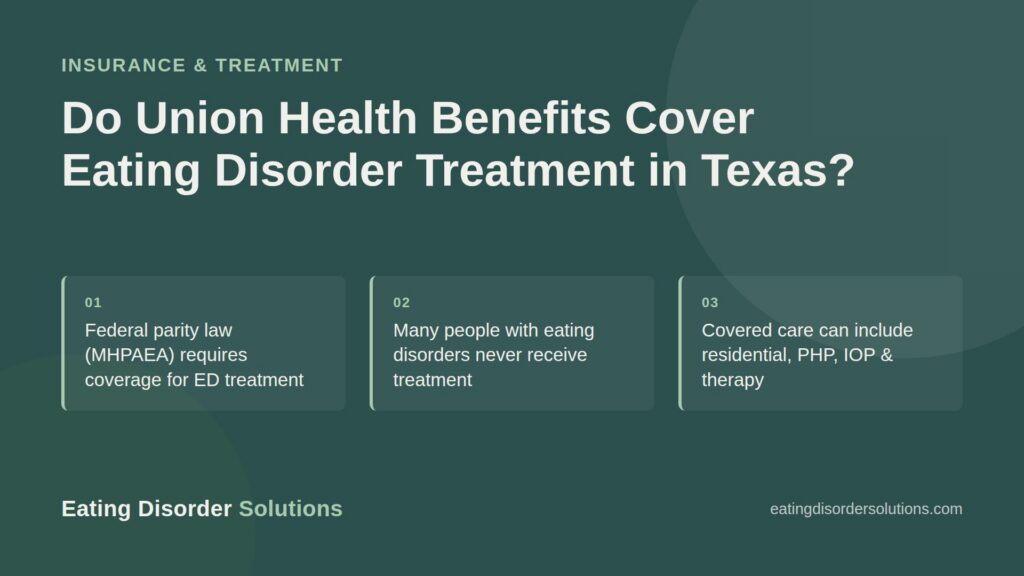
- Federal parity law (MHPAEA) requires union health plans to cover eating disorder treatment on par with comparable medical and surgical benefits.
- The majority of people with eating disorders never receive treatment, often because they don’t realize their union plan covers it.
- Covered levels of care can include residential treatment, PHP, IOP, individual therapy, nutrition counseling, and psychiatric care when the plan covers comparable benefits.
- Denials can be appealed internally and, if needed, escalated to the U.S. Department of Labor’s Employee Benefits Security Administration (EBSA).
- Eating Disorder Solutions’ admissions team verifies union health benefits at no cost, seven days a week.
If you or a family member is covered by a union health and welfare fund, you may have more eating disorder treatment benefits than you realize. Federal law requires that union health plans cover eating disorder treatment at the same level as comparable medical conditions — and in Texas, union members have access to specialized eating disorder care that can be authorized through their plan.
At Eating Disorder Solutions in Weatherford, Texas, our admissions team works with members covered by union health and welfare funds across the Dallas-Fort Worth area. This page explains what union health plans are required to cover for eating disorders, how to verify your benefits, and what to expect when you begin the admissions process.
Are Eating Disorders Covered Under Union Health Plans?
Yes. Eating disorders are classified as mental health conditions under federal law, and union health and welfare funds that provide mental health benefits are required to cover eating disorder treatment under the Mental Health Parity and Addiction Equity Act (MHPAEA).
In 2016, the 21st Century Cures Act explicitly clarified that eating disorders are mental health conditions covered by MHPAEA’s parity requirements. This means that if your union health plan covers inpatient medical treatment, it must also cover inpatient eating disorder treatment under equivalent criteria. If your plan covers nutritional counseling for medical conditions such as diabetes, it cannot exclude nutritional counseling for eating disorders. The U.S. Department of Labor’s Employee Benefits Security Administration (EBSA) has made eating disorder coverage a major enforcement priority and has stated that plans will be scrutinized for any limitations that create barriers to eating disorder treatment that do not exist for comparable medical conditions.
How Common Are Eating Disorders Among Working Adults?
Eating disorders are more prevalent among working-age adults than many people realize. According to the National Institute of Mental Health, the lifetime prevalence of binge eating disorder among U.S. adults is 2.8%, with prevalence highest in the 18–29 and 45–59 age groups. The lifetime prevalence of anorexia nervosa is 0.6% overall, with women three times more likely to be affected than men. Bulimia nervosa has a lifetime prevalence of 1.0% among adults.
Critically, the majority of people with eating disorders do not receive treatment. According to NIMH data, only 33.8% of adults with anorexia nervosa, 43.2% with bulimia nervosa, and 43.6% with binge eating disorder sought treatment specifically for their eating disorder during their lifetime. For union members, this treatment gap is often driven by a lack of awareness about what their health and welfare fund actually covers — and by the mistaken belief that eating disorder treatment is not a covered benefit.
What Levels of Care Do Union Health Plans Typically Cover?
Union health and welfare funds vary in their specific benefit structures, but plans that comply with MHPAEA are required to cover the full continuum of eating disorder treatment at levels comparable to medical and surgical benefits. Covered services may include residential treatment, partial hospitalization programs (PHP), intensive outpatient programs (IOP), individual therapy, nutrition counseling with a registered dietitian, psychiatric evaluation and medication management, and medical monitoring.
| Level of Care | Description | Typical Coverage Requirement Under MHPAEA |
|---|---|---|
| Residential Treatment (RTC) | 24/7 structured live-in care with medical, nutritional, and therapeutic support | Must be covered if plan covers comparable inpatient medical care |
| Partial Hospitalization (PHP) | Full-day program, typically 6–8 hours/day, 5 days/week | Must be covered if plan covers comparable day treatment for medical conditions |
| Intensive Outpatient (IOP) | 3–4 hours/day, 3–5 days/week structured outpatient program | Must be covered if plan covers comparable outpatient medical treatment |
| Individual Therapy | One-on-one sessions with a licensed eating disorder therapist | Must be covered if plan covers individual mental health therapy |
| Nutrition Counseling | Registered dietitian support for meal planning and nutritional rehabilitation | Must be covered if plan covers nutritional counseling for medical conditions |
| Psychiatric Services | Evaluation, medication management, and ongoing psychiatric support | Must be covered if plan covers psychiatric services for other conditions |
How Do I Verify My Union Health Benefits for Eating Disorder Treatment?
The first step is to contact your union’s health and welfare fund administrator directly. Ask specifically about your behavioral health benefits, including coverage for eating disorder treatment at residential, PHP, and IOP levels of care. Request information about your deductible, out-of-pocket maximum, co-insurance rates, and any prior authorization requirements.
Our admissions team at Eating Disorder Solutions can also verify your union health benefits on your behalf at no cost. We have experience working with a wide range of union health and welfare funds and can quickly determine what your plan covers, what documentation is required for authorization, and what your estimated out-of-pocket costs will be. This free verification service is available by phone seven days a week.
What If My Union Plan Denies Eating Disorder Treatment?
If your union health plan denies coverage for eating disorder treatment, you have the right to appeal. Under MHPAEA, a denial of eating disorder treatment at a level of care that would be covered for a comparable medical condition is potentially a parity violation. You can file an internal appeal with your plan and, if unsuccessful, request an external review by an independent organization.
The U.S. Department of Labor’s EBSA has stated that it will closely scrutinize residential treatment limitations and therapy and nutritional counseling restrictions for eating disorders. If you believe your plan’s denial constitutes a parity violation, you can file a complaint with EBSA at dol.gov/agencies/ebsa. Our admissions team can assist you in understanding your rights and can connect you with advocacy resources to support your appeal.
Eating Disorder Treatment at Eating Disorder Solutions
Eating Disorder Solutions in Weatherford, Texas serves union members and their families throughout the Dallas-Fort Worth area with a full continuum of evidence-based eating disorder treatment. Our programs include residential treatment, partial hospitalization, intensive outpatient, virtual IOP, and aftercare services, all delivered by a clinical team that specializes exclusively in eating disorders.
We treat all clinically recognized eating disorders, including anorexia nervosa, bulimia nervosa, binge eating disorder, ARFID, OSFED, and co-occurring conditions. Our evidence-based treatment modalities include Cognitive Behavioral Therapy (CBT-E), Dialectical Behavior Therapy (DBT), Acceptance and Commitment Therapy (ACT), Family-Based Treatment (FBT), trauma-informed care, nutrition counseling with registered dietitians, and psychiatric evaluation and medication management. Our admissions team handles the insurance verification and prior authorization process on your behalf, so you can focus on taking the first step toward recovery.
Frequently Asked Questions
Are union health plans required to cover eating disorder treatment?
Yes. Under the Mental Health Parity and Addiction Equity Act (MHPAEA) and the 21st Century Cures Act, union health plans that provide mental health benefits must cover eating disorder treatment at the same level as comparable medical conditions. This includes residential treatment, PHP, IOP, therapy, and nutritional counseling.
How do I find out what my union health plan covers for eating disorders?
Contact your union’s health and welfare fund administrator directly and ask about your behavioral health benefits. You can also call Eating Disorder Solutions at (844) 918-3917 and our admissions team will verify your benefits on your behalf at no cost.
Can I appeal if my union health plan denies eating disorder treatment?
Yes. You have the right to file an internal appeal with your plan and, if unsuccessful, request an external review. If you believe the denial violates MHPAEA parity requirements, you can also file a complaint with the U.S. Department of Labor’s Employee Benefits Security Administration.
Does my union health plan cover residential eating disorder treatment in Texas?
If your union health plan covers inpatient medical treatment, it is generally required under MHPAEA to cover residential eating disorder treatment under equivalent criteria. Our admissions team can verify your specific benefits and assist with the prior authorization process.
If you or someone you love is struggling with an eating disorder, do not wait for symptoms to worsen. Early intervention leads to significantly better outcomes. Eating Disorder Solutions is here to help — call us at (844) 918-3917 or visit eatingdisordersolutions.com to verify your union health benefits and learn more about our programs in Weatherford, Texas.
References
- [1] National Institute of Mental Health (NIMH). Eating Disorders Statistics. https://www.nimh.nih.gov/health/statistics/eating-disorders
- [2] U.S. Department of Labor, Employee Benefits Security Administration. Mental Health Parity Covers Treatment of Eating Disorders. https://blog.dol.gov/2024/02/29/breaking-the-silence-recognizing-mental-health-benefits-in-the-battle-against-eating-disorders
- [3] U.S. Department of Labor. Mental Health Parity and Addiction Equity Act (MHPAEA). https://www.dol.gov/general/topic/health-plans/mhpaea
- [4] American Psychiatric Association. Diagnostic and Statistical Manual of Mental Disorders, 5th Edition (DSM-5). 2013. https://www.psychiatry.org/psychiatrists/practice/dsm
Support and Crisis Resources
If you or someone you love is struggling, support is available. If you are in crisis or need immediate help, call or text 988 to reach the 988 Suicide and Crisis Lifeline, a free, confidential service available 24/7.
This article is general education and is not medical advice. It does not establish a clinician-patient relationship and is not a substitute for an individual assessment by a qualified eating disorder treatment professional.
Related Reading
References
NEDA — Insurance Issues for Eating Disorder Treatment (https://www.nationaleatingdisorders.org/insurance-legal-issues/)
SAMHSA — Know Your Rights: Parity for Mental Health and Substance Use Disorder Benefits (https://store.samhsa.gov/product/know-your-rights-parity-for-mental-health-substance-use-disorder-benefits/pep21-05-00-003)