Key Takeaways
Night eating syndrome (NES) is a recognized eating disorder marked by eating most of one’s food in the evening and overnight, low morning appetite, and disrupted sleep. It is a clinically defined condition, not a willpower problem, and it responds well to specialized, individualized treatment.
- NES involves a delayed pattern of eating, with little appetite in the morning and a strong drive to eat at night, often alongside insomnia.
- It is recognized in the DSM-5 as a form of Other Specified Feeding or Eating Disorder (OSFED) and frequently co-occurs with depression, anxiety, and disrupted sleep.
- NES is distinct from binge eating disorder and from sleep-related eating disorder, in which eating happens during a sleepwalking state.
- Evidence-based care combines cognitive and behavioral therapies, nutrition support, and, when appropriate, psychiatric care to address mood, sleep, and eating together.
- Recovery is achievable with the right support, and reaching out to a qualified professional is an important first step.
If you find yourself unable to sleep without eating, consuming most of your food after dinner, or waking in the night with an overwhelming urge to eat, you may be experiencing night eating syndrome, a recognized eating disorder that affects far more people than most realize. Night eating syndrome (NES) is not a lack of willpower. It is a clinically defined condition with real neurological, psychological, and behavioral roots, and it is treatable with the right support.
What Is Night Eating Syndrome?
Night eating syndrome is an eating disorder characterized by a persistent pattern of excessive food consumption in the evening and overnight hours. It was first described in 1955 by psychiatrist Albert Stunkard, who identified three hallmark features: morning anorexia (no appetite in the morning), evening hyperphagia (consuming a disproportionate share of daily food intake after dinner), and insomnia. Today, the Diagnostic and Statistical Manual of Mental Disorders, Fifth Edition (DSM-5) classifies NES as a subtype of Other Specified Feeding or Eating Disorder (OSFED), placing it within the formal spectrum of eating disorder diagnoses.
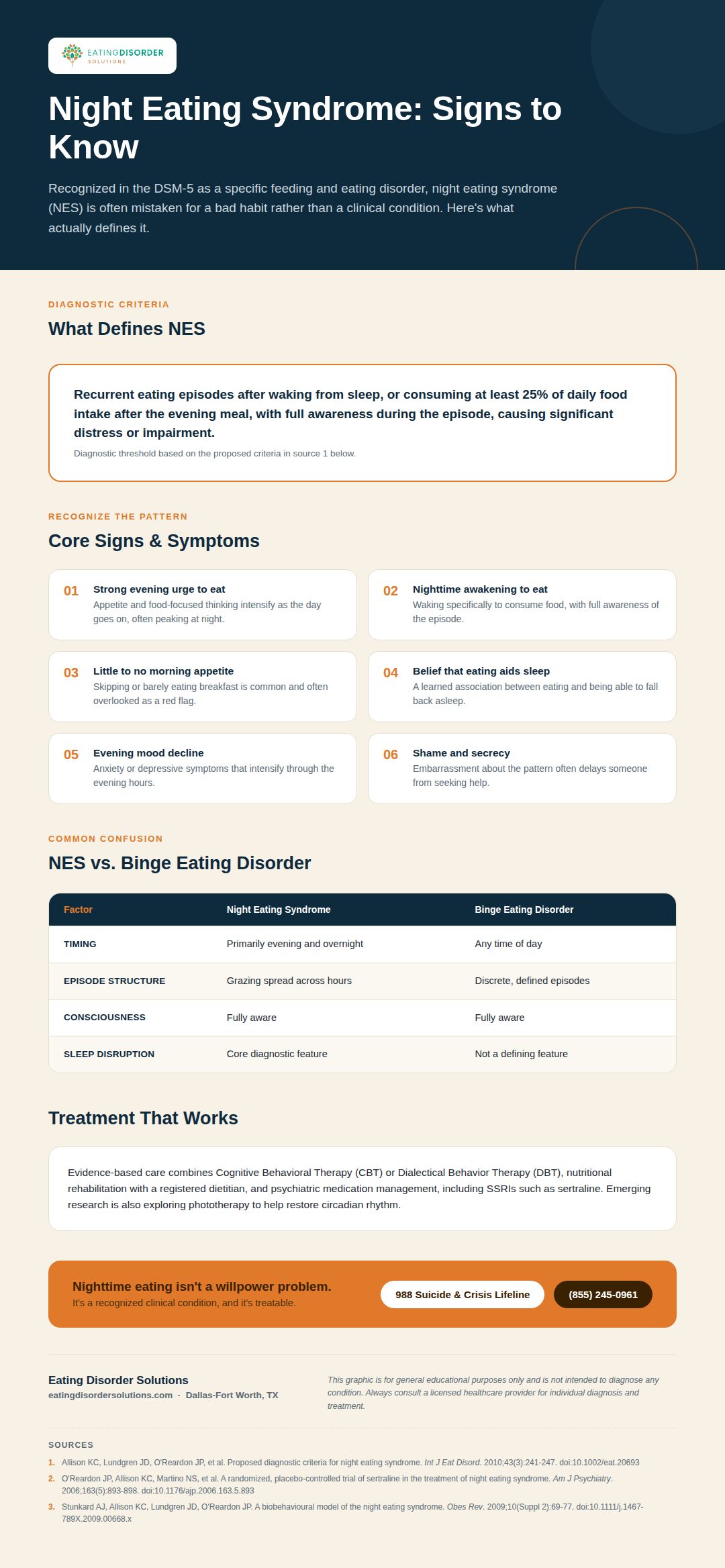
To meet the DSM-5 criteria for NES, a person must experience recurrent episodes of eating after awakening from sleep or consuming at least 25 percent of their daily food intake after the evening meal. Critically, the person must be fully conscious and aware during these episodes. This distinguishes NES from sleep-related eating disorder (SRED), in which eating occurs during a twilight or sleepwalking state. Symptoms must also cause significant distress or functional impairment and cannot be better explained by another medical condition, medication effects, or cultural norms (Allison et al., 2010).
How Common Is Night Eating Syndrome?
Night eating syndrome is more prevalent than its low public profile suggests, yet it remains widely underdiagnosed. Population research indicates it affects a small but meaningful share of adults, and rates are notably higher among people seeking care for weight-related concerns, people with type 2 diabetes, and those living with another eating disorder (Stunkard et al., 2009). Many people dismiss their symptoms as poor sleep hygiene or a lack of discipline and never receive appropriate care.
How Is Night Eating Syndrome Different from Binge Eating Disorder?
Night eating syndrome and binge eating disorder (BED) share some surface-level similarities, both involve eating beyond physical hunger and both carry significant emotional weight, but they are clinically distinct conditions that require different treatment approaches. Understanding this distinction matters because it shapes the treatment plan. A person with NES benefits from interventions that target circadian rhythm regulation and evening emotional dysregulation, while BED treatment focuses more heavily on binge episode interruption and impulse control.
| Diagnostic Feature | Night Eating Syndrome | Binge Eating Disorder |
| Timing of eating | Primarily evening and overnight | Any time of day |
| Episode structure | Grazing across multiple hours | Discrete, defined binge episodes |
| Amount per episode | Moderate; spread over time | Large amounts in a short period |
| Loss of control | Mild to moderate | Pronounced and distressing |
| Morning appetite | Absent or very low | Typically normal |
| Compensatory behaviors | None | None |
| DSM-5 classification | OSFED subtype | Independent diagnosis |
| Sleep disruption | Core feature | Not a defining feature |
What Are the Signs and Symptoms of Night Eating Syndrome?
Night eating syndrome presents across behavioral, psychological, and physical dimensions. Recognizing the full symptom picture is essential for early identification and intervention.
Behavioral symptoms include a strong urge to eat between dinner and bedtime, waking from sleep to eat, consuming more than one-quarter of daily food intake after the evening meal, and having no appetite until late afternoon. The pattern is cyclical: morning restriction leads to evening overconsumption, which disrupts sleep, which increases stress and emotional eating.
Psychological symptoms include evening worsening of mood, anxiety and depression intensifying as the day progresses, and a conditioned belief that eating is necessary to sleep. Shame, guilt, and secrecy around nighttime eating are common and frequently prevent people from seeking help.
Physical symptoms may include disrupted sleep architecture, fatigue, gastrointestinal discomfort from late eating, and, in cases with co-occurring metabolic conditions, worsening blood sugar control.
What Causes Night Eating Syndrome?
Night eating syndrome does not have a single cause. Research points to a convergence of biological, psychological, and behavioral factors that interact to produce and sustain the condition.
Circadian rhythm disruption is one of the most studied biological contributors. Individuals with NES show alterations in their sleep-wake cycle and in the internal systems governing eating behavior and metabolism (Stunkard et al., 2009). When the body’s internal clock is dysregulated, hunger hormones like ghrelin and leptin may shift their peak activity into nighttime hours, creating genuine physiological hunger at times when the body should be at rest.
Mental health conditions play a central role. Depression and anxiety are strongly associated with NES, and the relationship is bidirectional: mood disorders can trigger nocturnal eating patterns, and the shame and sleep disruption caused by NES can deepen both. Research also links eating the majority of one’s food in the evening or overnight with higher anxiety and depression scores. For many people, eating at night functions as a coping mechanism for stress or emotional pain that intensifies after the structure of the day dissolves, a learned association that becomes deeply ingrained over time. Substance use can also contribute, as certain substances alter brain chemistry in ways that increase nocturnal food cravings, particularly during periods of cessation.
How Is Night Eating Syndrome Treated?
Night eating syndrome is treatable, and recovery is achievable with a comprehensive, individualized approach. The most comprehensive treatment plans address the behavioral, psychological, and biological dimensions of the condition simultaneously.
Cognitive Behavioral Therapy (CBT) is the most evidence-supported psychotherapeutic intervention for NES. CBT helps individuals identify the thought patterns and emotional triggers that drive nighttime eating, restructure the conditioned associations between food and sleep or stress relief, and build healthier coping strategies for evening hours.
Dialectical Behavior Therapy (DBT) is particularly valuable when emotional dysregulation is a primary driver of nighttime eating. DBT skills, including distress tolerance, mindfulness, and emotion regulation, equip individuals to manage the evening emotional escalation that often precedes nocturnal eating episodes.
Nutritional rehabilitation with a registered dietitian is essential. A dietitian works to redistribute food intake more evenly across the day, reducing the physiological drive toward evening overconsumption. Structured meal planning and nutritional education are core components of this work.
Psychiatric support and medication management may include SSRIs, particularly sertraline (O’Reardon et al., 2006), which has shown efficacy in reducing NES symptoms in clinical trials by addressing the underlying mood dysregulation and potentially modulating the serotonin pathways involved in appetite and sleep.
Phototherapy (light therapy) is an emerging adjunctive treatment that targets the circadian rhythm component of NES, helping to reset the internal clock and normalize hunger timing.
At Eating Disorder Solutions in Texas, NES is treated within a fully integrated, multidisciplinary framework. Depending on the severity of symptoms and co-occurring conditions, individuals may be best served by Residential Treatment, Partial Hospitalization (PHP), or Intensive Outpatient (IOP) programming. Each level of care includes individualized therapy, dietitian support, psychiatric services, and evidence-based group programming, all designed to address the full complexity of NES and any co-occurring mental health conditions.
Frequently Asked Questions
Is night eating syndrome a real eating disorder?
Yes. Night eating syndrome is a clinically recognized eating disorder classified under OSFED in the DSM-5. It causes significant psychological distress and functional impairment and requires professional treatment, it is not a willpower problem.
Can night eating syndrome go away on its own?
Without treatment, NES tends to persist and often worsens over time, particularly when co-occurring depression or anxiety goes unaddressed. Professional treatment significantly improves outcomes.
How is night eating syndrome diagnosed?
Diagnosis involves a clinical interview, validated screening tools such as the Night Eating Diagnostic Questionnaire (NEDQ), and a review of DSM-5 criteria by a qualified mental health professional.
What is the difference between night eating syndrome and sleep-related eating disorder?
The key distinction is awareness. People with NES are fully conscious and remember their nighttime eating. People with SRED eat during a sleepwalking state with no memory of the episode. SRED is a sleep disorder; NES is an eating disorder.
If you or someone you love is struggling with night eating syndrome or any other eating disorder, compassionate, specialized care is available. Eating Disorder Solutions offers evidence-based treatment at multiple levels of care in Texas. Call us today at 855-245-0961 or visit eatingdisordersolutions.com to speak with our admissions team.
References
- Allison KC, Lundgren JD, O’Reardon JP, et al. Proposed diagnostic criteria for night eating syndrome. Int J Eat Disord. 2010;43(3):241-247. doi:10.1002/eat.20693
- O’Reardon JP, Allison KC, Martino NS, et al. A randomized, placebo-controlled trial of sertraline in the treatment of night eating syndrome. Am J Psychiatry. 2006;163(5):893-898. doi:10.1176/ajp.2006.163.5.893
- Stunkard AJ, Allison KC, Lundgren JD, O’Reardon JP. A biobehavioural model of the night eating syndrome. Obes Rev. 2009;10(Suppl 2):69-77. doi:10.1111/j.1467-789X.2009.00668.x
Support and Crisis Resources
If you or someone you love is struggling, support is available. If you are in crisis or need immediate help, call or text 988 to reach the 988 Suicide and Crisis Lifeline, a free, confidential service available 24/7.
Related Reading
- FBT Explained: How Family-Based Treatment Supports Eating Disorder Recovery
- Decoding Treatment Plans: What to Expect for Eating Disorder Recovery
For more educational articles and resources on eating disorder recovery, visit our Educational Resources page.