Choosing an eating disorder treatment center is one of the most important decisions a person or family will make in the recovery process, and asking the right questions upfront is the clearest way to separate appropriate, individualized, transparent care from a program that simply looks good on a website.
Key Takeaways
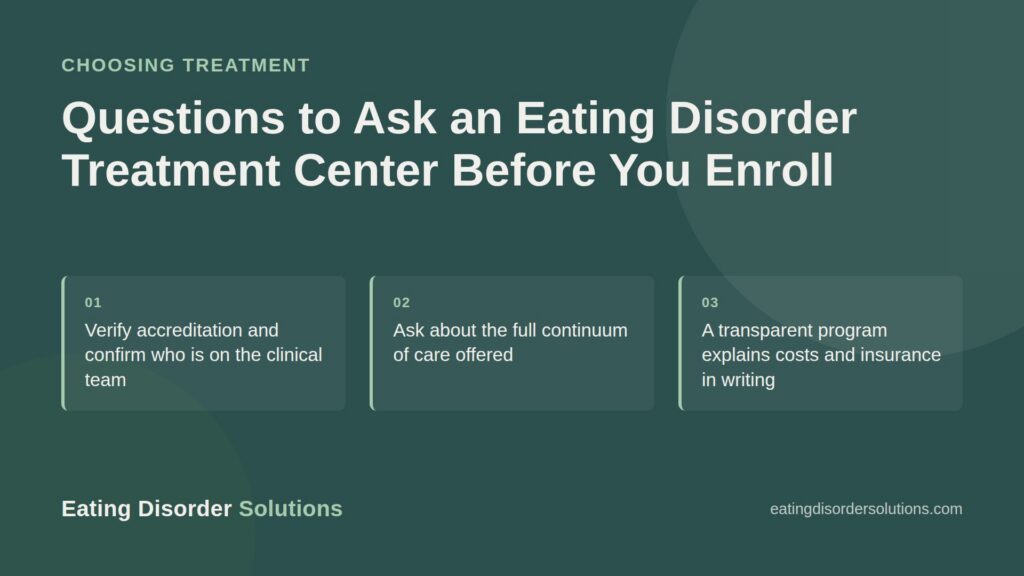
- Verify accreditation (Joint Commission or CARF) and confirm who is actually on the clinical team, not just who’s listed on the website.
- A strong program offers a full continuum of care (residential, PHP, IOP, outpatient) and a clear plan for moving between levels as needs change.
- Treatment should be individualized, not a fixed curriculum applied to every patient.
- Ask how co-occurring conditions like anxiety, depression, OCD, and trauma are addressed alongside the eating disorder, not after it.
- Medical monitoring, dietitian-led nutrition therapy, and documented aftercare planning are markers worth confirming directly, not assuming.
- Aftercare planning should start well before discharge, with real connections to outpatient providers already in place.
- A transparent program should verify insurance and explain costs in writing before you commit to anything.
Below are the questions worth asking any eating disorder treatment center before you enroll, along with what a thorough answer should sound like and what a vague one might be hiding.
Essential Questions to Ask an Eating Disorder Treatment Center
1. Are you accredited, and who is actually on the clinical team?
Accreditation from an organization like the Joint Commission or CARF means a facility has been independently reviewed against clinical and safety standards. Ask to see the accreditation directly rather than taking a logo on the website at face value. Then ask specifically who will be treating you or your loved one day to day: licensed therapists, a psychiatrist or psychiatric nurse practitioner, and a registered dietitian who specializes in eating disorders. The National Institute of Mental Health describes eating disorders as serious conditions associated with a higher risk of co-occurring mental health conditions, which is part of why the makeup of the clinical team matters as much as the facility itself. A program that can’t clearly name these roles, or that leans heavily on unlicensed “coaches” or “mentors” for clinical work, is worth a closer look before you commit.
2. What levels of care do you offer, and how do you move between them?
Eating disorder recovery often involves a personalized recovery journey, and it frequently isn’t linear. A strong program offers a continuum: residential care for those who need 24-hour support, partial hospitalization (PHP) for structured full-day treatment, intensive outpatient (IOP) for a lighter but still regular schedule, and standard outpatient support for ongoing maintenance. Ask how decisions about level of care are made, who is involved in that conversation, and what happens if a step up or a step down in care becomes necessary mid-treatment. A program that only offers one level of care should be able to explain clearly where a patient goes next if their needs change.
3. How is my treatment plan actually personalized?
Eating disorders show up differently from person to person, shaped by different histories, triggers, and co-occurring conditions, so the plan built for you should reflect those individual differences rather than follow a generic template. Ask how the center builds an individualized plan: what assessments they use at intake, how often the plan is reviewed and adjusted, and how your specific diagnosis, history, and goals shape your day-to-day care. Ask for an example of how two patients with the same diagnosis might receive different treatment plans. Be wary of any program that describes a single fixed curriculum or schedule applied to every patient regardless of their circumstances.
4. How do you treat co-occurring conditions like anxiety, depression, or trauma?
Eating disorders frequently occur alongside anxiety, depression, OCD, or a trauma history. Ask whether the clinical team is equipped to treat these conditions concurrently, not as an afterthought once the eating disorder is “handled.” MedlinePlus, a service of the National Institutes of Health, describes treatment as typically involving a multidisciplinary team of medical, nutritional, and mental health professionals working together on a plan tailored to the individual. Ask how often that team actually meets to coordinate care, and whether one point person is responsible for keeping the pieces connected.
5. What does medical monitoring look like?
Eating disorders can carry serious medical risk, so ask how closely the program monitors your physical health throughout treatment, starting with whether there’s a physician on staff or on call, how vitals and labs are monitored and how often, and how the program handles medical stabilization if someone is underweight or medically compromised at admission. Ask what happens if a medical concern arises mid-treatment: does the program have the capability to manage it on site, or is there a clear protocol for transferring to a higher level of medical care. A program should be able to walk through this without hesitation or vague reassurance.
6. What role does family play in treatment?
Family involvement, when appropriate, is a component many programs build directly into treatment, particularly for adolescents and young adults. Ask whether the center offers family therapy sessions, family education about the eating disorder itself, or structured ways for loved ones to stay involved during treatment and prepare for their role after discharge. If family involvement isn’t a fit for your situation, ask what alternative support structures the program offers instead, such as connecting patients with peer support or a support network outside the family.
7. How do you approach meals and nutrition therapy?
This is one of the most important questions to ask, and one many people forget. Ask how meals are structured day to day, whether a registered dietitian leads nutrition therapy and how often patients meet with them, how the program supports patients through the anxiety that often comes with eating, and what supervised versus independent meals look like as treatment progresses. Ask whether there’s a plan for building a sustainable relationship with food that extends beyond the treatment setting, since meal support in a controlled environment is different from managing meals at home.
8. What’s your staff-to-patient ratio?
Ask how staffing levels affect supervision, individualized attention, and the program’s ability to respond quickly if a crisis arises. Ask directly what the ratio is during meals, therapy groups, and overnight hours, since it can vary significantly across the day, and ask how many patients each primary therapist carries on their caseload. A specific number gives you more information to compare across programs than a vague reassurance does.
9. What does aftercare and discharge planning look like?
Recovery doesn’t end at discharge. Ask when aftercare planning starts (it should begin well before the last day of treatment, not the day of), what kind of step-down support is arranged, and how the program helps connect patients to outpatient therapists, dietitians, and support groups in their home area. Ask whether the program follows up after discharge, and if so, for how long and in what form. A written discharge plan that names specific providers is a stronger sign than a general promise to “provide referrals.”
10. What will this actually cost, and do you accept my insurance?
Ask for a clear answer on insurance verification, what’s covered versus out-of-pocket, and whether there are any fees that aren’t obvious upfront, such as assessment fees or charges for services outside the core program. A trustworthy program will verify your insurance benefits before you commit and explain the numbers in plain language, in writing, rather than leaving you to piece it together from a phone call.
Red Flags vs. Green Flags
The National Institute of Mental Health outlines what to look for when evaluating eating disorder treatment options, and that same idea of comparing evidence-based, individualized care applies directly to the conversations you have with a facility before enrolling.
Green flags: clear, specific answers to every question above; accreditation you can verify independently; a named clinical team with real, checkable credentials; a dietitian-led nutrition approach; a documented discharge and aftercare process; and a willingness to put insurance and cost details in writing before you commit.
- They answer questions about staffing ratios and clinical credentials with specifics, not general reassurance.
- They give you time to think it over rather than pushing same-day enrollment.
- They can describe what happens if your needs change mid-treatment.
Red flags: vague or deflected answers; pressure to enroll immediately; no clear medical oversight; a one-size-fits-all program description; or an unwillingness to put insurance and cost information in writing.
- They can’t name who is actually on the clinical team or what licenses they hold.
- They rely on testimonials or marketing language in place of concrete answers.
- They’re unclear about what happens after discharge or dismiss the question entirely.
Frequently Asked Questions
How many questions should I ask before choosing a treatment center?
There’s no fixed number, but the 10 questions above cover the core areas worth understanding before enrolling: clinical credentials, levels of care, personalization, co-occurring conditions, medical monitoring, family involvement, nutrition therapy, staffing, aftercare, and cost. A program that can answer all of them clearly gives you a much stronger basis for deciding than one that answers only a few.
What if the center can’t answer a question right away?
A brief pause to check specifics, like exact staff ratios or current insurance panels, is normal and not necessarily a red flag on its own. What matters more is whether they follow up promptly with a real, specific answer, versus deflecting or repeating a vague, reassurance-only response.
Should I ask these questions over the phone or in person?
Either works. Most centers are used to fielding these questions during an initial phone consultation, and a written or emailed answer can also be useful to have on record for comparison against other programs you’re considering.
Is it okay to ask about staff credentials directly?
Yes. Asking who will be providing care, and confirming their licenses and specialties, is a normal and expected part of evaluating any treatment center. A program that treats this question as intrusive is itself worth noting.
What’s the difference between residential and PHP/IOP levels of care?
Residential treatment provides 24-hour care in a live-in setting. PHP (partial hospitalization) typically involves full-day treatment several days a week while the person returns home or to a residence in the evening. IOP (intensive outpatient) involves fewer hours per week and more independence, usually as a step-down from PHP or residential care as someone progresses in recovery.
Ask the Right Questions Before You Choose
The right eating disorder treatment center will welcome these questions, not avoid them. If you’re evaluating options for yourself or someone you love, take this list into every call and write down what you hear, since it’s easier to compare answers side by side than to rely on memory. A transparent program should be able to give clear, specific answers every time.
Related Reading
Resources
- National Institute of Mental Health: Eating Disorders
- NIMH: Eating Disorders — What You Need to Know
- MedlinePlus (NIH): Eating Disorders
Citations
- National Institute of Mental Health. “Eating Disorders.” nimh.nih.gov.
- National Institute of Mental Health. “Eating Disorders: What You Need to Know.” nimh.nih.gov.
- MedlinePlus, National Library of Medicine (NIH). “Eating Disorders.” medlineplus.gov.