Key Takeaways
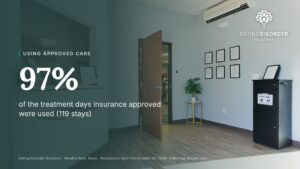
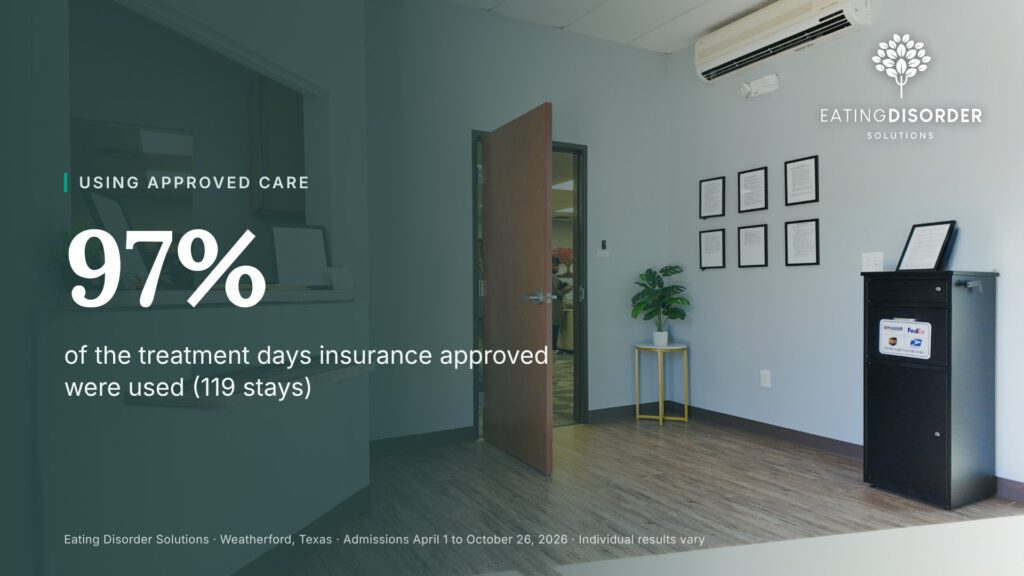
- Clients used 97% of the treatment days their insurance approved, across 119 stays with approvals on file.
- By payer group, approved days used ranged from 96% to 99%.
- Of 127 stays, 76 used residential care, 30 used partial hospitalization and 38 used intensive outpatient care.
- A single stay can include more than one level of care, so the counts add up to more than 127.
- This is an internal review of program records, not a controlled study. Individual results vary.
Why Approved Days Matter to Families
When insurance approves eating disorder care, it is fair to ask a simple question: do clients actually stay for the care they were approved to receive?
An authorization records the treatment days approved by a plan. This review compares approved days with recorded days of care. It does not look at why any stay ended. Our article on medical necessity for eating disorder treatment explains how those approvals are decided in the first place.
How Approvals Work, in Brief
This review does not describe any insurer’s authorization process. At Eating Disorder Solutions, the admissions team acts as a liaison with your insurance company and keeps you updated, as described on our admissions page. This review uses EDS utilization review records, which track the treatment days approved at each level of care and the days received.
For each stay, we compared the days approved at each level of care with the days the client actually received. The share of approved days used tells you, in one number, how closely actual care matched approved care.
What the Data Shows
Across 119 stays with insurance approvals on file, clients used 97% of approved treatment days. That number held up across payer groups:
| Payer | Stays | Approved days used |
|---|---|---|
| Ambetter | 14 | 98% |
| Blue Cross Blue Shield | 70 | 96% |
| UnitedHealthcare | 20 | 99% |
| All other payers | 23 | 96% |
The stay counts in the table add up to all 127 stays. The approved-days percentages, including the 97% overall, use only the stays that had approvals on file (119 in total). The source data does not break out how many of each payer group’s stays had approvals on file. When a client moved between levels of care inside our program, those transfers were counted as one stay, so 15 records were merged into others.
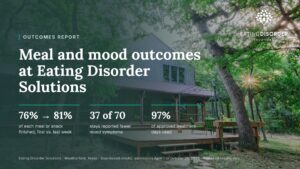
This finding is one part of a wider release that also covers meal completion and mood and energy surveys. You can see the full picture in our 2026 meal and mood outcomes overview.
Levels of Care Clients Used
Across the 127 stays admitted from April 1 through October 26, 2026, records show use of residential, PHP and IOP care. A stay could use more than one level, so these counts overlap.
- Residential: 76 stays (60%). Residential care at The Ranch in Weatherford provides round-the-clock support. Learn more about our residential program.
- Partial hospitalization (PHP): 30 stays (24%). PHP offers full days of structured treatment while clients sleep at home or nearby.
- Intensive outpatient (IOP): 38 stays (30%). IOP runs fewer hours per week, in person at our Weatherford outpatient center or through virtual IOP.
Of the 127 stays, 27 were still in treatment when the data was pulled. If you are weighing the outpatient options, our article on the difference between PHP and IOP explains how they compare.
How to Read These Numbers
- Used days are not outcomes. This percentage describes overall use of authorized treatment days. It does not measure engagement, clinical outcomes or whether any one client completed a recommended course of care.
- Small groups move more. A payer group with 14 stays can shift noticeably from one review period to the next.
- Open stays. Some stays were still in treatment, so their approvals and days used may change.
- No comparison group. This review describes our own records. It does not compare clients to other programs or to people who were not in treatment.
These figures come from Eating Disorder Solutions program records. This is an internal review of program records, not a controlled study, and it has not been independently audited. Individual results vary. This data describes how clients used approved care. It is not a statement about which insurance plans any program is in network with.
Questions to Ask Any Program About Insurance
- Will the program check my benefits before admission and explain what is likely to be covered?
- Who talks with my insurance company during treatment, and how will I hear about approvals or denials?
- What happens if insurance stops approving days before the team thinks I am ready to step down?
- How often do clients stay for the full care they were approved to receive?
For a broader checklist, see our guide to questions to ask before you enroll.
When to Reach Out for Help
If you are worried about yourself or someone you love, you do not need to have the insurance questions figured out before you call. Eating disorders are serious, and the NIMH notes that they can be treated successfully (NIMH). The NIMH also describes treatment plans that combine psychotherapy, medical care and monitoring, and nutritional counseling (NIMH). An assessment is a good first step toward finding the right mix.
Talking With a Professional
At Eating Disorder Solutions, adults complete a clinical assessment before admission, and our admissions team verifies insurance benefits at no cost. Our admissions page explains the process.
FAQ
What does it mean to use 97% of approved treatment days?
Across 119 stays with insurance approvals on file, clients received 97% of the treatment days their insurance had approved. This percentage describes overall use of authorized treatment days. It does not measure engagement, clinical outcomes or whether any one client completed a recommended course of care.
Did the results differ by insurance company?
Only slightly. Approved days used ranged from 96% to 99% across the payer groups in this review: Ambetter, Blue Cross Blue Shield, UnitedHealthcare and all other payers combined.
Why do the level-of-care counts add up to more than 127?
Some clients use more than one level of care during a single stay, for example residential followed by PHP or IOP. Each level a stay used is counted once.
Does this mean every plan covers eating disorder treatment at Eating Disorder Solutions?
No. This review describes how clients used care that was already approved. Coverage depends on your plan. Our admissions team can check your benefits before admission.
Is this a research study?
No. It is an internal review of utilization review records, not a controlled study, and it has not been independently audited. Individual results vary.
References
- National Institute of Mental Health. “Eating Disorders: What You Need to Know.” Accessed November 2026. www.nimh.nih.gov
- National Institute of Mental Health. “Eating Disorders.” Accessed November 2026. www.nimh.nih.gov
Related Reading
- Weatherford Residential Eating Disorder Treatment
- Meal and Mood Outcomes at Eating Disorder Solutions: What Our 2026 Data Shows
- What Is Medical Necessity for Eating Disorder Treatment?
- What Is the Difference Between PHP and IOP for Eating Disorders?
Resources
- National Alliance for Eating Disorders Helpline
- 988 Lifeline: call or text 988, any time, during an emotional crisis.
- In a medical emergency, call 911.
This article is general education and is not medical advice.
If you have questions about treatment or insurance coverage, our admissions team can help in a confidential conversation. Call (855) 245-0961 or reach out through our contact page.