
Key Takeaways
Partial Hospitalization Programs (PHP) and Intensive Outpatient Programs (IOP) are two structured, non-residential levels of eating disorder care. PHP offers more hours of support each week, while IOP is lighter and fits around work, school, or home life. The right choice depends on a person’s medical and psychological needs and is decided with a clinical team.
- PHP and IOP are both structured levels of care that do not require an overnight stay.
- PHP is more intensive, usually more days and hours per week, and often serves as a step down from residential or inpatient care.
- IOP is less time-intensive and supports people balancing recovery with daily responsibilities.
- Many treatment plans move between PHP and IOP as needs change, guided by a clinical team rather than a fixed timeline.
Introduction
Eating disorder affects millions of individuals with eating disorders and their families each year, often requiring specialized treatment beyond basic outpatient care. When considering treatment options, understanding the difference between a Partial Hospitalization Program (PHP) and an Intensive Outpatient Program (IOP) is essential to choosing the right level of support and care for eating disorders.
Both PHP and IOP represent different levels of care for eating disorder treatment, reflecting varied intensity, structure, and medical monitoring to meet the needs of patients at different stages of eating disorder recovery. These treatment programs focus on addressing eating behaviors and symptoms through intensive outpatient treatment or partial day treatment depending on individual circumstances.
At Eating Disorder Solutions (EDS), we acknowledge that such choices can feel overwhelming. This article aims to provide a clear understanding of PHP vs IOP, guiding you or your loved one towards the most appropriate eating disorder treatment program for lasting recovery.
Understanding Partial Hospitalization Programs (PHP) for Eating Disorders
Clinical guidance describes PHP and IOP as part of a continuum, or stepped, model of eating disorder care. The American Psychiatric Association practice guideline (Crone and colleagues, 2023) and a review of intensive treatment options by Herpertz-Dahlmann (2021) outline how day-based programs let people step up or step down in intensity as their needs change.
A Partial Hospitalization Program (PHP) is an intensive treatment program designed as a higher level of care for individuals who require more structured eating disorder care but do not need inpatient treatment or residential care. This PHP program provides intensive outpatient eating disorder treatment, with comprehensive medical monitoring and frequent therapy sessions that often run five days a week.
PHP typically involves several hours of care during the day, including individual therapy, group therapy, family-based treatment, nutritional counseling, meal support, and ongoing physical health assessments. This structured treatment is delivered in a specialized treatment center or treatment program environment while allowing patients to live at home each night.
According to the Substance Abuse and Mental Health Services Administration (SAMHSA), a PHP eating disorder treatment program is a crucial intensive level of care that bridges inpatient care and outpatient care, offering the benefits of therapeutic supervision and medical monitoring without the need for 24-hour residential care (SAMHSA).
What Is an Intensive Outpatient Program (IOP) for Eating Disorders?
An Intensive Outpatient Program (IOP) is a less intensive treatment option compared to a PHP program for eating disorders but is an essential part of a comprehensive treatment plan. It provides structured therapy sessions several times per week, typically 3 to 5 days, with fewer hours per day compared to PHP, generally 3 to 4 hours, offering a balance between effective treatment and outpatient freedom.
IOP focuses on continuing recovery for individuals with eating disorders who are medically stable but still require regular psychological support and care for eating disorders outside the inpatient or residential treatment settings. Treatment for eating disorders in an IOP includes individual therapy, group therapy, nutritional education, and meal support, helping patients reinforce healthy eating behaviors while living at home or independently.
The National Institute of Mental Health (NIMH) notes that IOPs provide important intensive outpatient treatment with flexible scheduling suited for those transitioning from PHP or residential treatment or for those beginning outpatient care for milder eating disorder symptoms (NIMH).
Partial Hospitalization vs Intensive Outpatient for Eating Disorder Treatment: Key Differences
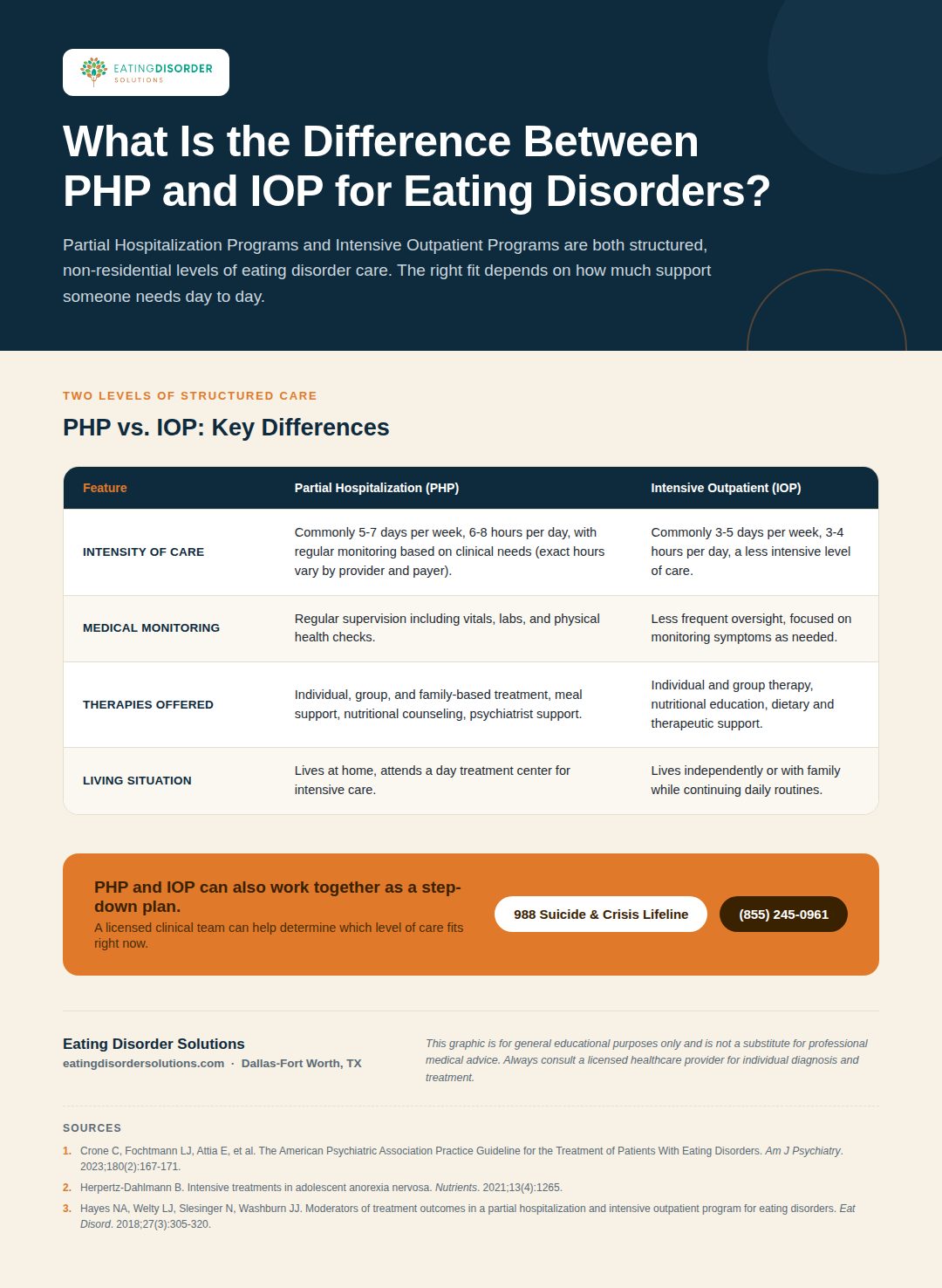
| Feature | Partial Hospitalization Program (PHP) | Intensive Outpatient Program (IOP) |
| Intensity of Care | High intensity, typically 5-7 days per week, 6-8 hours per day with intensive level of care and daily medical monitoring | Moderate intensity, 3-5 days per week, 3-4 hours per day offering less intensive outpatient eating disorder care |
| Medical Monitoring | Regular medical supervision including vitals, labs, and physical health monitoring as part of comprehensive treatment | Less frequent medical oversight, focused on monitoring symptoms and adjustments as needed |
| Therapies Offered | Individual therapy, group therapy, family-based treatment, meal support, nutritional counseling, and psychiatrist support | Individual and group therapy, nutritional education, dietary support, and therapeutic counseling |
| Living Situation | Patients live at home or in a support environment but undergo intensive treatment at a day treatment center | Patients live independently or with family and attend therapy sessions part-time as part of outpatient treatment |
| Level of Structure | Highly structured treatment five days a week with scheduled sessions and treatment activities | Structured but more flexible, accommodating personal schedules and outpatient commitments |
| Ideal Candidates | Individuals needing a higher level of care but medically stable enough to avoid inpatient or residential treatment | Medically stable individuals requiring ongoing support or a step-down after PHP or residential care |
| Role in Continuum of Care | Often a step down from residential treatment or a step up from basic outpatient care, offering intensive outpatient treatment | Commonly a step down from PHP or residential treatment or an entry-level outpatient treatment option for eating disorder symptoms |
Understanding the differences between PHP and IOP helps determine the right level of care based on medical needs, severity of eating disorder symptoms, and lifestyle factors like work or school. The comparison below outlines aspects key to choosing the right treatment program for each individual within the continuum of eating disorder treatment:
When to Choose PHP or IOP for Eating Disorder Treatment?
Choosing between PHP vs IOP for eating disorders depends on a thorough eating disorder assessment conducted by a specialized treatment team, which includes psychiatrists, therapists, and medical professionals. Such evaluation considers the severity of eating disorder symptoms like binge eating disorder, medical stability, physical health, and past treatment history.
- Consider PHP if: You need a higher level of care with intensive treatment five days a week, require regular medical monitoring for eating disorder behaviors or physical health concerns, or experience significant disruptions in eating behaviors needing a PHP eating disorder treatment program.
- Consider IOP if: You are medically stable, symptoms are manageable with outpatient care, and you seek a structured outpatient treatment option suitable for balancing work or school, or as a critical step-down phase from PHP or residential treatment.
Your treatment team at EDS will work with you to identify the right level of support and develop a comprehensive treatment plan tailored to your unique recovery needs, enabling you to recover from eating disorders effectively.
Benefits of Combining PHP and IOP in an Eating Disorder Treatment Plan
An effective treatment plan for eating disorders often combines PHP and IOP in a sequential approach to ensure continuous care and facilitate stable long-term eating disorder recovery. Beginning with PHP allows for more comprehensive treatment and medical monitoring during the most intensive phase of recovery.
As symptoms stabilize, transitioning to IOP supports maintenance of progress through continued individual therapy, group therapy, and nutritional support within a flexible outpatient care framework. This layered approach helps individuals with eating disorders gradually regain independence while maintaining access to necessary clinical support.
Frequently Asked Questions About PHP and IOP for Eating Disorders
1. What does PHP stand for in eating disorder treatment?
PHP stands for Partial Hospitalization Program, an intensive outpatient treatment program offering several hours of structured care five days a week without requiring overnight inpatient care.
2. How is IOP different from PHP for eating disorders?
IOP, or Intensive Outpatient Program, provides fewer weekly hours of intensive treatment than PHP and allows greater flexibility, serving as a step-down or initial outpatient treatment option for eating disorders.
3. Can PHP and IOP be part of the same treatment plan?
Yes, many treatment plans use PHP initially for intensive care and transition to IOP for ongoing recovery and support within a structured treatment framework.
4. Is residential treatment required before PHP or IOP?
Not always. Residential treatment, which provides 24-hour care, may be necessary for severe cases, but many individuals with eating disorders start treatment at the PHP or IOP level depending on medical stability and specific treatment needs.
5. Are PHP and IOP covered by insurance?
Many insurance plans cover PHP and IOP as medically necessary treatment options. It is important to verify your benefits with the insurance provider before beginning treatment.
6. Who is an ideal candidate for an outpatient treatment program like IOP?
Individuals who are medically stable but require structured therapy sessions and support to address eating disorder behaviors often benefit from IOP.
7. How do I know if I need a higher level of care than IOP?
If you experience medical complications, severe psychological symptoms, or inability to maintain adequate nutrition, your treatment team may recommend a higher level of care such as PHP or inpatient care to ensure safety and effective recovery.
Take the Next Step Toward Recovery with Eating Disorder Solutions
Choosing the right treatment program for an eating disorder is a critical step on the path to healing and recovery. Whether a Partial Hospitalization Program or an Intensive Outpatient Program best fits your unique situation, expert guidance tailored to individuals with eating disorders is essential for a successful recovery journey.
Eating Disorder Solutions (EDS) offers compassionate, evidence-based eating disorder care, specializing in developing comprehensive treatment plans that include PHP and IOP to meet the evolving needs of patients. Our dedicated treatment team, including therapists and psychiatrists, supports every stage of your recovery with personalized care.
Contact us today to learn more about PHP IOP eating disorder treatment options and take the first step toward lasting wellness through specialized treatment designed for people struggling with an eating disorder.
References
- Crone C, Fochtmann LJ, Attia E, et al. The American Psychiatric Association Practice Guideline for the Treatment of Patients With Eating Disorders. Am J Psychiatry. 2023;180(2):167-171. https://doi.org/10.1176/appi.ajp.23180001
- Herpertz-Dahlmann B. Intensive Treatments in Adolescent Anorexia Nervosa. Nutrients. 2021;13(4):1265. https://doi.org/10.3390/nu13041265
- Hayes NA, Welty LJ, Slesinger N, Washburn JJ. Moderators of treatment outcomes in a partial hospitalization and intensive outpatient program for eating disorders. Eat Disord. 2018;27(3):305-320. https://doi.org/10.1080/10640266.2018.1512302
Related Reading
Support and Crisis Resources
If you or someone you care about is struggling with an eating disorder, support is available:
If you or someone you love is struggling, support is available. If you are in crisis or need immediate help, call or text 988 to reach the 988 Suicide and Crisis Lifeline, a free, confidential service available 24/7.