Key Takeaways
Dialectical behavior therapy (DBT) is a skills-based talk therapy that helps people manage intense emotions without turning to eating disorder behaviors. Originally developed for borderline personality disorder, it has been adapted for eating disorders, especially those involving bingeing, purging, or impulsivity. DBT teaches four core skill sets: mindfulness, distress tolerance, emotion regulation, and interpersonal effectiveness.
- DBT targets the emotional dysregulation that often drives bingeing, purging, and restriction.
- It teaches four core skills: mindfulness, distress tolerance, emotion regulation, and interpersonal effectiveness.
- Research supports DBT for bulimia and binge eating disorder, particularly where impulsivity or strong emotions are involved.
- DBT is often used alongside other treatments and works best as part of a coordinated care team.
- It may not be the right fit for everyone; a clinician can help determine whether DBT suits your needs.
What Is Dialectical Behavior Therapy (DBT)?
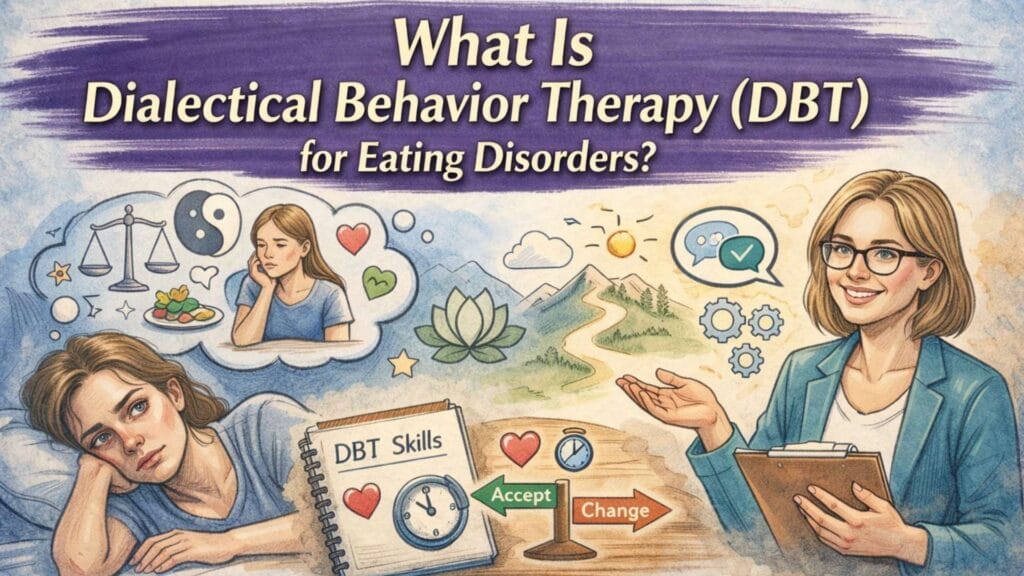
Dialectical Behavior Therapy (DBT) is a comprehensive, evidence based form of Cognitive Behavioral Therapy (CBT) developed by Dr. Marsha M. Linehan in the late 1980s at the University of Washington. Originally developed to treat individuals with borderline personality disorder and chronic suicidal behavior, DBT has become an important treatment approach for conditions involving intense emotions and impulsive behaviors, including bulimia nervosa and binge eating disorder. The term “dialectical” refers to DBT’s core principle of balancing acceptance and change, helping individuals accept themselves while developing healthier ways to change harmful behaviors. DBT teaches four core skill areas: mindfulness, distress tolerance, emotion regulation, and interpersonal effectiveness. These skills can help individuals manage difficult emotions, tolerate distress without turning to binge eating or purging, improve relationships, and develop healthier coping strategies. A comprehensive DBT program may include individual therapy, skills training groups, and phone coaching for support between sessions. Research has supported DBT as an effective approach for emotional dysregulation and has led to adaptations specifically designed for eating disorders, particularly bulimia nervosa and binge eating disorder.
Which Eating Disorders Can DBT Help Treat?
DBT can be particularly helpful for eating disorders that involve emotional dysregulation, impulsive behaviors, and difficulty coping with distress. While DBT is not the primary treatment for every eating disorder, it can be used as part of a comprehensive treatment plan, especially when binge eating or purging is connected to intense emotions or co-occurring mental health conditions.
- Bulimia Nervosa: DBT can help reduce binge eating and purging by teaching skills for managing emotional triggers, urges, and distress without relying on eating disorder behaviors.
- Binge Eating Disorder: DBT can help individuals recognize emotional triggers for binge eating and develop healthier strategies for managing stress, difficult emotions, and urges to binge.
- Anorexia Nervosa: DBT may help address emotional regulation, anxiety, distress tolerance, and rigid thinking that can make recovery more difficult, although other specialized treatments are typically central to anorexia treatment.
- OSFED: DBT may be helpful for individuals with Other Specified Feeding or Eating Disorder when symptoms are associated with emotional dysregulation, impulsivity, or difficulty coping with distress.
- ARFID: DBT may provide support for managing anxiety and distress related to eating, particularly when emotional regulation difficulties are present, although ARFID generally requires specialized approaches targeting the specific reasons for food avoidance.
DBT can be used across residential, PHP, IOP, and outpatient eating disorder treatment, although the way it is delivered can differ by program.
- Residential Treatment: DBT may be incorporated into a highly structured 24 hour program with individual therapy, skills groups, supervised meals, and support between sessions.
- Partial Hospitalization Program (PHP): DBT skills may be provided through several hours of treatment during the day, often including group skills training, individual therapy, meal support, and treatment for co-occurring conditions.
- Intensive Outpatient Program (IOP): DBT is often provided through scheduled group and individual sessions several days per week while the person lives at home.
- Outpatient: DBT may involve weekly individual therapy, weekly skills groups, or both, with the person practicing skills independently between appointments.
The specific DBT approach depends on the treatment center. Some programs provide comprehensive DBT, while others incorporate selected DBT skills into a broader eating disorder treatment program such as CBT-E, nutritional counseling, and psychiatric care.
How Is DBT Used to Treat Eating Disorders?
For many individuals, eating disorder behaviors like restriction, bingeing, and purging serve as a way to cope with overwhelming emotions. DBT directly addresses this underlying emotional dysregulation. A DBT therapist helps the patient understand the function of their behaviors and then teaches them effective DBT skills to use instead. The application of DBT to eating disorders recognizes that these behaviors are not simply about food; they are about patterns of behavior that have developed as a response to emotional pain. DBT focuses on replacing these harmful patterns with healthier, more effective coping strategies.
Research has shown that DBT is particularly effective for eating disorders characterized by impulsive behaviors (Safer et al., 2001; Telch et al., 2001). For bulimia nervosa, DBT helps individuals manage the intense emotions that trigger the binge-purge cycle, with distress tolerance skills being especially crucial for riding the wave of an urge without acting on it. A landmark study by Safer, Telch, and Agras (2001) found that DBT significantly reduced binge eating episodes in individuals with binge eating disorder. The emotion regulation skills learned in DBT provide alternative ways to cope with the feelings that lead to bingeing. DBT often includes a focus on identifying the specific emotions that trigger eating disorder behaviors, which is a key element of the individual DBT therapy component. DBT includes both acceptance-based and change-based strategies, making it uniquely suited for the complex emotional landscape of eating disorder recovery.
DBT for eating disorders focuses on helping a person recognize the connection between emotions, urges, thoughts, and eating disorder behaviors. Rather than simply trying to suppress an urge to binge or purge, DBT teaches skills for tolerating distress, regulating emotions, and creating enough space to choose a different response.
- STOP Skill: When an urge to binge or purge appears, the person pauses before acting. The approach is to Stop, Take a step back, Observe, and Proceed mindfully. The goal is to interrupt the automatic reaction and ask, “What am I feeling right now, and what response will actually help?”
- Urge Surfing: Instead of treating an urge as something that must immediately be acted on, the person observes it like a wave. A helpful mindset is, “This feeling is intense, but I do not have to act on it.” The person notices the physical sensations of the urge, watches it rise and fall, and uses breathing to remain present.
- Check the Facts: The person examines the thought behind an emotional reaction instead of automatically accepting it as true. For example, instead of thinking, “I ate more than planned, so I ruined everything,” they can ask, “What actually happened? Am I responding to the facts or to fear and shame?” This helps separate emotional interpretations from reality.
- Opposite Action: When an emotion creates an urge that would make the situation worse, the person practices a healthier response. For example, shame may create an urge to isolate after eating, while the opposite action may be staying connected with a supportive person. The goal is to respond intentionally rather than automatically following the emotion.
- Radical Acceptance: Instead of fighting reality with thoughts such as, “This cannot be happening,” the person practices acknowledging what is happening without approving of it. A recovery focused mindset might be, “I do not like how uncomfortable this feels, but I can accept that I am uncomfortable without needing to escape through an eating disorder behavior.”
- Mindful Eating: The person practices becoming aware of thoughts, emotions, physical sensations, and reactions around eating without immediately judging or acting on them. The goal is to become more present and intentional rather than automatically responding to distress.
- Emotion Regulation: The person identifies the emotion, what triggered it, and the action urge that followed. For example, loneliness may trigger an urge to binge. Instead of viewing bingeing as the only way to cope, the person learns to address the underlying emotion through healthier coping strategies.
- Dialectical Thinking: DBT teaches people to move away from all or nothing thinking. Instead of, “I slipped up, so I completely failed,” the mindset becomes, “A setback happened, and recovery can continue from this moment.” This approach helps reduce shame and perfectionism while keeping the focus on continued recovery.
Signs DBT is Right for You
- Bingeing or purging is triggered by intense emotions, stress, anxiety, anger, loneliness, or shame.
- There are strong urges to act impulsively even when the person knows the behavior may be harmful.
- The person has difficulty regulating emotions or tolerating distress without turning to eating disorder behaviors.
- There is significant all or nothing thinking, perfectionism, or difficulty coping with setbacks.
- The person experiences shame or guilt after eating and struggles with urges to isolate or compensate.
- Bulimia or binge eating co-occurs with depression, anxiety, PTSD, OCD, or other mental health concerns.
- Previous treatment has focused primarily on eating behaviors, but emotional triggers continue to drive symptoms.
- The person wants practical skills for managing cravings, urges, stress, and difficult emotions.
- Relationships or interpersonal conflicts frequently trigger eating disorder behaviors.
- The person is looking for an approach that combines acceptance of current experiences with active behavioral change.
DBT vs. CBT for Eating Disorders
While both DBT and CBT are evidence-based treatments for eating disorders, they differ in important ways. CBT focuses primarily on identifying and changing distorted thoughts and behaviors related to food and body image. DBT, as a modified form of CBT, adds a powerful layer of acceptance-based strategies, including mindfulness and validation, to the change-focused approach. This makes DBT particularly well-suited for patients with high emotional intensity and impulsive behaviors. The right therapy depends on the individual’s specific needs, and many treatment programs, including those at Eating Disorder Solutions, integrate both approaches. The elements of DBT that emphasize acceptance and validation can be especially healing for individuals who have experienced trauma or who struggle with deep shame about their eating disorder.
| DBT Skill Module | Goal | How It Helps with Eating Disorders |
| Mindfulness | Increase awareness of the present moment without judgment. | Helps patients observe binge or purge urges without acting on them; fosters a non-judgmental stance toward food and body image. |
| Distress Tolerance | Survive crisis situations without making them worse. | Provides concrete distress tolerance skills (e.g., self-soothing, distraction) to manage the intense distress that triggers eating disorder behaviors. |
| Emotion Regulation | Understand, label, and manage intense emotions. | Addresses the root cause of many eating disorder behaviors by teaching emotion regulation skills as healthier alternatives to restriction or bingeing. |
| Interpersonal Effectiveness | Build and maintain healthy relationships. | Helps patients communicate their needs, set boundaries, and navigate social situations that may trigger eating disorder urges. |
What to Expect in a DBT Program
A standard DBT program involves several components that work together to provide comprehensive support. Individual therapy sessions with a primary DBT therapist occur weekly and focus on applying DBT skills to specific life challenges and treatment targets. A weekly DBT skills training group is where patients learn DBT and practice the four core skill modules in a supportive environment alongside peers. Phone coaching allows patients to call their therapist between DBT sessions for in-the-moment support on how to use DBT skills during a crisis. A therapist consultation team ensures that DBT therapists are providing effective and adherent treatment. DBT exercises and worksheets are often assigned between sessions to help patients practice DBT skills and apply them in their everyday lives. DBT results are best achieved when all components of the program are engaged with consistently and with commitment.
DBT at Eating Disorder Solutions
At Eating Disorder Solutions, we integrate Dialectical Behavior Therapy into our comprehensive treatment programs across all levels of care. Our expert clinicians are trained in DBT and use its principles to help clients build a foundation for lasting recovery. We offer both individual therapy sessions and DBT skills training groups to ensure our clients receive the full benefit of this evidence-based approach. Our DBT program is designed to help individuals with a range of eating disorders, including anorexia, bulimia, and binge eating disorder, develop the DBT skills they need to manage their emotions and build a life free from disordered eating. Access to DBT is a cornerstone of our clinical model, and we are committed to providing the highest quality DBT treatment available.
How Long Does DBT Last for Eating Disorder Treatment?
DBT for eating disorders can vary in length depending on the person’s symptoms, treatment setting, and goals. A standard comprehensive DBT program often lasts 6 months to 1 year, while DBT adapted specifically for bulimia or binge eating may be delivered in shorter programs. Some eating disorder DBT programs use approximately 20 weekly group sessions lasting about 2 hours each.
DBT can include both private individual therapy and group skills training. Individual sessions are typically about 1 hour once a week, while skills training groups commonly last 2 to 2.5 hours once a week. Some programs also offer phone or between session coaching to help individuals use DBT skills during difficult situations.
How long someone needs DBT depends on the severity and duration of the eating disorder, emotional regulation difficulties, and co-occurring conditions such as depression, anxiety, OCD, trauma, or substance use. Some people benefit from several months of treatment, while others continue DBT therapy or skills work for a year or longer. The goal is to develop skills that can increasingly be used independently as recovery progresses.
How Much Does DBT for Eating Disorder Treatment Cost Without Insurance in Texas?
Without insurance, DBT for eating disorders in Texas commonly costs about $100 to $300 per individual session, while DBT skills groups may cost around $40 to $120 per session. A comprehensive DBT program that combines individual therapy, skills groups, and additional support can cost several thousand dollars over the course of treatment.
The total cost depends on how often sessions occur, session length, whether treatment is individual or comprehensive DBT, the provider’s experience and credentials, group fees, psychiatric or medication services, treatment for co-occurring conditions, location, and how long treatment continues. Specialized eating disorder providers may charge more, while sliding scale rates, payment plans, and lower-cost group programs may reduce expenses.
Does Insurance Cover DBT for Eating Disorder Treatment in Texas?
Yes, many insurance plans in Texas may cover DBT for eating disorders, particularly when it is considered medically necessary and provided by a covered mental health professional or treatment program. Coverage depends on the individual plan, provider network, prior authorization requirements, and whether DBT is included as a covered behavioral health service. Major providers such as Blue Cross Blue Shield of Texas, Aetna, UnitedHealthcare/Optum, Cigna/Evernorth, Humana, Molina Healthcare, and Superior HealthPlan may provide coverage, depending on the specific policy.
Alternatives to DBT for Eating Disorder Treatment
- CBT-E (Enhanced Cognitive Behavioral Therapy): Focuses on changing thoughts and behaviors that maintain eating disorder symptoms, including restrictive eating, bingeing, purging, and body image concerns.
- Family Based Treatment (FBT): Involves family members in supporting recovery, particularly for adolescents with anorexia nervosa or bulimia nervosa.
- Interpersonal Psychotherapy (IPT): Addresses relationship difficulties, grief, isolation, and interpersonal stress that may contribute to eating disorder symptoms.
- Acceptance and Commitment Therapy (ACT): Helps individuals accept difficult thoughts and emotions while developing behaviors that align with their personal values.
- Exposure and Response Prevention (ERP): Particularly useful when eating disorder symptoms overlap with OCD. It gradually exposes individuals to feared situations while reducing compulsive or avoidance behaviors.
- Nutritional Counseling: A registered dietitian helps develop balanced eating patterns, challenge food rules, and address nutritional deficiencies or fear foods.
- Medication Management: Certain medications may be used alongside therapy to address eating disorder symptoms or co-occurring conditions such as depression, anxiety, or OCD.
- Trauma-Focused Therapy: Approaches such as trauma focused CBT or EMDR may be considered when unresolved trauma contributes to eating disorder symptoms.
Frequently Asked Questions
What are the 4 main skills of DBT?
The four main DBT skills modules are Mindfulness, Distress Tolerance, Emotion Regulation, and Interpersonal Effectiveness. These skills are taught in DBT through a skills group format and are designed to work together to help individuals increase self-awareness, cope with painful emotions, manage emotional responses, and build healthier relationships. DBT skills training is a core component of any comprehensive DBT program and is one of the most important elements of DBT that distinguishes it from other forms of therapy.
Is DBT a type of CBT?
Yes, DBT is a modified form of Cognitive Behavioral Therapy (CBT). While it includes many of the same principles as CBT, dialectical behavior therapy places a greater emphasis on acceptance and mindfulness as a foundation for change. It was specifically designed to treat the severe emotional dysregulation and suicidal behavior associated with borderline personality disorder, and has since been adapted for a wide range of mental health conditions including eating disorders.
Who is DBT not recommended for?
While DBT is an effective mental health treatment for many, it may not be the best fit for everyone. Individuals who are not willing to commit to the intensive structure of a comprehensive DBT program, including both individual therapy and group therapy, may struggle to get the full benefit. Additionally, those who are actively psychotic or in need of immediate medical stabilization for their eating disorder would require a different level of care before beginning DBT. A DBT therapist or mental health professional can help determine whether dialectical behavior therapy is the right therapy for a given individual.
What is the 24-hour rule in DBT?
The 24-hour rule in DBT is a guideline that states patients should not call their therapist for phone coaching within 24 hours of a self-harm or suicidal behavior. This rule is designed to prevent the inadvertent reinforcement of harmful behaviors by ensuring that phone coaching is used to help patients use their DBT skills proactively, rather than as a response to a crisis that has already occurred. It is one of the unique structural elements of DBT that supports long-term behavior change.
Does DBT Focus on Stopping Eating Disorder Behaviors or Understanding Why They Happen?
DBT focuses on both reducing eating disorder behaviors and understanding the emotions, thoughts, triggers, and situations that contribute to them. Rather than simply telling someone to stop bingeing or purging, DBT helps identify what happens before, during, and after the behavior and teaches practical skills for responding differently. Common topics that can be addressed in DBT for eating disorders include emotional regulation, binge and purge urges, distress tolerance, shame and guilt, impulsivity, body image distress, all or nothing thinking, interpersonal conflict, stress, trauma related symptoms, self criticism, mindfulness, avoidance, and co-occurring conditions such as anxiety or depression. Treatment may also explore patterns such as using food or eating disorder behaviors to numb emotions, cope with rejection, manage anger, reduce anxiety, or regain a sense of control. The overall goal is to help the person understand the function of the behavior while building healthier ways to manage emotions and difficult situations.
If you are struggling with an eating disorder and believe that learning new coping skills could help, Dialectical Behavior Therapy may be the right path for you. Contact Eating Disorder Solutions today at 855-245-0961 or visit eatingdisordersolutions.com to learn more about our DBT-informed programs. Research has shown that eating disorders and sleep quality are closely interconnected, often exacerbating each other. Individuals experiencing these challenges may benefit from addressing both issues simultaneously for more effective treatment outcomes. Prioritizing a consistent sleep routine alongside therapy can lead to improved overall well-being and recovery. Honoring eating disorder nurses is essential for the support and guidance they provide to individuals on their recovery journey. These dedicated professionals play a crucial role in promoting understanding and compassion, ensuring that clients feel safe and heard throughout their treatment process. By recognizing their contributions, we can foster a more supportive environment for those who are navigating the complexities of eating disorders. In addition to therapy, implementing bulimia nervosa recovery support strategies can play a crucial role in the healing process. These strategies may include joining support groups, engaging in mindfulness practices, and developing a strong network of friends and family who understand the journey. Combining these approaches with professional guidance can enhance resilience and promote a more sustainable recovery.
References
Safer DL, Telch CF, Agras WS. Dialectical behavior therapy for bulimia nervosa. Am J Psychiatry. 2001;158(4):632-634.
Telch CF, Agras WS, Linehan MM. Dialectical behavior therapy for binge eating disorder. J Consult Clin Psychol. 2001;69(6):1061-1065.
Support and Crisis Resources
If you or someone you love is struggling, support is available. If you are in crisis or need immediate help, call or text 988 to reach the 988 Suicide and Crisis Lifeline, a free, confidential service available 24/7.
Related Reading
- FBT Explained: How Family-Based Treatment Supports Eating Disorder Recovery
- What Does a Dietitian Do in Eating Disorder Treatment?
References
National Alliance for Eating Disorders (https://www.allianceforeatingdisorders.com/)
ANAD — Free Eating Disorder Peer Support & Resources (https://anad.org/)