
Anorexia vs. Bulimia
Why these two get confused
Anorexia and bulimia are the two most widely recognized eating disorders, and they’re also the two most commonly mixed up — partly because both involve intense preoccupation with weight and body image, and partly because a lot of popular media flattens both into a single stereotype. In clinical terms they’re distinct conditions with different core behaviors, different medical risk profiles, and in some cases, different treatment emphases. They can also co-occur, or a person can move between presentations over time, which is part of why a side-by-side comparison is more useful than treating either in isolation.
Eating pattern: restriction vs. binge-purge cycles
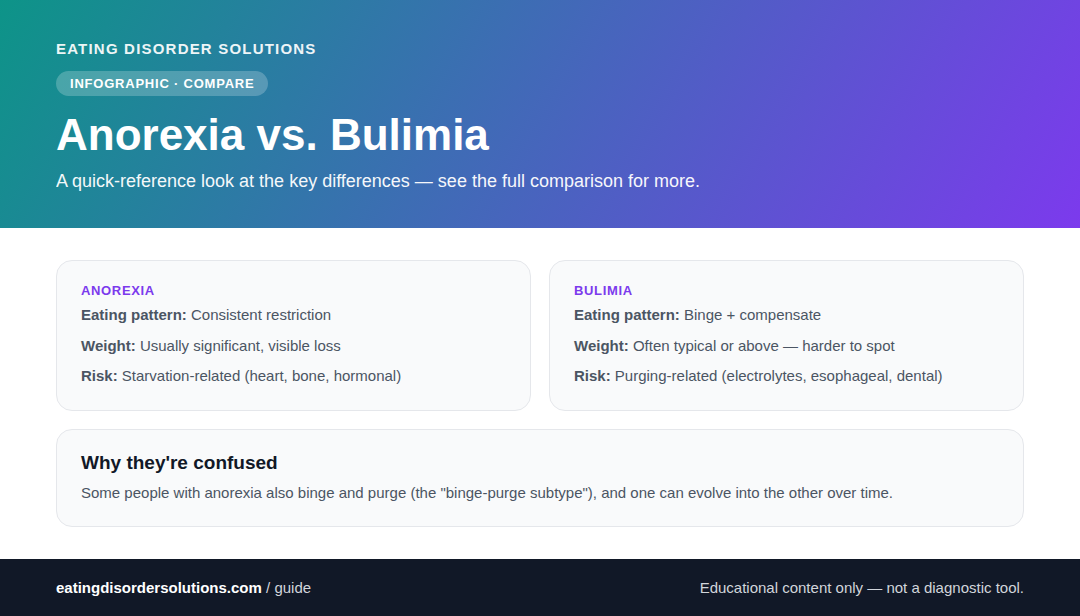
Anorexia nervosa centers on restriction — significantly limiting food intake, often alongside an intense fear of weight gain and a distorted sense of body size. Bulimia nervosa centers on a cycle: episodes of eating a large amount of food in a short window, followed by compensatory behavior meant to “undo” it — self-induced vomiting, laxative misuse, excessive exercise, or fasting. The core difference isn’t “how much someone eats” in isolation, it’s the pattern: sustained restriction versus a binge-and-compensate cycle.
Weight presentation: why it’s not a reliable marker
One of the most persistent myths about both conditions is that you can identify them by body size. Anorexia is more often associated with being underweight, but that’s not universal — atypical anorexia describes the same restriction pattern and psychological features in someone who isn’t underweight by clinical standards. Bulimia, by definition, frequently occurs at a normal or above-average body weight, since the binge-purge cycle doesn’t always produce visible weight loss. A person can have either condition, with serious medical risk, while looking completely “fine” from the outside.
Medical risks: different, both serious
Anorexia’s primary medical risks come from sustained undernutrition — effects on bone density, heart function, hormonal regulation, and in more severe cases, organ function. Bulimia’s risks are more directly tied to the compensatory behaviors themselves: electrolyte imbalances from purging (which can affect heart rhythm), damage to the esophagus and teeth from repeated vomiting, and gastrointestinal complications. Both can become medical emergencies, which is why our Safety Red Flags page applies to either condition.
Overlap and movement between the two
It’s common for someone to move between presentations over the course of an illness, or to show features of both at once (a pattern sometimes described diagnostically as OSFED, when it doesn’t fully meet criteria for either). This is part of why treatment approaches for both conditions overlap significantly, even though the day-to-day behaviors look different.
Shared risk factors, and why the split isn’t always clean
Anorexia and bulimia get taught as two separate boxes, but the things that put someone at risk for either one overlap heavily. A history of dieting is the single most consistent risk factor researchers point to for both conditions — not because dieting causes an eating disorder on its own, but because it’s often the behavior that turns a vulnerability into a pattern. Perfectionism, a strong drive for control, difficulty tolerating uncertainty, and a tendency to link self-worth to body shape or weight show up across both diagnoses at similar rates. Family history matters too: having a close relative with any eating disorder, not just the same one, raises risk.
Where the two genuinely diverge is less in why they start and more in how the body and behavior respond once a pattern takes hold. Someone prone to rigid, effortful control tends to drift toward restriction; someone whose control breaks down under stress tends to drift toward the binge-purge cycle. But that’s a tendency, not a rule, which is part of why clinicians increasingly think about eating disorders on a spectrum rather than as fixed, separate categories — see our Eating Disorder Spectrum page for more on that model.
This matters practically because a family member watching for “the anorexia signs” or “the bulimia signs” specifically can miss what’s actually happening if the presentation doesn’t match the textbook version. Watching for the underlying pattern — rigid rules around food, distress that’s clearly tied to eating or body image, secrecy — catches more than watching for a specific diagnostic checklist.
Myths that get in the way of recognizing either condition
Myth: “She eats in front of me, so it can’t be anorexia.” Fact: restriction doesn’t always mean visible food refusal. It can mean quietly eating less than a portion looks like, cutting food into pieces and moving them around, or eating normally at some meals while heavily restricting at others.
Myth: “He’d have to be underweight for it to be serious.” Fact: both conditions occur at every body weight. Bulimia in particular is frequently missed specifically because weight often looks unremarkable — see the FAQ below.
Myth: “Throwing up sometimes after overeating isn’t really bulimia.” Fact: frequency and the presence of a pattern matter more than any single episode. A repeated cycle — even an occasional one — of eating followed by compensatory behavior (vomiting, laxatives, excessive exercise) is worth a conversation with a professional, not something to wait out.
Myth: “These are about vanity or willpower.” Fact: both are recognized psychiatric conditions with serious physical risk, not a lifestyle choice or a phase driven by wanting to look a certain way. Genetics, temperament, and brain chemistry all play a documented role.
Frequently asked questions
Can someone have both anorexia and bulimia?
Not simultaneously in the strict diagnostic sense, but it’s common for someone’s presentation to shift between them over time. See our OSFED page for how mixed presentations are classified.
Is bulimia less serious than anorexia because weight often looks normal?
No. Bulimia carries its own serious medical risks, particularly related to electrolyte imbalance and cardiac strain from purging, regardless of body weight.
How is treatment different for anorexia versus bulimia?
Both typically involve nutritional rehabilitation, medical monitoring, and therapy. Anorexia treatment often emphasizes medical stabilization and weight restoration; bulimia treatment often emphasizes interrupting the binge-purge cycle. Our Treatment Levels infographic covers how level of care is determined.
Where can I read more about each condition individually?
See our full pages on Anorexia and Bulimia, or the detailed Anorexia vs. Bulimia comparison.
Can eating disorder behaviors change from restriction to binge-purge over time, or the other way around?
Yes — this is common enough that clinicians have a name for it, often called “crossover” or “migration” between presentations. Someone diagnosed with anorexia may later develop binge-purge behaviors, and the reverse also happens. This is one reason ongoing care and monitoring matter even after initial symptoms improve.
Does someone need to lose a specific amount of weight for either diagnosis to apply?
No. Diagnostic criteria for bulimia don’t reference weight at all, and even for anorexia, the criteria focus on whether weight is significantly low for that individual’s age, development, and health history — not a fixed number or percentage that applies to everyone.
What this covers
- Anorexia centers on severe restriction and fear of weight gain; bulimia centers on binge-purge cycles.
- Weight presentation can differ, but neither disorder has a single reliable ‘look’ — both occur across all body sizes.
- Each carries its own primary medical risks, covered in more detail on the full comparison page.
- Warning signs overlap in places, which is part of why the two get confused.