
Eating Disorder Symptoms by Category
A different lens than “warning signs”
Our Warning Signs infographic covers general cross-disorder signs organized around what’s visible from the outside — behavior, physical changes, social withdrawal. This page organizes the same territory differently: by the type of symptom itself, with more emphasis on the internal, psychological experience that often drives the visible behaviors.
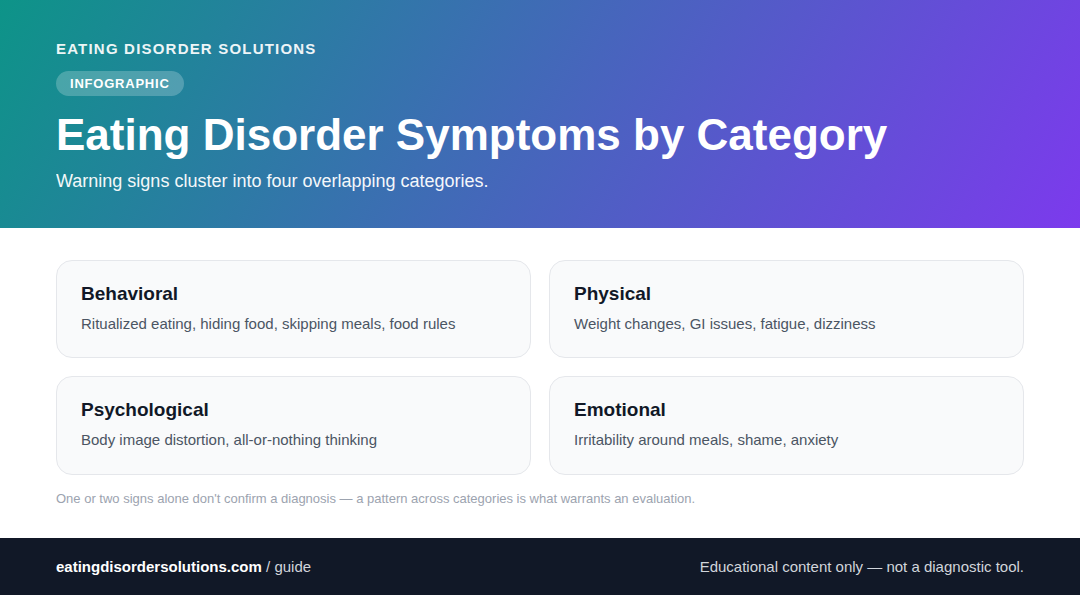
Behavioral symptoms: the “what someone does” category
Rigid rules around food (specific times, specific “safe” foods, avoidance of entire categories), rituals around eating (cutting food into small pieces, eating very slowly or very fast, specific plate arrangements), and secretive behavior around meals all fall here.
Physical symptoms: what the body shows
Weight fluctuation in either direction, fatigue, dizziness, changes in menstrual cycle, cold intolerance, and visible changes to skin, hair, or nails are common physical symptoms. These are frequently the last symptoms to appear, since psychological and behavioral changes often precede visible physical ones by months.
Psychological symptoms: the internal experience
This category covers the cognitive and emotional patterns underneath the behavior — persistent, intrusive thoughts about food, weight, or body shape; black-and-white thinking about “good” and “bad” foods; a self-worth that becomes tightly tied to eating behavior or body image; and perfectionism that extends into other areas of life. Psychological symptoms are often the earliest to appear and the hardest for someone else to notice.
Emotional symptoms: how it feels day to day
Anxiety that spikes around meals or food decisions, irritability or mood swings connected to eating, shame or guilt after eating, and a general sense of being controlled by thoughts about food rather than in control of them. These emotional symptoms often drive the behavioral ones.
Why categorizing this way is useful
Looking at symptoms by category rather than by visible sign alone helps make sense of presentations that don’t fit a single obvious pattern — someone might show mostly psychological and emotional symptoms for a long stretch before behavioral or physical symptoms become noticeable to others.
How symptoms across categories interact in real life
The four-category breakdown on this page (behavioral, physical, psychological, emotional) is useful for organizing what to look for, but in an actual person’s experience, these categories constantly feed into each other rather than staying separate. A psychological symptom — a growing preoccupation with body shape, for instance — often drives a behavioral one, like skipping meals or developing food rules. That behavioral change then produces physical symptoms as the body adapts to reduced intake. The physical symptoms, in turn, can intensify emotional distress, which reinforces the original psychological preoccupation. It’s a loop more than a line, which is part of why intervening early, before the loop fully establishes itself, tends to be easier than intervening later.
This is also why treatment for eating disorders typically addresses more than one category at once rather than treating physical symptoms in isolation from psychological ones, or vice versa. Restoring physical health without addressing the underlying thought patterns tends to produce short-lived improvement; addressing thought patterns without stabilizing physical health can be medically unsafe. Comprehensive treatment works across categories for exactly this reason.
When symptoms alone aren’t enough to go on
Any single symptom from any one category, viewed in isolation, is common in people who don’t have an eating disorder — fatigue has dozens of ordinary causes, mood swings happen to everyone, and pickiness about food is widespread without being clinical. What shifts a symptom from “worth noting” to “worth a professional conversation” is usually some combination of persistence over weeks rather than days, symptoms clustering across more than one category, and a noticeable change from that person’s own baseline. A clinical evaluation, not a self-scored checklist, is the only reliable way to move from “these symptoms are present” to “this is or isn’t an eating disorder” — this page and the others like it are built to help you recognize when that evaluation is worth pursuing, not to replace it.
Symptoms across the lifespan
The four categories on this page apply across ages, but how each one presents can shift with life stage. In children and younger teens, behavioral and physical symptoms are often what get noticed first, partly because adults around them control more of the eating environment and can spot changes in what and how much a child eats; psychological symptoms in this age group can be harder to identify because younger children often lack the vocabulary to describe an internal preoccupation with body image or control. In adults, especially those living independently, behavioral symptoms can be far easier to conceal, and psychological or emotional symptoms — a long-standing but unspoken preoccupation with weight, for instance — sometimes surface only when a life change (a health scare, a pregnancy, a major stressor) makes the pattern harder to sustain quietly. Eating disorders in midlife and older adulthood are increasingly recognized as more common than previously assumed, and symptoms in this group can be misattributed to unrelated health or age-related changes rather than investigated as a possible eating disorder.
Frequently asked questions
Which category of symptoms usually appears first?
It varies, but psychological and emotional symptoms — persistent thoughts about food or body image, anxiety around eating — often precede visible behavioral or physical changes.
Do all four categories need to be present for it to be a concern?
No. Symptoms from even one category, if persistent and distressing, are worth paying attention to.
How is this different from the general Warning Signs page?
Both cover similar ground but organize it differently — Warning Signs groups by what’s visible from the outside, this page groups by symptom type including the internal psychological experience. They’re complementary, not duplicates.
Can psychological symptoms exist without any behavioral changes yet?
Yes, and this is common in earlier stages — persistent thoughts about food, weight, or body image can be present well before visible behaviors develop.
Can someone show psychological symptoms for years before anything behavioral changes?
Yes. A preoccupation with body image or a fear of weight gain can exist internally for a long time before it translates into visible behavior like restriction or bingeing. This internal period is sometimes when early intervention is most effective, but it’s also the hardest time for anyone else to notice something is happening.
Do symptoms always get worse in the same order — behavioral, then physical, then the rest?
No, there’s no fixed sequence. Some people show physical signs early because of a pre-existing medical vulnerability; others show emotional distress for a long stretch with no visible behavioral or physical change at all.
What this covers
- Behavioral: ritualized eating, hiding food, skipping meals, rigid food rules.
- Physical: weight changes, GI issues, fatigue, dizziness.
- Psychological: body image distortion, all-or-nothing thinking.
- Emotional: irritability around meals, shame, anxiety.
- One or two signs alone don’t confirm a diagnosis — a pattern across categories is what warrants an evaluation.