
Types of Eating Disorders
Why “eating disorder” isn’t one thing
“Eating disorder” gets used as a catch-all, but it covers a genuinely wide range of conditions with different core behaviors, different risk profiles, and different treatment approaches. Some center on restriction, some on bingeing, some on compulsive behavior around exercise or food “purity” rather than quantity. Knowing which pattern you’re looking at — in yourself or someone else — matters, because it changes what kind of support actually helps.
The twelve types, in more depth
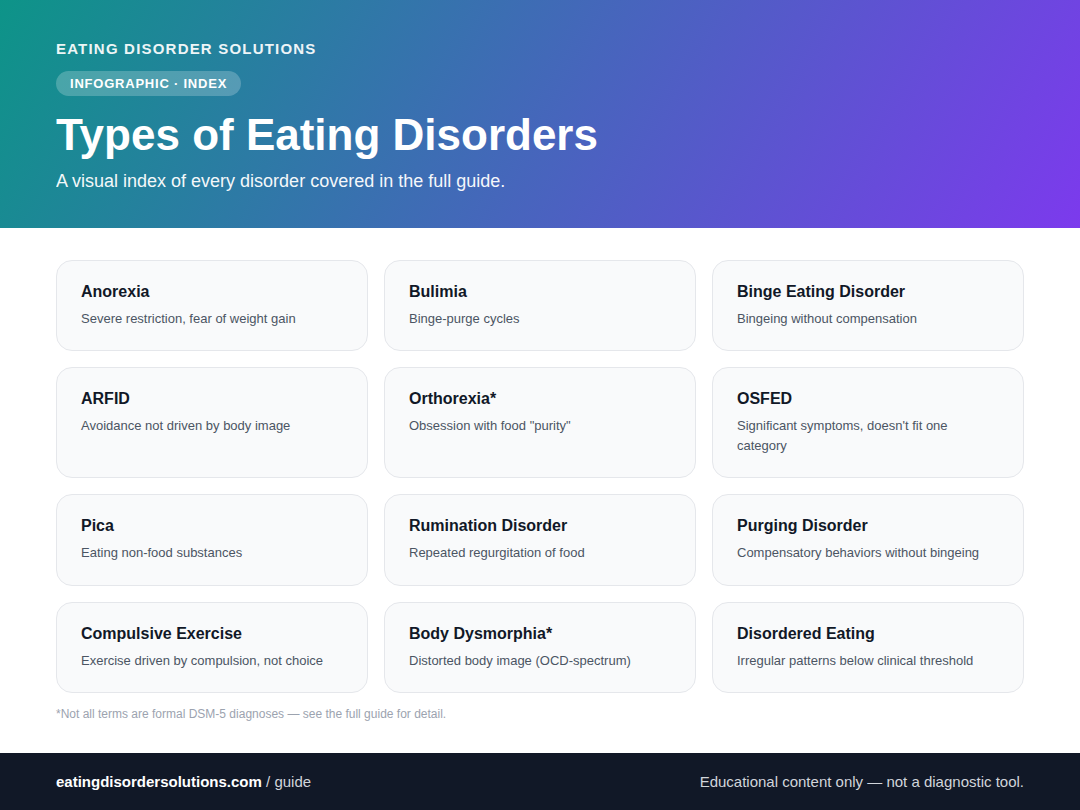
Anorexia centers on food restriction driven by an intense fear of weight gain and a distorted body image, often alongside significant weight loss, though not always. Bulimia involves cycles of binge eating followed by compensatory behavior like purging or excessive exercise. Binge Eating Disorder involves recurring binge episodes without regular compensatory behavior — the most commonly diagnosed eating disorder overall.
ARFID involves significant food avoidance or restriction not driven by body image concerns — often sensory sensitivities, fear of choking or vomiting, or simple lack of interest in food. Orthorexia (not a formal DSM-5 diagnosis, but a widely recognized pattern) involves an obsessive focus on “clean” or “pure” eating that becomes restrictive and distressing in its own right. OSFED covers presentations with significant symptoms that don’t fully match another category’s specific criteria — it’s a real and often serious diagnosis, not a “lesser” one.
Pica involves persistently eating non-food substances. Rumination Disorder involves repeated, effortless regurgitation of food, distinct from vomiting. Purging Disorder involves compensatory behaviors like self-induced vomiting without the binge-eating episodes seen in bulimia.
Compulsive Exercise describes exercise driven by compulsion or guilt rather than choice, sometimes continuing through injury or illness. Body Dysmorphia (an OCD-spectrum condition closely related to eating disorders) involves a distorted, distressing preoccupation with perceived flaws in appearance. Disordered Eating describes irregular eating patterns that fall below the threshold for a formal diagnosis but can still affect health and quality of life.
How to use this index
If you’re not sure which category fits what you’re seeing, start broad — the Warning Signs or Symptoms by Category infographics cover cross-disorder signs before you need to narrow to a specific type. If two types seem similar, our Compare series looks at them side by side.
How these types overlap and change over time
The twelve categories on this page are useful for organizing information, but real presentations are messier than any list makes them look. It’s common for someone’s symptoms to partially match more than one category at once, or to shift from one presentation to another over months or years — restriction that develops binge-purge features, or an ARFID-like food avoidance pattern in childhood that evolves into something closer to anorexia in adolescence. This is exactly why OSFED (Other Specified Feeding or Eating Disorder) exists as a category: not as a lesser or vaguer diagnosis, but as clinical recognition that a meaningful number of people don’t fit neatly into one box, and that their symptoms are just as real and just as worth treating.
Clinicians increasingly describe this using spectrum or dimensional models rather than treating each type as a fully separate condition — see our Eating Disorder Spectrum page for more detail on that approach. Practically, this means a person’s diagnosis might be updated over the course of treatment as their presentation changes, and that’s a normal part of accurate, responsive care rather than a sign that the original diagnosis was wrong.
Why this list isn’t a self-diagnosis tool
Reading through twelve descriptions and finding the one that sounds most familiar is a natural instinct, but a page like this is built for orientation, not diagnosis. Several of these conditions share surface features — food restriction shows up in anorexia, ARFID, and orthorexia; a preoccupation with control and body image shows up across most of them — and telling them apart accurately depends on clinical history, patterns over time, and context that a self-assessment can’t fully capture. If one or two of these descriptions feel personally relevant, that’s a reasonable signal to bring to a professional conversation, not a conclusion to act on alone. Our Warning Signs Tool can help organize what you’re noticing before that conversation.
A note on evolving classification
The names and boundaries on this page reflect the current DSM-5 framework, but eating disorder classification has changed meaningfully over the past few decades and continues to evolve. ARFID and binge eating disorder, for example, weren’t formally recognized as their own diagnoses until relatively recently in the history of the DSM — before that, presentations that clearly involved significant impairment were often classified under a catch-all “not otherwise specified” category that provided less specific guidance for treatment. That history matters for two reasons: first, it’s a reminder that a formal diagnostic category catching up to a real, already-existing pattern of suffering is normal, not a sign the pattern wasn’t serious before it had a name; second, it means research and treatment approaches for the more recently recognized categories are, in some cases, less extensive than for anorexia and bulimia, which have been studied for longer. That’s improving quickly, but it’s worth knowing if you’re researching treatment options for a less commonly discussed type.
Frequently asked questions
What’s the difference between disordered eating and an eating disorder?
Disordered eating describes irregular patterns that don’t meet full clinical criteria for a specific diagnosis but can still be worth addressing. See our Disordered Eating vs. Eating Disorder comparison.
Is orthorexia a real diagnosis?
Orthorexia isn’t currently a formal DSM-5 diagnosis, but it’s a widely recognized clinical pattern taken seriously by treatment providers. See our Orthorexia vs. Anorexia comparison.
Can someone have more than one of these at once?
Yes. Co-occurrence is common, and presentations can shift over time.
Where should I start if I’m not sure which type applies?
Our Warning Signs Tool is a good general starting point; condition-specific tools like the ARFID Assessment go deeper once you have a sense of direction.
Do eating disorder types run in families?
Family history is one of the more consistently documented risk factors across nearly all eating disorder types — having a first-degree relative with any eating disorder increases risk, and it doesn’t have to be the same specific type. Genetics appear to influence general vulnerability more than which specific presentation develops.
Is there a “mildest” type on this list?
No — severity varies enormously within every category on this page, and “atypical” or “other specified” categories are not automatically less serious than the more commonly named ones. Medical risk and impact on daily life are better indicators of severity than which category a presentation technically falls into.
What this covers
- A single-glance index of every disorder type covered in this guide: Anorexia, Bulimia, Binge Eating Disorder, ARFID, OSFED, Pica, Rumination Disorder, Orthorexia, Purging Disorder, Compulsive Exercise, Body Dysmorphia, and Disordered Eating.
- Not all of these are formal DSM-5 diagnoses (orthorexia and body dysmorphia are flagged as such on the graphic) — see the full guide for detail on each.
- Meant as a visual sitemap for the whole guide section, not a diagnostic checklist.