Key Takeaways
Selective eating disorder in adults is another name for avoidant/restrictive food intake disorder (ARFID), a condition where someone limits what they eat because of sensory sensitivities, low interest in food, or fear of negative consequences like choking. It is more than picky eating and can affect nutrition and daily life, and support is available.
- ARFID is driven by sensory sensitivity, low appetite or interest, or fear of aversive experiences, not by body image concerns.
- It differs from ordinary picky eating because it can affect nutrition, health, and social life.
- ARFID can occur in adulthood, not only in childhood.
- A clinician can diagnose ARFID and rule out other medical or psychological causes.
- Treatment is individualized and may include therapy and nutritional support.
Introduction
Selective eating disorder, medically recognized as avoidant restrictive food intake disorder (ARFID), is a complex mental disorder characterized by restrictive eating involving a limited range of preferred foods. Adults with ARFID often show sensory sensitivities and aversion to certain foods, which is much more severe than typical picky eating in adults or children. Researchers describe ARFID as involving sensory sensitivity, low interest in eating, and fear of aversive consequences such as choking (Thomas et al., 2017). This eating disturbance leads to poor food choices, malnutrition, and psychosocial challenges impacting work or school. This article discusses ARFID in adults, the symptoms of ARFID, causes, risk factors, and treatment for ARFID in adults offered by Eating Disorder Solutions (EDS) that include cognitive behavioral therapy and other targeted treatments for eating disorders.
Understanding Selective Eating Disorder in Adults
Adults with ARFID struggle with restrictive eating and food avoidance stemming largely from sensory sensitivities to texture, smell, taste, or appearance of certain foods, or as a result of a strong aversion linked to negative experiences like choking or vomiting. This disordered eating pattern leads to nutritional deficiencies and reliance on supplements to get adequate nutrients. The behavior and symptoms of ARFID are categorized as a feeding and eating disorder in the Diagnostic and Statistical Manual of Mental Disorders (DSM-5), which highlights that unlike anorexia nervosa or bulimia nervosa, the condition lacks concerns about body image or desire to lose weight. ARFID can cause significant psychosocial impairment, affecting social functioning and quality of life for individuals with ARFID struggling daily with limited food intake.
Symptoms and Signs of Selective Eating Disorder in Adults
- Severely limited food variety, often fewer than 20 types of food tolerated, reflecting food neophobia
- Avoidance or refusal to try new foods due to sensory sensitivities related to texture, color, smell, or temperature of certain foods
- Marked distress, anxiety, or fear around intake of new or unfamiliar foods, often linked with past traumatic experiences such as choking or vomiting
- Significant weight loss or failure to maintain healthy body weight, leading to malnutrition and medical complications
- Dependence on nutritional supplements to get adequate vitamins and minerals
- Difficulty participating in social eating, dining out, or eating with others resulting in isolation and psychosocial issues
- Absence of body weight, body image, or body shape concerns, differentiating it from anorexia nervosa and other eating disorders
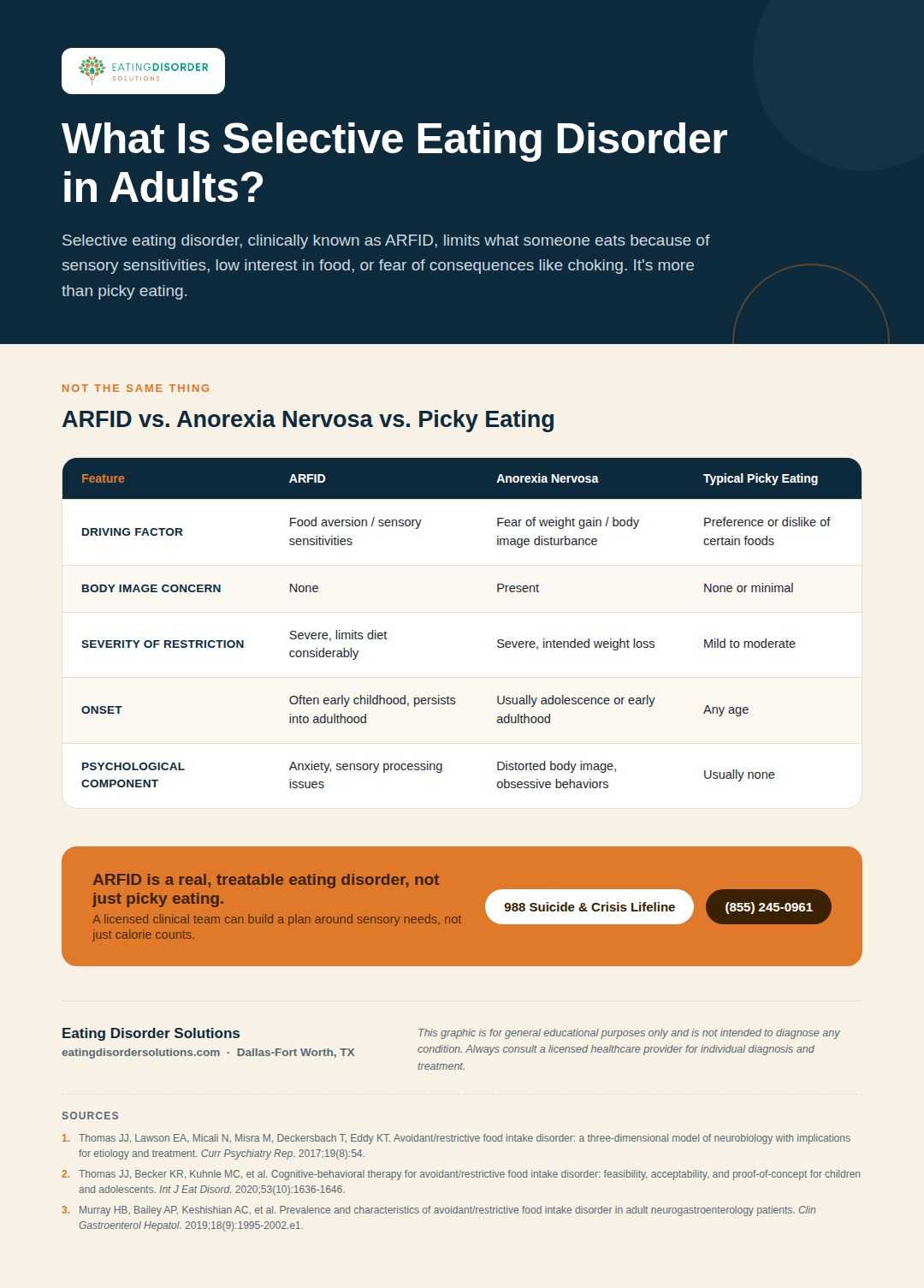
How Selective Eating Disorder Differs From Anorexia Nervosa and Picky Eating
| Feature | Selective Eating Disorder (ARFID) | Anorexia Nervosa | Typical “Picky Eating” |
| Driving Factor | Food aversion/sensory sensitivities | Fear of weight gain/body image disturbance | Preference or dislike of certain foods |
| Body Image Concern | None | Present | None or minimal |
| Severity of Food Restriction | Severe, limits diet considerably | Severe, intended weight loss | Mild to moderate |
| Impact on Nutritional Status | Often significant deficits | Significant deficits | Usually minimal |
| Onset | Often early childhood but persists into adulthood | Usually adolescence or early adulthood | Any age |
| Psychological Component | Anxiety, sensory processing issues | Distorted body image, obsessive behaviors | Usually none |
| Social Impact | Significant avoidance of social eating | Social withdrawal common | Minimal |
It is important to clearly differentiate selective eating disorder in adults (ARFID), anorexia nervosa, and typical picky eating in adults. ARFID is characterized by food aversion or sensory sensitivities creating restrictive eating, without the negative body image, fear of weight gain, or body shape concerns seen in anorexia nervosa or bulimia nervosa. Typical picky eating in adults or picky eaters may display dislike or preference against certain foods, but generally do not experience severe nutritional deficits or the psychosocial consequences seen in ARFID.
ARFID symptoms involve avoidance and restrictive eating patterns that can result in significant weight loss, malnutrition, and complex medical issues, unlike mild to moderate restrictive eating or picky or selective eating behaviors.
Causes and Risk Factors
The causes and risk factors of selective eating disorder or ARFID in adults are multifactorial and continue to be studied. Genetics, psychological conditions like anxiety disorders, sensory processing issues common in autism spectrum disorder, and environmental influences all contribute to develop ARFID. A history of traumatic events such as choking or vomiting during feeding or illness in childhood, history of picky eating in adults or children, and other mental health conditions are known risk factors. Individuals with ARFID often experience comorbid conditions like depression or social anxiety causing significant eating disturbances and avoidance behaviors. Understanding these risk factors is important for accurate ARFID diagnosis and tailoring successful treatment plans.
Treatment Options for Selective Eating Disorder in Adults
Treating ARFID in adults involves a comprehensive approach aimed at expanding the range of preferred foods, improving nutritional status, and addressing the underlying psychological and sensory factors. Cognitive behavioral therapy (CBT) is one approach used for ARFID, and early studies suggest it may help individuals with ARFID confront fears related to food intake, reduce anxiety, and modify restrictive eating patterns. Exposure therapy targeting food neophobia and sensory integration techniques to reduce sensory sensitivities can be used alongside CBT.
Given the risk of malnutrition and other medical complications from restrictive eating, medical monitoring and nutritional counseling are critical components of treatment for ARFID in adults. The treatment team typically includes mental health professionals, dietitians, and physicians experienced in treatment for eating disorders. Collaborative, evidence-based treatments enhance healthy eating and support psychosocial recovery for adults and children struggling with ARFID and other eating disturbances.
FAQs About Selective Eating Disorder in Adults
1. What is the difference between selective eating disorder and picky eating in adults?
Selective eating disorder or ARFID involves restrictive eating patterns due to aversion or sensory sensitivities and often leads to nutritional deficiencies, whereas picky eating is less severe and rarely impacts health.
2. Can selective eating disorder develop in adulthood or only in childhood?
While ARFID often begins in childhood, it can persist or even emerge in adulthood due to life changes, trauma, or mental health conditions.
3. How is selective eating disorder diagnosed in adults?
Diagnosis is based on clinical evaluation and criteria in the Statistical Manual of Mental Disorders, considering eating behavior, nutritional status, and psychological factors.
4. What role does sensory sensitivity play in selective eating disorder?
Sensory sensitivities to food texture, taste, smell, or appearance often lead adults with ARFID to avoid certain foods severely.
5. Is cognitive behavioral therapy effective for selective eating disorder in adults?
CBT is one approach that may help people reduce anxiety related to food and gradually increase dietary variety. Early studies of CBT for ARFID show promise, though more research in adults is still needed (Thomas et al., 2020).
6. Can selective eating disorder cause serious health problems in adults?
Yes. If untreated, selective eating disorder can result in malnutrition, vitamin deficiencies, and impaired daily functioning.
7. How can I seek treatment if I suspect I have selective eating disorder?
You should contact a mental health professional specializing in eating disorders for assessment and personalized treatment planning.
Take Action Today: Get Help at Eating Disorder Solutions
If you or someone you know struggles with selective eating disorder as an adult, support and treatment are available. At Eating Disorder Solutions (EDS), our experienced treatment team offers compassionate, evidence-based care tailored to adults living with ARFID and other eating disorders. We specialize in treating ARFID using cognitive behavioral therapy and other evidence-informed approaches for adults to address sensory sensitivities, eating disturbances, and restrictive eating patterns.
References
- Thomas JJ, Lawson EA, Micali N, Misra M, Deckersbach T, Eddy KT. Avoidant/restrictive food intake disorder: a three-dimensional model of neurobiology with implications for etiology and treatment. Curr Psychiatry Rep. 2017;19(8):54. https://doi.org/10.1007/s11920-017-0795-5
- Thomas JJ, Becker KR, Kuhnle MC, et al. Cognitive-behavioral therapy for avoidant/restrictive food intake disorder: feasibility, acceptability, and proof-of-concept for children and adolescents. Int J Eat Disord. 2020;53(10):1636-1646. https://doi.org/10.1002/eat.23355
- Murray HB, Bailey AP, Keshishian AC, et al. Prevalence and characteristics of avoidant/restrictive food intake disorder in adult neurogastroenterology patients. Clin Gastroenterol Hepatol. 2019;18(9):1995-2002.e1. https://doi.org/10.1016/j.cgh.2019.10.030
Support and Crisis Resources
If you or someone you care about is struggling with an eating disorder, support is available:
If you or someone you love is struggling, support is available. The National Institute of Mental Health offers free, research-based information about eating disorders at nimh.nih.gov. If you are in crisis or need immediate help, call or text 988 to reach the 988 Suicide and Crisis Lifeline, a free, confidential service available 24/7.