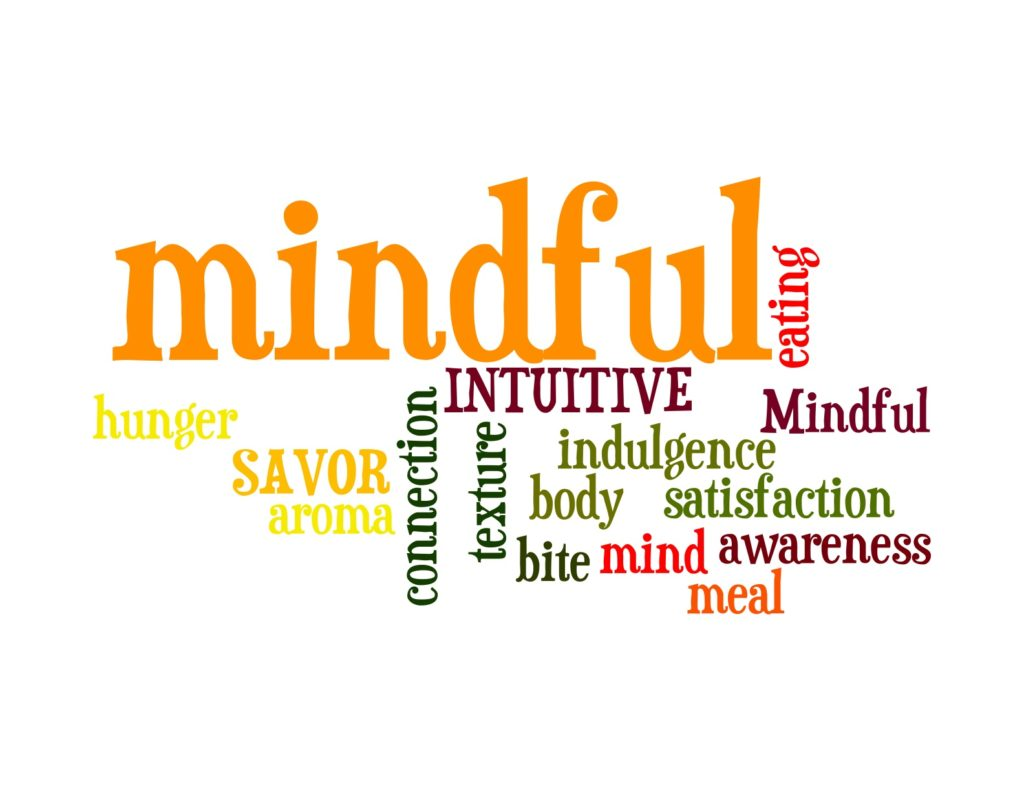
The purpose of mindful eating is to reconnect to the joy of eating by becoming aware of your thoughts, emotions, feelings, and behaviors associated with the eating experience. Mindful eating helps identify the causes to eat (am I hungry or am I bored?), what am I in the mood for (sweet or salty?), how you feel after eating (satisfied or not satisfied?), and even your emotions during and after the meal. Mindful eating is a practice that takes time.
How do you begin mindful eating? Start by asking yourself simple questions throughout the meal. Some examples may include the following:
- Am I paying attention to my body’s hunger and satiety cues?
- What is driving me to eat — physical or emotional cues?
- How quickly am I eating?
- How would I describe the food?
- Does the food look appealing and how does it smell?
- Next, take a bite and be descriptive! What comes to mind as you notice the texture, temperature, and taste of the food?
Why is mindful eating helpful?
- You are learning your TRUE likes and dislikes without judgment of the food
- Have you ever eaten in front of a tv or too quickly and realize you didn’t even taste the meal? Mindful eating helps you feel satisfied by paying attention to all of your senses
- This helps with decreasing urges to binge and/or overeat
- You are reconnecting to your satiety senses — “mmmm that was tasty” rather than “I didn’t even realize I ate this bowl of ice cream and did I even enjoy it?”
- This decreases the need to go back for more or overeat as you are listening to your fullness cues and feeling satisfied
That being said, it is okay to over-indulge on occasion–if you want to!
Mindful Eating vs. Intuitive Eating: What’s the Difference?
Mindful eating and intuitive eating are related but not identical. Mindful eating is a skill: it’s the practice of slowing down and paying close attention to the sensory experience of a meal, without judgment. Intuitive eating is a broader framework built on that skill, along with body trust, rejecting diet culture, and honoring hunger and fullness as valid signals rather than problems to manage. Think of mindfulness as one of the tools you use to eventually eat more intuitively. For a quick way to gauge where you currently stand with food, this self-test on whether your relationship with food is healthy can help you identify patterns worth bringing to treatment.
Why Hunger and Fullness Cues Can Feel Confusing in Recovery
For many people recovering from an eating disorder, hunger and fullness signals aren’t reliable yet. Restriction, bingeing, purging, or years of dieting can blunt or distort these cues, so “listen to your body” can feel like impossible advice early in recovery. That’s normal, and it’s not a sign mindful eating isn’t working for you. If hunger shows up as intense, urgent, or even frightening, especially during renourishment, that’s a distinct and common experience worth understanding on its own — see our guide on handling extreme hunger in anorexia recovery. Rebuilding trust in your body’s signals is a gradual process, and we cover what that looks like in how to rebuild trust with your body after an eating disorder.
How a Dietitian Supports Mindful Eating in Treatment
Practicing mindful eating on your own is very different from practicing it while working with a registered dietitian who understands eating disorders. A dietitian can help you build a structured meal plan first, since mindful eating techniques are far more effective once your body is adequately nourished and hunger/fullness cues have started to stabilize. They can also help you work through the emotional and cognitive distortions that come up around specific foods, portions, or textures. To see what that collaboration actually looks like in practice, read what a dietitian does in eating disorder treatment.
Why This Matters for Recovery
Mindful eating isn’t a quick fix and it isn’t a substitute for treatment, but as one skill within a broader recovery plan, it can help you rebuild a relationship with food that’s based on curiosity and self-trust instead of rules and judgment. If any of what’s described above — confusing hunger cues, urges to binge, or a strained relationship with food — sounds familiar, our clinical team can help you figure out the right level of care and support to work through it.
Authored by Emily Baum, M.S., RDN, LD
References
Mindful Eating: The Art of Presence While You Eat — PMC (https://pmc.ncbi.nlm.nih.gov/articles/PMC5556586/)
Mindful eating: what we know so far — PubMed (https://pubmed.ncbi.nlm.nih.gov/36045097/)