Quick Summary: New clinical outcomes data from Eating Disorder Solutions’ Weatherford program shows the clearest area of progress for clients treated between March and September 2026 was interpersonal connection: the ability to trust others and feel less isolated. That result matters because rebuilding relationships is often one of the hardest, and most important, parts of eating disorder recovery.
Key Takeaways
- Interpersonal functioning showed the strongest improvement of any area measured in this reporting period.
- Clients reported a real reduction in loneliness and difficulty trusting others by the end of treatment.
- This result outperformed every other measured domain, reflecting the relational focus of EDS’s treatment model.
- Emotional symptom relief was gradual and steady, which is the pattern clinically expected in eating disorder recovery.
- Irritability and difficulty focusing on goals remained common at discharge, pointing to where programming continues to evolve.
Why Interpersonal Connection Is Central to Eating Disorder Recovery
Eating disorders often isolate people from the relationships that matter most to them, family, friends, and their own sense of trust in others. That isolation isn’t incidental to the illness; for many clients, it’s one of its core features. So when outcomes data shows meaningful improvement in interpersonal connection, it’s measuring something close to the heart of what recovery actually looks like, not a secondary benefit.
At Eating Disorder Solutions, we track progress using a structured clinical outcomes assessment, administered at intervals throughout each client’s time in treatment and tailored to their level of care. That gives our clinical team an ongoing, data-driven picture of what’s changing over the course of treatment, alongside the clinical judgment our team applies every day.
The Data: A Clear Standout Result
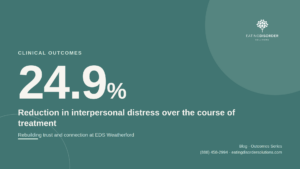
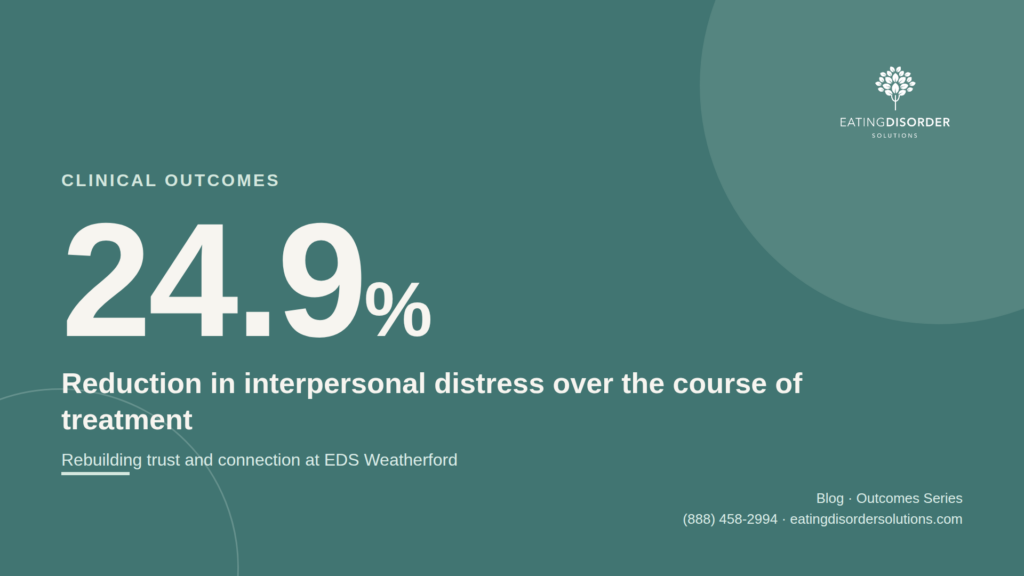
Between March 2 and September 24, 2026, 57 clients across our Weatherford residential, outpatient, and Tele-IOP programs completed enough assessments for a before-and-after comparison. Interpersonal distress fell 24.9% over the course of treatment, driven by gains in trust and a measurable drop in feelings of loneliness. Only about one in five clients showed any worsening on this measure.
This was the strongest result of any domain measured in this refresh, stronger than symptom-distress measures tracked over the same period. It’s a meaningful finding, because interpersonal change is often slower and harder to achieve than symptom relief alone.
What Rebuilding Connection Actually Looks Like
Admission scores on interpersonal measures were already relatively low for this population, meaning many clients arrived without severe relational distress to begin with, but for those who did struggle with trust and isolation, the improvement was substantial and consistent. By the end of treatment, feelings of loneliness and difficulty trusting others were both reported far less often than at facilities that treat different populations, a pattern consistent with the relational strength of eating disorder-focused programming specifically.
This kind of progress tends to build gradually, through the day-to-day work of group therapy, family involvement, and the therapeutic relationships clients build with their treatment team over the course of a residential or outpatient stay. It’s not the kind of change that shows up overnight, which is part of why tracking it over months, rather than weeks, matters.
Where the Work Continues
No outcomes report tells the whole story if it only shares the good news, and this one is no exception. Irritability and difficulty focusing on goals remained common at discharge, reported by roughly seven in ten clients, and barely moved between admission and their last survey. These are the areas our clinical team is actively working to address through more structured emotion-regulation and goal-setting programming earlier in treatment, rather than treating them as a fixed feature of recovery.
Emotional symptom relief overall, covering mood and anxiety-related distress, improved gradually rather than dramatically. That pace is what’s clinically expected for this population. Eating disorders are chronic, complex conditions, and steady, incremental progress is a realistic and clinically meaningful outcome, not a disappointing one.
Why This Matters for Families Considering Treatment
If you’re researching treatment options for someone you love, it’s worth knowing that not every meaningful sign of progress looks like a dramatic symptom reduction. Renewed ability to trust a parent, reconnect with a friend, or feel less alone is a real clinical outcome, even when it doesn’t show up as the flashiest number in a report. Programs built around the relational dimension of eating disorder recovery are aiming for exactly this kind of change.
When to Reach Out for Help
Eating disorders can be difficult to recognize, both in ourselves and in people we love. Changes in eating patterns, an increased focus on weight or body image, withdrawal from friends and family, or mood changes around meals are all worth paying attention to. You don’t need to wait until things feel like a crisis to reach out.
Talking With a Professional
Every client at Eating Disorder Solutions begins with a confidential clinical assessment to understand their history and determine the right level of care to start at. You don’t need to have all the answers before you call: our team can walk you through what treatment could look like, insurance questions, and next steps for you or someone you love.
Related Reading
- Weatherford Residential Program
- Weatherford Outpatient Program
- Virtual Intensive Outpatient (Tele-IOP) Program
References
- National Alliance for Eating Disorders. “Help & Support.” Accessed October 2026. https://www.allianceforeatingdisorders.com
- National Institute of Mental Health (NIMH). “Eating Disorders.” Accessed October 2026. https://www.nimh.nih.gov/health/topics/eating-disorders
FAQ
Why does interpersonal connection matter so much in eating disorder recovery? Eating disorders often isolate people from the relationships they rely on most. Rebuilding trust and connection addresses one of the core features of the illness, not just a side effect of treatment.
Is a 24.9% improvement in interpersonal connection a good result? Yes. It was the strongest result of any area measured in this reporting period, and interpersonal change is generally slower and harder to achieve than symptom relief alone.
Does this mean every client leaves treatment with no lingering difficulties? No. Irritability and difficulty focusing on goals remained common at discharge in this data, which is part of why our programming continues to evolve around emotion regulation and goal-setting.
Is this outcomes data independently reviewed? Yes. Findings are reviewed by EDS’s clinical leadership, including a licensed physician and licensed clinical social worker, and verified by Discovery MSO, LLC.
Resources
- National Alliance for Eating Disorders Helpline
- In an emergency, call 911
This article is general education and is not medical advice.
If you or someone you love may be struggling, Eating Disorder Solutions’ team is available for a confidential conversation about treatment options. Call (888) 458-2994 to speak with someone today.