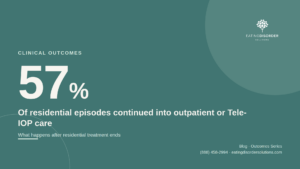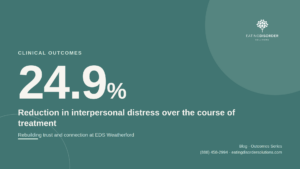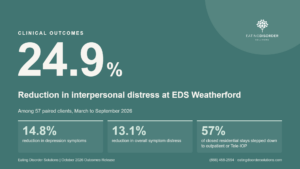
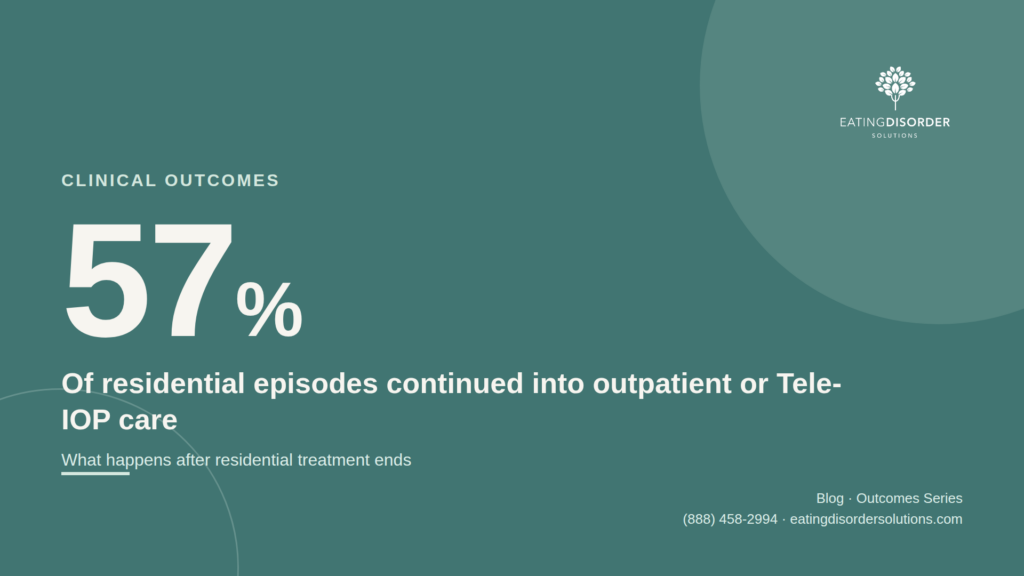
Quick Summary: Leaving residential eating disorder treatment isn’t the end of the process: it’s a transition. New outcomes data shows that of Weatherford residential episodes that closed between March and September 2026, 57% moved directly into Eating Disorder Solutions’ outpatient or Tele-IOP programs to continue care, rather than ending treatment altogether.
Key Takeaways
- Of Weatherford residential episodes that closed in this reporting window, 57% transitioned into EDS’s outpatient or Tele-IOP programs.
- Step-down planning is coordinated by the clinical team and individualized to each client’s readiness, not automatic.
- Continuing care after residential treatment is associated with sustaining the gains made during a structured stay.
- EDS’s outpatient and Tele-IOP options are designed to meet clients at different points in their recovery journey.
Why the Transition Out of Residential Care Matters
Residential treatment provides a level of structure and support that day-to-day life doesn’t. Meals are planned, support is constant, and the environment itself is built around recovery. The transition out of that structure is one of the most clinically important moments in an eating disorder treatment episode, and it’s also one of the most vulnerable, because clients are asked to carry what they’ve built in residential care into a much less structured world.
That’s why continuity of care matters as much as the residential stay itself. A well-designed step-down process doesn’t just discharge a client and hope the progress holds. It plans, ahead of time, for what comes next.
The Data: A Majority of Residential Episodes Continue Into Outpatient Care
Between March 1 and September 2026, EDS tracked residential episodes at Weatherford through to their close. Of the residential episodes that closed in this window, 57% transitioned into EDS’s outpatient program or Tele-IOP to continue treatment. That figure comes from a cross-check against our internal episode records, which track step-downs more precisely than survey data alone can.
This is a meaningful number, and it’s worth being precise about what it does and doesn’t claim. It reflects clients whose residential episode ended and who then continued care at a lower level of intensity within EDS’s programs, it isn’t a claim about every client who was ever admitted, and it isn’t a claim about long-term outcomes after that step-down. It’s a snapshot of how the continuum is actually being used in this window.
What Step-Down Planning Looks Like in Practice
Step-down planning at EDS isn’t automatic, and it isn’t a single decision made on a client’s last day of residential treatment. It’s coordinated by the clinical team throughout a client’s stay, based on clinical readiness rather than a fixed timeline. Some clients are ready to move to a lower level of structure sooner; others need more time in a fully supported residential environment before that transition makes sense.
When a step-down does happen, it’s designed to feel like a continuation of the same treatment relationship rather than a disruption of it: the same clinical team, informed by the same treatment history, adjusting the level of support rather than starting over.
Two Paths Forward: Outpatient and Tele-IOP
EDS offers two main pathways for clients stepping down from residential care. Our Weatherford outpatient program provides structured, in-person support for clients who are ready for less intensive, day-to-day treatment while living at home or in a supportive environment nearby. Our virtual intensive outpatient program (Tele-IOP) extends that same structured support to clients who need flexibility, whether because of location, work, school, or family obligations, without stepping away from consistent, structured care.
Having both options available means the step-down decision can be based on what a client actually needs next, rather than on what happens to be geographically convenient.
Why This Isn’t the Whole Story
It’s worth being honest about what this figure doesn’t tell us. Not every residential episode ends in a step-down to EDS’s own outpatient programs: some clients transition to care elsewhere, and some episodes end for reasons unrelated to clinical readiness. A 57% step-down rate means there’s more work to do in understanding and improving the transitions that don’t follow this path, and that’s an active area of attention for our clinical and operations teams going forward.
What Families Can Ask Before Discharge
If you’re supporting someone in residential treatment, it’s reasonable to ask the clinical team directly what step-down planning looks like for their specific situation, and when that conversation will start. A program that can describe a clear, individualized plan, rather than a generic timeline that applies to everyone is one that’s treating the transition itself as part of the clinical work, not an afterthought once a residential stay ends.
When to Reach Out for Help
If someone you love recently completed residential eating disorder treatment, or is approaching that transition, this is often when consistent support matters most. A step down in the intensity of care doesn’t mean a step down in how much support is available: it means a different kind of support, matched to where someone is in their recovery.
Talking With a Professional
Every client at Eating Disorder Solutions begins with a confidential clinical assessment to understand their history and determine the right level of care to start at, and that same clinical team stays involved as a client’s needs change over time. Our team can walk you through what step-down care could look like, insurance questions, and next steps for you or someone you love.
Related Reading
- Weatherford Residential Program
- Weatherford Outpatient Program
- Virtual Intensive Outpatient (Tele-IOP) Program
References
- National Institute of Mental Health (NIMH). “Eating Disorders.” Accessed October 2026. https://www.nimh.nih.gov/health/topics/eating-disorders
- National Alliance for Eating Disorders. “Help & Support.” Accessed October 2026. https://www.allianceforeatingdisorders.com
FAQ
Does every client who completes residential treatment move into outpatient care afterward? No. Step-down planning is individualized to each client’s readiness and clinical need, coordinated by the treatment team: it isn’t automatic, and some episodes end in other ways.
What’s the difference between EDS’s outpatient program and Tele-IOP? The outpatient program provides structured, in-person support near our Weatherford location. Tele-IOP offers the same level of structured care delivered virtually, for clients who need more flexibility.
Why does continuity of care matter after residential treatment? The transition out of a structured residential environment is one of the more vulnerable points in recovery. Coordinated step-down planning is designed to help clients carry the progress made in residential care into a less structured setting.
Is this data independently reviewed? Yes. Findings are reviewed by EDS’s clinical leadership, including a licensed physician and licensed clinical social worker, and verified by Discovery MSO, LLC.
Resources
- National Alliance for Eating Disorders Helpline
- In an emergency, call 911
This article is general education and is not medical advice.
If you or someone you love is approaching the transition out of residential care, Eating Disorder Solutions’ team is available for a confidential conversation. Call (888) 458-2994 to speak with someone today.