
Key Takeaways
Unresolved loss can drive disordered eating as well, which we explore in grief and eating disorders.
Emotional eating means turning to food to cope with feelings, and it is a common experience for most people. Binge Eating Disorder is different: it is a diagnosable condition marked by recurrent episodes of eating large amounts of food with a real loss of control, followed by significant distress. Knowing where occasional emotional eating ends and a clinical eating disorder begins helps people recognize when it is time to seek support.
- Emotional eating usually keeps a sense of control, while Binge Eating Disorder involves a distinct, distressing loss of control.
- BED is the most common eating disorder in the United States and is a formal psychiatric diagnosis.
- BED episodes are not followed by purging or other compensatory behaviors, which distinguishes it from bulimia.
- People with BED can be of any body size; the diagnosis is based on behavior and distress, not weight.
- Evidence-based treatments like CBT and DBT, along with nutritional and medical support, can help break the cycle.
Do you reach for food when you’re stressed, sad, or bored? This is emotional eating, using food as a coping mechanism for feelings rather than physical hunger. It’s a common experience that nearly everyone has from time to time. However, when eating in response to emotions becomes frequent, involves a loss of control, and is accompanied by intense guilt, it may be a sign of Binge Eating Disorder (BED), a serious and diagnosable mental health condition. While they may seem similar, understanding the key differences between emotional eating and BED is crucial for knowing when to seek professional help.
What Is Emotional Eating?
Emotional eating is the act of using food to self-soothe or cope with difficult emotions. It’s a learned behavior, not a clinical diagnosis. The trigger isn’t physical hunger but rather an emotional cue, stress from a looming deadline, the sadness of a breakup, or the boredom of a quiet evening. The food provides temporary comfort, distraction, or a brief dopamine hit from the brain’s reward system. While frequent emotional eating can lead to feelings of guilt and may contribute to disordered eating patterns, it does not typically involve the same intensity, frequency, or loss of control that defines Binge Eating Disorder.
What Is Binge Eating Disorder (BED)?
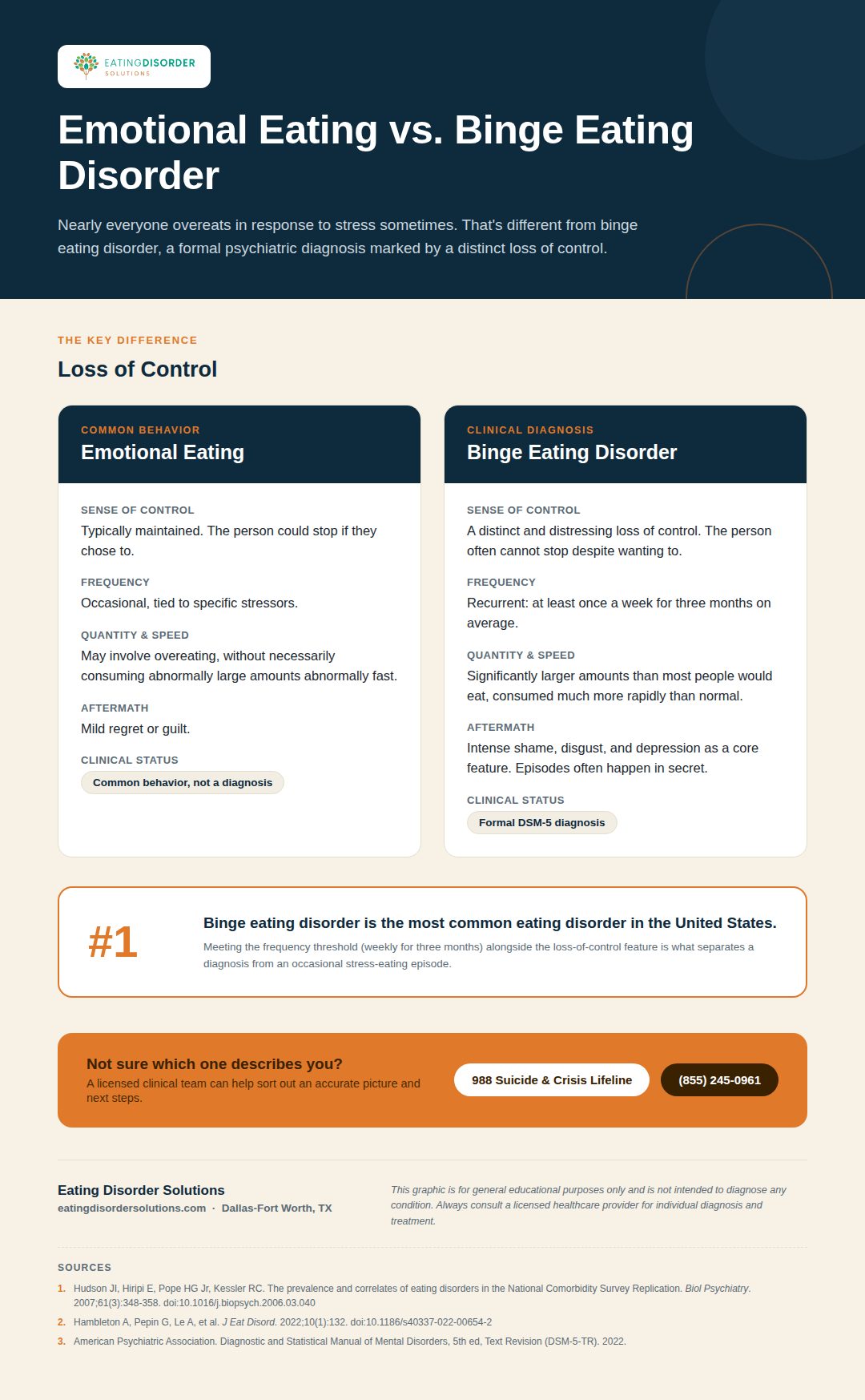
Binge Eating Disorder is the most common eating disorder in the United States (Hudson et al., 2007). It is a formal psychiatric diagnosis characterized by recurrent episodes of eating an unusually large amount of food in a short period, accompanied by a distinct sense of loss of control. According to the DSM-5, these binge episodes must occur at least once a week for three months and cause significant distress.
Unlike emotional eating, a binge eating episode is not just about eating past the point of fullness. It is a compulsive experience where the individual feels they cannot stop, even when they want to. These episodes are often followed by intense feelings of shame, disgust, and depression.
Key Differences: Emotional Eating vs. Binge Eating Disorder
The primary distinction lies in the frequency, quantity, loss of control, and level of distress. While both are triggered by emotions, BED is a clinical disorder with specific diagnostic criteria.
| Characteristic | Emotional Eating | Binge Eating Disorder (BED) |
| Control | The individual generally feels in control, even if they overeat | A distinct and distressing loss of control during the episode |
| Quantity | May involve overeating, but not necessarily a large amount of food | Consuming a significantly larger amount of food than most people would in a similar timeframe |
| Frequency | Occasional, often tied to specific stressors | Recurrent, occurring at least once a week for three months on average |
| Speed of Eating | May eat at a normal or slightly faster pace | Often involves eating much more rapidly than normal |
| Emotional Aftermath | May feel mild regret or guilt | Intense feelings of shame, disgust, and depression are a core feature |
| Secrecy | Usually done openly | Often done in secret due to embarrassment and shame |
| Diagnosis | A common behavior, not a clinical diagnosis | A formal psychiatric diagnosis with specific criteria in the DSM-5 |
What Are the Signs and Symptoms of Binge Eating Disorder?
Recognizing BED involves looking for a consistent pattern of specific behaviors and emotional responses. Key diagnostic criteria and signs include:
- Recurrent Binge Episodes: Eating a large amount of food in a discrete period with a sense of lost control.
- Associated Behaviors: Episodes involve eating rapidly, eating until uncomfortably full, eating large amounts when not hungry, eating alone due to embarrassment, and feeling disgusted or very guilty afterward.
- Marked Distress: Significant emotional distress regarding the binge eating is present.
- No Compensatory Behaviors: Unlike bulimia nervosa, binge eating is not followed by purging, excessive exercise, or fasting.
- Hoarding Food: Secretly stashing food to eat later during a binge.
- Social Withdrawal: Avoiding friends and activities to create time for binge sessions.
Health Risks of Binge Eating Disorder
BED is associated with numerous serious health consequences, many of which are linked to the effects of eating large quantities of food (Hambleton et al., 2022). Physical health risks include Type 2 Diabetes, high blood pressure and high cholesterol, metabolic syndrome, cardiovascular disease, polycystic ovarian syndrome (PCOS), gastrointestinal issues like acid reflux and bloating, and sleep problems including sleep apnea.
Psychological risks are equally severe and include a high co-occurrence with anxiety disorders, depression, bipolar disorder, and substance use disorders.
When and How to Seek Help
If you find that your eating habits are causing you significant distress, interfering with your daily life, and feel out of your control, it is time to seek professional help. You do not need to meet the full diagnostic criteria for BED to deserve support.
- Psychotherapy: Cognitive Behavioral Therapy (CBT) is a leading evidence-based treatment that helps individuals identify triggers, challenge negative thought patterns, and develop healthier coping skills. Dialectical Behavior Therapy (DBT) is also effective for improving emotion regulation.
- Nutritional Counseling: A registered dietitian helps clients normalize eating patterns, abandon the diet-binge cycle, and build a healthy relationship with food.
- Medical and Psychiatric Care: A physician monitors physical health, while a psychiatrist may prescribe medications, such as SSRIs or Vyvanse (the only FDA-approved medication for BED), to help reduce binge urges and address co-occurring conditions.
At Eating Disorder Solutions, our expert team provides comprehensive, evidence-based care for Binge Eating Disorder. We address the underlying emotional triggers and provide you with the tools to break the cycle of bingeing and find lasting peace with food.
Frequently Asked Questions
Is it still BED if I don’t binge on “junk” food?
Yes. A binge episode is defined by the quantity of food and the loss of control, not the type of food. It can involve any kind of food.
Can you have BED and be at a “normal” weight?
Absolutely. While BED is often associated with being in a larger body, individuals with BED can be of any size or weight.
Is emotional eating always a bad thing?
Not necessarily. It’s natural to find comfort in food sometimes. It becomes a problem when it’s your primary or only coping mechanism, happens frequently, and causes you distress.
What’s the first step to getting help for BED?
Reaching out to a therapist, dietitian, or your primary care doctor is a brave first step. Acknowledging the problem and asking for help opens the door to recovery.
If you feel trapped in a cycle of emotional eating or bingeing, you do not have to struggle alone. There is a path to a more peaceful relationship with food, and the team at Eating Disorder Solutions offers specialized, evidence-based care for Binge Eating Disorder.
References
- Hudson JI, Hiripi E, Pope HG, Kessler RC. The prevalence and correlates of eating disorders in the National Comorbidity Survey Replication. Biol Psychiatry. 2007;61(3):348-358. doi:10.1016/j.biopsych.2006.03.040
- Hambleton A, Pepin G, Le A, et al. Psychiatric and medical comorbidities of eating disorders: findings from a rapid review of the literature. J Eat Disord. 2022;10(1):132. doi:10.1186/s40337-022-00654-2
- American Psychiatric Association. Diagnostic and Statistical Manual of Mental Disorders. 5th ed, text revision (DSM-5-TR). American Psychiatric Association Publishing; 2022.
Support and Crisis Resources
If you or someone you love is struggling, support is available. If you are in crisis or need immediate help, call or text 988 to reach the 988 Suicide and Crisis Lifeline, a free, confidential service available 24/7.
Related Reading
If you or someone you love is struggling with binge eating disorder, learn more about compassionate, evidence-based care on our Binge Eating Disorder Treatment page.